
SCHOOL FOR THOUGHT
May 31, 2010 by .(JavaScript must be enabled to view this email address) at 11:57 AM
The Institute of Marriage and Family Canada recently released Why are Ontario Parents Leaving the Public School System? - a report showing that even though funding for Ontario public schools has been steadily increasing (from about $14.4 billion in 2002/03 to about $19.5 billion in 2009/10 - about a 36% increase), enrollment in Ontario publicly-funded schools has been dropping (from not quite 2 million in 2002/03 to just over 1.9 million in 2009/10 - about a 5% decrease). At the same time, enrollment in Ontario privately-funded schools has been increasing (by about 8% between 2000 and 2005, the latest year for which figures are available).
Perhaps as a reflection of its desire to have all Ontario students attend publicly-funded schools, Ontario is the only major Canadian province that does not pay a portion of private school tuition fees. However, the ever-rising percentage of students leaving the public school system suggests that the government’s policy of spending more and more on its public schools and nothing on its private schools is backfiring.

May 31, 2010 by .(JavaScript must be enabled to view this email address) at 10:45 AM
School for Thought is starting to sound like a broken record--or nowadays a broken CD--when we keep saying that SES should not be the excuse for failure. This Wall Street Journal essay, A Tale of Two Students, illustrates why it's the schooling that is important and how school choice can make a difference.
I have a feeling the ripple effect from students who graduate from successful schools of choice will be great.

May 30, 2010 by .(JavaScript must be enabled to view this email address) at 05:45 AM
Here's an item from Australia that touches on a number of recent themes.
It describes what is happening in a desperately-poor Aboriginal community where the teachers have started using Direct Instruction. Achievement has soared, behaviour is transformed, and the community is electrified. The bad news is that the program is very expensive, but the good news is that the revolution has been brought about by "stock standard Education Queensland" teachers and with "the cautious support of the Queensland Education department".
May 28, 2010 by .(JavaScript must be enabled to view this email address) at 11:58 AM
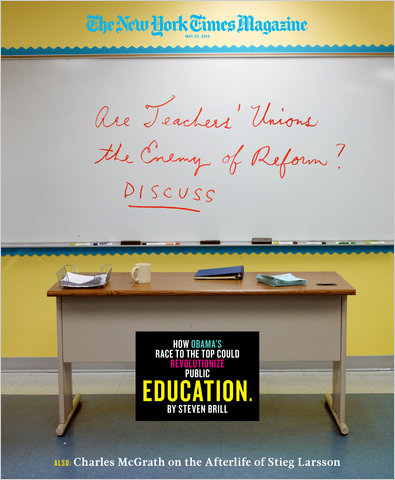
Many School for Thought readers have brought the NYTimes article on Obama's Race for the Top to our attention. Teachers' Unions' Last Stand is a long essay outlining how the need for improvement, accountabilty and the demand by parents for school choice has lead to the Race for the Top program. The article also explains how Democratic politicians have changed their tune when faced with a growing constiuency that wants school choice.
"The teachers' unions have become accustomed in recent years to fighting off reform efforts by Republicans and think-tank do-gooders. They ignore the rhetorical noise, while sticking to the work of negotiating protectionist contracts with the politicians who run school systems and depend on their political support. But what happened last month in Washington could signal a new era in which the unions have to worry that Democrats, like Washington's mayor, Adrian Fenty, not only won't yield in contract negotiations but will also support laws and programs aimed at forcing accountability."
On the SES argument, the article outlines two schools with identical populations, even having kids in both schools from the same family, but getting very different results:
"Same building. Same community. Sometimes even the same parents. And the classrooms have almost exactly the same number of students. In fact, the charter school averages a student or two more per class. This calculus challenges the teachers unions' and Perkins's "resources" argument - that hiring more teachers so that classrooms will be smaller makes the most difference. (That's also the bedrock of the union refrain that what's good for teachers - hiring more of them - is always what's good for the children.) Indeed, the core of the reformers' argument, a'd the essence of the Obama approach to the Race to the Top, is that a slew of research over the last decade has discovered that what makes the most difference is the quality of the teachers and the principals who supervise them. Dan Goldhaber, an education researcher at the University of Washington, reported, "The effect of increases in teacher quality swamps the impact of any other educational investment, such as reductions in class size.'
This building on 118th Street could be Exhibit A for that conclusion.
'I've got one child in a charter and have had two in public schools,' says Bernice Wynn, who runs an optician's shop on Lenox Avenue with her husband, and whose daughter, Tiana, is in the Harlem Success Academy. 'There is no comparison. Tiana is in first grade and already reading chapter books and writing stories.'"
In order for states to be eligible for Race for the Top funding, they will be assessed on a number of criteria and teacher accountabilty is a big one. No more will tenure trump good teaching. In fact, teacher colleges will be part of the accountabilty equation.
What does all of this mean for Canadian schools? Well, we are probably about 10 years behind U.S. reforms. We are still looking at class size when other jurisdictions, like California, have "been there, done that" a decade before with all usual complications. Malcolm Gladwell's negative comments about Ontario's experience with class size caps, made right in front the Premier, must have made quite a few educrats squirm. Gladwell, who has made a career out of looking at outliers and tipping points, was right. Student achievement depends on effective teaching.
This study looks at the link between teaching practice and student academic performance:
Abstract:
"Quantitative studies of school effects have generally supported the
notion that the problems of U.S. education lie outside of the school. Yet
such studies neglect the primary venue through which students learn, the
classroom. The current study explores the link between classroom
practices and student academic performance by applying multilevel
modeling to the 1996 National Assessment of Educational Progress in
mathematics. The study finds that the effects of classroom practices,
when added to those of other teacher characteristics, are comparable in
size to those of student background, suggesting that teachers can
contribute as much to student learning as the students themselves."
Highlights:
"Quantitative research on whether schools matter has generally supported the notion that
the problems of U.S. education lie outside of the schools. Some research finds that when
the social backgrounds of students are taken into account, school characteristics do not
seem to influence student outcomes, suggesting that schools do not serve as avenues for
upward mobility, but instead reinforce existing social and economic inequalities"
However, "The study finds that classroom practices indeed have a marked effect on student achievement and
that, in concert with the other aspects of teaching under study, this effect is at least as
strong as that of student background. This finding documents the fact that schools
indeed matter, due to the overwhelming influence of the classroom practices of their
teachers."
"The first hypothesis, that, of the aspects of teacher quality, classroom practices will have the
greatest effect, is confirmed by the models."
"Another important interrelationship involves the trade-off between teacher quality
and teacher quantity. Smaller class sizes are negatively associated with teachers majoring in
their relevant subject and in receiving substantial amounts of professional development,
whereas teacher major and time in professional development are positively associated with one
another. These relationships suggest that schools tend to choose between hiring more teachers
or investing in improved teacher quality through recruiting teachers with better preservice
training and providing teachers with more and better in-service training."
So for Canadian students, a lower family income doesn't have to doom them to poor expectations and/or failure. They are certainly challenged, but with effective teaching practice combined with parental school choice to find it, there is hope.

May 28, 2010 by .(JavaScript must be enabled to view this email address) at 08:35 AM
School for Thought is one year old today. When we began, we imagined that we would have difficulty coming up with ideas to blog about, but there have been many topics and debates on almost every aspect of education. Some of them have been very informative and helpful, others have been rather lively!
At SQE, we hope you keep coming back for what is sure to be an interesting if not challenging time for education. School For Thought welcomes your "thoughts" as we go forward.
May 27, 2010 by .(JavaScript must be enabled to view this email address) at 12:27 PM
We've all seen the cartoon stereo-typical teenager--texting, attached to earpods, TV on, doing homework--all at the same time and apparently doing all with ease. Daniel Willingham has taken a look at multi-tasking in young people and found that the reality is not all that funny. This short piece from the Washington Post follow and the accompanying video explain more.
"How often have you heard someone say "kids today learn differently-they multitask constantly." The implication often drawn is that kids "need" to multitask in order to be engaged, or perhaps we should even say that that's how they think best.
The data suggest otherwise.
It is true that kids today multitask a lot, usually with media. That is, they have music or videos on while they do other things. It's also true that kids are better at multitasking than older people. That advantage is supported by better working memory, and young people have better raw processing speed on those sorts of functions. So it's not likely that young people are better at multi-tasking than old people because they have practiced it a lot. It's likely that young people have always been better at multi-tasking than older people.
If doing a lot of multiitasking made you better at it, we should see differences in multi-tasking ability among kids who do a lot and kids who do very little. But those differences are not observed. In fact, college kids who report being chronic multi-taskers are actually somewhat "worse" than their peers at some basic components of cognitive control (like switching attention).
There is not good evidence that students today "must" multi-task. But there is good evidence that multi-tasking is seldom a good idea, if you really care about the task you're working on. Doing two things at once usually is detrimental. No big surprise there. Somewhat more surprising is that even just having the television on as background noise produces negative effects. The impact of background music on cognitive tasks is more complex: Sometimes it hurts and sometimes it doesn't. Whether the differences are due to the type of music, type of task, type of person, or a combination of factors is still unknown.
Kids today may "want" to multi-task because they are used to doing it. But that doesn't mean they should."
So making sure kids learn how to focus on task at hand might just be the right thing to do after all!
May 26, 2010 by .(JavaScript must be enabled to view this email address) at 08:49 AM
Ontario school councils that try to engage and involve parents through fundraising activities will find their efforts seriously curtailed on two fronts.
First, those Parent Reaching Out Grants have had their application deadline date changed. On May 6th, the Parent Engagement Office announced it was changing the deadline for school councils to apply for their maximum $1,000 grant. It has been moved up to June 11th from October. So now school councils are scrambling to come up with ideas for how to spend that $1,000 on engaging parents who aren’t even at the school yet!
Second, in a long list of banned behaviors and products, the Ontario government has now banned bake sales and pizza days. PPM 150 was primarily aimed at banning unhealthy foods in school cafeterias and vending machines, but it also extends the ban to traditional fundraising events like school bake sales and pizza days. Read it here. There is a loophole, however, where up to 10 days may be deemed “special event” days when pizza and bake sales would be permitted. While many parents have termed these activities more like fund-RAIDING, school councils just might have to focus on their REAL purpose—student acheivement and school accountability.
May 25, 2010 by .(JavaScript must be enabled to view this email address) at 06:07 AM
Now available from our lending library is Learning As We Go: Why school choice is worth the wait by Paul T. Hill, the director of the Center on Reinventing Public Education, which studies alternative governance, financing, human resources, and accountability systems for public elementary and secondary education.
The lack of stunning gains for American school choice programs (charter schools in 43 states and vouchers or tuition tax credits in about a dozen jurisdictions) has emboldened critics and dismayed supporters alike. This book posits that, while the theories behind the school choice movement are correct, they fail to take into consideration "the real-world factors that can complicate, delay, and even in some instances interfere with the cause and effect relationships identified by the theories behind school choice". These real-world factors include political opposition, entrenched systems, inevitable time lags, and the complexity of creating good schools. The excerpt elaborates on the forces behind political opposition to school choice. (pp. 21-22)
"School choice threatens to upset existing patterns of resource allocation and substantive decision-making. It is too simple to say that the interests standing against choice are those that now benefit most from the existing arrangements in public education - but only a little. There are individuals and groups with no children in schools and no personal financial interests at stake who nonetheless adhere to the ideas sketched above. Moreover, some families that could exercise choices that might benefit their children educationally avoid doing so, out of a belief that keeping their children in traditional public schools is an act of civic virtue.
"However, the main interests at stake are those of people whose jobs, incomes, or positions of power depend on the current arrangements in public education. These groups include current public school employees, particularly permanent district central office staff, state school officials, and teachers' unions.
"These groups have strong interests in keeping key decisions within traditional channels. Most choice plans eliminate automatic spending on state and district bureaucracies, requiring instead that funds flow first to the schools parents choose and then to external service providers only if schools decide to buy their services. These provisions threaten bureaucracies that now control as much as half the money available for public education and offer guaranteed life-time employment to their staffs. Most choice plans also transfer authority for teacher-hiring and pay-setting to individual schools. This further weakens the central bureaucracies that are now staffed to hire and allocate teachers. More importantly, it undercuts teachers' unions in two ways. By making individual schools the employers of teachers, choice would render district-wide collective bargaining units moot: teachers would organize at the school rather than district level. Teachers' unions would therefore lose the capacity to control teacher pay and working conditions for a whole district with one collective bargaining agreement. They would also be at risk of losing members as teachers in some schools might choose not to unionize...."
May 23, 2010 by .(JavaScript must be enabled to view this email address) at 06:30 AM
Since it's the May 24 in Canada and our readers are probably at loose ends, here is a link to two one-hour videos of a symposium on high-stakes testing. It turns out that is not a simple, straight-forward issue at all. Much of the symposium is quite interesting and thought-provoking but, if you can't watch all of it, we suggest you select the segment involving Dr. Daniel Koretz in Part I (Minute 16 - Minute 39).
May 21, 2010 by .(JavaScript must be enabled to view this email address) at 02:00 PM
A little competition is good for the teachers' unions. Looks like it will be an exciting race to see which union gets to organize all those new ECEs that are just ripe for the picking come September when all-day kindergarten starts in Ontario.
Read this letter from the Ontario English Catholic Teachers Association President to members which provides the "facts and insight into the reasoning behind the decision by the Provincial Executive to recommend that OECTA organize early childhood educators (ECEs) into Association bargaining units." The letter goes on to say, "The ELKP creates jobs for teachers. At OECTA's Beginning Teachers conference on February 19, Premier Dalton McGuinty told 350 teachers that, 'five years from now, there will be over 3,500 more JK and SK teachers as a result of this new program.'"
One of their biggest concerns is that class sizes will increase again. According to former education Minister Wynne, class sizes will increase under the new program. IF class size is SO important, and they have just spent the last two years bragging about its success, why are they negating its effects? Because with declining enrolments it's about jobs, jobs, jobs.
This is the union stance here, here, and here. This is the Elementary Teachers Federation of Ontario (ETFO) list of questions and concerns. You can hear their president at this link talk about how they successfully lobbied to make sure that their members were well represented.
Any one who thinks that the all-day kindergarten day care was about kids should think again. Let the games begin.

 Subscribe to our Blog

