
SCHOOL FOR THOUGHT
January 31, 2012 by .(JavaScript must be enabled to view this email address) at 06:30 AM
In a comment to yesterday’s blog, Andrew asked for examples of schools that are succeeding in teaching basic skills to low-socioeconomic kids. I will plan to give a few more examples tomorrow, but I decided to start with the KIPP schools since there are now 109 of them and all are apparently succeeding. Rather than provide some dull statistics (available on the KIPP website), I thought I would give a couple of excerpts from Malcolm Gladwell’s book Outliers.
- KIPP Academy seems like the kind of school in the kind of neighborhood with the kind of student that would make educators despair - except that the minute you enter the building, it’s clear that something is different. The students walk quietly down the hallways in single file. In the classroom, they are taught to turn and address anyone talking to them in a protocol known as ‘SSLANT’: smile, sit up, listen, ask questions, nod when being spoken to, and track with your eyes. On the walls of the school’s corridors are hundreds of pennants from the colleges that KIPP graduates have gone on to attend. Last year, hundreds of families from across the Bronx entered the lottery for KIPP’s two fifth-grade classes. It is no exaggeration to say that just over ten years into its existence, KIPP has become one of the most desirable public schools in New York City. (p. 251)
- The student’s name is Marita. She’s an only child who lives in a single-parent home. Her mother never went to college. The two of them share a one-bedroom apartment in the Bronx. Marita used to go to a parochial school down the street from her home, until her mother heard of KIPP. ‘When I was in fourth grade, me and one of my other friends, Tanya, we both applied to KIPP,’ Marita said. ‘I remember Miss Owens. She interviewed me, and the way she was saying made it sound so hard I thought I was going to prison. I almost started crying. And she was like, If you don’t want to sign this, you don’t have to sign this. But then my mom was right there, so I signed it.’ With that, her life changed. (pp. 263-264)
- [Marita] has made a bargain with her school. She will get up at five-forty-five in the morning, go in on Saturdays, and do homework until eleven at night. In return, KIPP promises that it will take kids like her who are stuck in poverty and give them a chance to get out. It will get 84 percent of them up to or above their grade level in mathematics. On the strength of that performance, 90 percent of KIPP students get scholarships to private or parochial high schools instead of having to attend their own desultory high schools in the Bronx. And on the strength of that high school experience, more than 80 percent of KIPP graduates will go on to college, in many cases being the first in their family to do so. How could that be a bad bargain? (p. 267)
January 30, 2012 by .(JavaScript must be enabled to view this email address) at 08:19 AM
I don’t know how many of our readers follow the comments in our blog, but just so’s you know - an ongoing (and ongoing and ongoing) argument has been ongoing seemingly forever. That is the question of whether demographics are destiny - in other words, is it impossible to teach low socioeconomic kids to a high standard.
Margaret Wente has just written an interesting column on this topic, showing just how intransigent the differences are between well-educated affluent Canadians and poorly-educated lower-class Canadians. Their entire lifestyles are radically different, including what they eat, their divorce rates, how they exercise, and what schools they send their children to.
On the one hand, it is probably unfair and unrealistic to expect schools to completely overcome such entrenched problems. On the other hand, we can’t just throw up our hands in despair and condemn unlucky poor kids to oblivion.
It seems to me that the best shot at lifting kids out of poverty is to equip them with good basic skills - especially the ability to read, write, and add up. Without these skills, they have virtually no chance. With these skills, other things become possible.
The good news is - poverty need be no barrier to teaching low socioeconomic young kids basic skills. While it may well be harder (they change schools much more, their vocabularies are impoverished, they lack familiarity with the conventions of print, and so forth), it is definitely possible. We know this because a handful of schools are doing it.
A modest proposal: schools should make teaching the three R’s their number one priority.
January 29, 2012 by .(JavaScript must be enabled to view this email address) at 08:01 AM
Here’s a short clip about an important difference between great teachers and poor teachers. It ends with an important insight about bullying. YouTube link
January 28, 2012 by .(JavaScript must be enabled to view this email address) at 07:08 AM
Larry Summers has an op-ed piece in the New York Times talking about how the knowledge explosion should lead to changes in how kids are educated. His first point is that the increasingly easy access to facts (“the entire Library of Congress will soon be accessible on a mobile device with search procedures that are vastly better than any card catalogue”) means that “factual mastery will become less and less important”.
Dr. Summers, however, has failed to take into consideration that, while much has changed in the outside world, the physiology of the human brain has remained the same for millennia (see yesterday’s blog), and our ability to apply information is still constrained by our very limited working memory storage capacity. Here’s an excellent posting from Kitchen Table Math on this topic.
The bottom line: students still need to learn facts and students still need to learn basic skills to automaticity.

January 27, 2012 by .(JavaScript must be enabled to view this email address) at 12:02 PM
The latest addition to our lending library is Moonwalking with Einstein: The art and science of remembering everything. The author is a journalist who got interested in memory training when he covered the U.S. Memory Championship. Although the author had no previous aptitude for or interest in memory training, he decided to train for the contest - which he ended up winning the next year. Most people assume that memory is memory (and it deteriorates as you age), but it turns out that this is not true. "The brain is like a muscle, ... and memory training is a form of mental workout. Over time, like any form of exercise, it'll make the brain fitter, quicker, and more nimble." The book reveals many techniques (ancient and modern) for improving memory, and along the way relates many interesting stories about the denizens of the quirky subculture of memorizers. Memory, it seems, is a gift we all possess but which all too often slips our minds.
The excerpt (pp 18-19) deals with mankind's shift in memory preservation away from the oral tradition of pre-literate societies (for example, India's priests who were charged with memorizing the Vedas or the Greek epics such as the Odyssey and the Iliad). These memorized passages were repositories of useful knowledge that could be passed on to successive generations. Today, much of our collective memory has been externalized.
- Physiologically, we are virtually identical to our ancestors who painted images of bison on the walls of the Lascaux cave in France, among the earliest cultural artifacts to have survived to the present day. Our brains are no larger or more sophisticated than theirs. If one of their babies were to be dropped into the arms of an adoptive parent in twenty-first-century New York, the child would likely grow up indistinguishable from his or her peers.
- All that differentiates us from them is our memories. Not the memories that reside in our own brains, for the child born today enters the world just as much a blank slate as the child born thirty thousands years ago, but rather the memories that are stored outside ourselves - in books, photographs, museums, and these days in digital media. Once upon a time, memory was at the root of all culture, but over the last thirty millennia since humans began paining their memories on cave walls, we've gradually supplanted our own natural memory with a vast superstructure of external memory aids - a process that has sped up exponentially in recent years. Imagine waking up tomorrow and discovering that all the world's ink had become invisible and all our bytes had disappeared. Our world would immediately crumble. Literature, music, law, politics, science, math: Our culture is an edifice built of externalized memories.
- If memory is our means of preserving that which we consider most valuable, it is also painfully linked to our own transience. When we die, our memories die with us. In a sense, the elaborate system of externalized memory we've created is a way of fending off mortality. It allows ideas to be efficiently passed across time and space, and for one idea to build on another to a degree not possible when a thought has to be passed from brain to brain in order to be sustained.
- The externalization of memory not only changed how people think; it also led to a profound shift in the very notion of what it means to be intelligent. Internal memory became devalued. Erudition evolved from possessing information internally to knowing how and where to find it in the labyrinthine world of external memory. It's a telling statement that pretty much the only place where you'll find people still training their memories is at the World Memory Championship and the dozen national memory contests held around the globe. What was once a cornerstone of Western culture is now at best a curiosity. But as our culture has transformed from one that was fundamentally based on internal memories to one that is fundamentally based on memories stored outside the brain, what are the implications for ourselves and for our society/ What we've gained is indisputable. But what have we traded away? What does it mean that we've lost our memory?
January 26, 2012 by .(JavaScript must be enabled to view this email address) at 05:40 AM
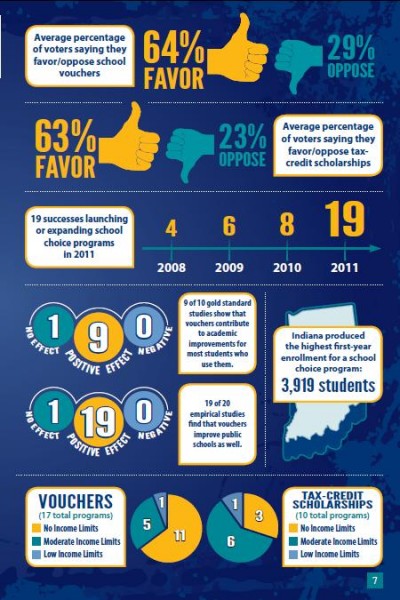
That's the title of the Friedman Foundation's latest round-up of the state of school choice in the United States.
Defined as "a common sense idea that gives all parents the power and freedom to choose their child’s education, while encouraging healthy competition among schools
and other institutions to better serve students’ needs and priorities", school choice is clearly gaining momentum in the United States.
There may be a lull this year, since it is an election year and many legislators will be focusing on getting re-elected, but watch for more gains in 2013. You heard it here first.
Of course, the rest of the phrase "a rising tide" is "that floats all boats", and other studies suggest that when more parents can transfer their children to other schools, the local public schools improve as a result of the increased competition. Here's a Wikipedia article on this phenomenon.
Logically, then, as more and more school choice is offered in the US, the better and better the kids will do. A rising tide that floats all boats.
January 25, 2012 by .(JavaScript must be enabled to view this email address) at 06:33 AM
Greetings from Orlando, FL, whence I fly home today. So I thought I'd give you a bit of a math lesson. The temperature here has been averaging around 75 degrees Fahrenheit. To convert Fahrenheit to Celsius, just deduct 32, multiply by 5, and divide by 9. This means it's about 23 degrees Celsius here.
At home, it's currently -3 degrees Celsius. To convert Celsius to Fahrenheit, multiply by 9, divide by 5, and subtract 32. This means it's about 27 degrees Fahrenheit there.
Any way you slice it, it's warm here and it's cold there.
January 24, 2012 by .(JavaScript must be enabled to view this email address) at 06:38 AM
Nearing the end of my Florida tour, I bring you this report from Ocala. The governor has just released a report ranking the state's 67 school districts on the basis of their performance on the state tests. In Ocala, which ranked 44th, the usual suspects are criticizing the rankings - saying it's not fair to compare districts with different socioeconomic makeups and adding that the unfair comparison is disheartening to those with low rankings.
This may come as a surprise to some, but this time I agree with the usual suspects. Of course, this doesn't mean that I would totally junk the rankings - just make them fair. The basis of comparison should be the value added by school districts - for example, Tennessee's Value-Added Assessment model.
January 23, 2012 by .(JavaScript must be enabled to view this email address) at 05:39 AM
The Society for Quality Education is pleased to announce the publication of The Sky Has Limits: Online Learning in K-12 Public Education in Canada, a review of virtual education. The report is authored by respected educator Dr. Paul Bennett, Principal of Schoolhouse Consulting.
As students become more cyber-savvy and Apple proposes i-books to replace textbooks, online learning has fantastic potential to attract and retain learners, but there are challenges. Dr. Bennett found:
“In spite of the tremendous advantages afforded by introducing online learning programs, significant barriers stand in the way of its natural growth and expansion. With the exception of British Columbia, the spread of online learning and virtual schools has stalled and, for the vast majority of Canada’s 5 million K to 12 public school students, the sky has limits.”
The report’s findings dispute those of other Canadian studies of how the teaching profession views virtual education: “Most provincial teacher unions show tepid support for online learning, holding fast to labour contract agreements which effectively limit online learning to a supplemental role in the K-12 public system.”
Other key findings:
· After enjoying an initial advantage, Canada has been overtaken by the United States in the rate of growth of online learning over the past two years.
· There is potential for governments to save money outside of traditional “bricks and mortar” schooling.
· Private provision of e-learning is becoming more innovative and is growing rapidly.
The full report can be found at: /parents/theskyhaslimits or on our Reports and Research page.

January 22, 2012 by .(JavaScript must be enabled to view this email address) at 08:15 AM
Consider this good news story in the Toronto Star. No public school ESL for this very brave girl.
"Roya was packed and ready to fly to Canada to continue her high school education in safety at Ottawa's Ashbury College. It is one of the country's leading private schools, which prides itself on a progressive and caring learning environment."
There is even a fundraising effort for the tuition. Now I hardly think the Star chose this school because they wanted to keep her among the elites of Ottawa.
Here's another good news story in the National Post about an alternative public school in the northwest corner of Toronto that appears to be succeeding. It is one that we would encourage the TDSB to multipy and prosper. Well actually, we did years ago when we arranged for Angus McBeath of Edmonton school fame to meet with the board. Now it seems that some smart trustees listened and hired someone like Spence to carry out the vision. Humberwood Downs, for those who don't know the city, is in an area of high immigrant population, low income, and high needs. Parents are choosing it for many reasons, including the obvious one of location, but one parent put it best:
“We thought about a private school,” continues Mr. Mehta. “But all the things we are looking for are available in this school."
If a board won't provide alternatives, then parents should have access to private or public education alternatives. The point is private schools are not all for the elite and public schools ("for the common good") don't have to look like this either.

 Subscribe to our Blog

