
SCHOOL FOR THOUGHT
February 28, 2010 by .(JavaScript must be enabled to view this email address) at 10:23 AM
Central Falls is a small rust-belt Rhode Island town with lots of boarded-up windows and abandoned buildings. The median income in the town is approximately $22,000. About half the high school students are failing their classes and last fall only 7% of grade 11 students tested proficient in math. But when the school board superintendent asked the teachers (whose salaries average around $75,000) to teach an extra 25 minutes a day and help with tutoring, the union refused. To its dismay, the school board trustees have responded by firing every single teacher at the school.
In the photo at the top of this article, one of the teachers is holding a sign that says in part “We care about our students.”
Words fail us.
February 27, 2010 by .(JavaScript must be enabled to view this email address) at 10:04 AM
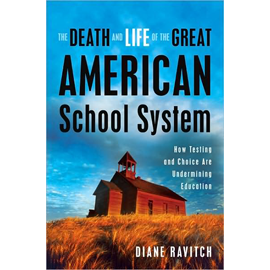
Recently added to our lending library is The Death and Life of the Great American School System: How testing and choice are undermining education, by Diane Ravitch. This book is interesting because the author is a prominent education reformer who is repudiating policies which she once supported - in particular accountability measures and school choice. The vast majority of the book is devoted to the problems with the way accountability measures have played out in the United States, and it would be very hard to argue with her conclusion that they are not working well and may even be harmful. Point to Ravitch.
We'll give another point to Ravitch for her proposal to improve schools by means of a national curriculum. This section seems like kind of of an afterthought: it's a bit sketchy and poorly-argued, but we'll concede that a national curriculum, if well done, would probably increase student learning.
However, the chapter in which Ravitch nixes school choice is not very convincing at all. Evaluating the results of existing school choice programs is very tricky, because there are so many different combinations and permutations and because it's hard to get a handle on student progress in the first place. The fact that there has not yet been the spectacular improvement anticipated by school choice proponents does not mean that the time has come to write off the potential of school choice. As a result of the opposition of the powerful education lobbies, to date only very limited school choice programs have been tried. In every case, market forces are significantly inhibited in some way. For example, in Cleveland, Florida, DC, and Milwaukee, the school vouchers are limited to a few low-income families. There are still a lot of strings on charter schools, and most receive less money than competing conventional public schools. In Chile and New Zealand, the government micro-manages the participating schools and severely restricts the eligibility of schools to participate.
It would be premature to write off the potential of school choice to improve academic achievement since none of the current implementations has given it a fair chance. When true school choice was tried in the past, for example in classical Greece and the medieval Islamic empire, it got consistently excellent results. In fact, competitive educational markets have always done a better job of serving the public than state-run educational systems. The crippled school choice systems currently in effect are that way because they were the best education reformers dared to hope for in the face of fierce opposition from status-quo educators. Their thinking was that once a limited school choice program had been established, it would be possible to gradually broaden its scope. But this is not happening in most cases, and in some jurisdictions the movement is towards more limitations on school choice.
Half measures will not do. Since the educational establishment will fight as hard against a modest school choice program as they will against a full-blown school choice program, education reformers must hold out for a real experiment in market-driven schooling. The basic principle is that the reform is inadequate, perhaps even counter-productive, if it leaves the educational establishment in positions of power from which they can stifle competition and use regulatory micro-management to extend government control to private schools.
February 26, 2010 by .(JavaScript must be enabled to view this email address) at 08:41 AM
The comments on "If the Student Hasn't Learned, the Teacher Hasn't Taught" have evolved into a discussion on teachers' unions. To some, it is almost incomprehensible that rank-and-file teachers cling so strongly to their unions. After all, in most jurisdictions teachers are forced to join the union if they want to teach in a public school, and they have no option but to pay the approximately $1000 union dues annually. Furthermore, the unions turn around and spend some of these forced dues on left-wing political activities, such as working to defeat conservative political candidates - even though many teachers do not support left-wing causes. Lastly, the teachers' unions frequently indulge in outrageous antics and extreme positions that harm the reputation of the profession and turn public opinion against teachers.
Some commenters believe that teachers are being skilfully manipulated by their unions into meekly toeing the party line. And there may be some truth in this theory. Certainly, there is a constant barrage of propaganda from the unions about evil conservative politicians, teacher bashing, threats to teachers on every side, and so forth. But there at least two other - much more compelling - reasons for teachers to support their unions.
In the first place, the unions are extremely effective at negotiating their members' contracts. In Ontario, at least, unionized teachers earn considerably more than private school teachers, while being asked to devote less teaching time and receiving much richer benefits and pensions.
In the second place, most unionized teachers are employed by a large school board - in many cases the only possible source of employment in their geographical area. In economics, this state of affairs is referred to as a monopsony - a market situation where the entire demand for a product or service consists of only one buyer. As such, a monopsonist can often dictate terms to its suppliers in the same way that a monopolist can dictate terms to its buyers. Most teachers correctly perceive that they would be at the mercy of their employer without the protection of a strong union.
If individual principals were free to hire teachers and set salaries, teachers' loyalty to their unions would probably be greatly reduced.
February 25, 2010 by .(JavaScript must be enabled to view this email address) at 06:31 AM
As a helpful contribution to the discussion on teacher bashing raging in the comments to "If the Student Hasn't Learned, the Teacher Hasn't Taught", we thought we'd publish a list of ways that people can avoid being called teacher bashers when they criticize either the performance of individual teachers or some aspect of the profession as a whole. Here is the complete list.
February 24, 2010 by .(JavaScript must be enabled to view this email address) at 07:43 AM
Further to yesterday's posting, there is a second education myth that helps teachers sleep at night, and that is the myth of developmental readiness - the belief that children will learn when they're ready. Even though this is demonstrably untrue, the myth of developmental readiness is deeply-rooted and informs much educational practice. Because of it, many teachers simply accept their students' poor performance and, mindful of the children's self-esteem and the parents' peace of mind, fail to honestly report how far behind the kids actually are. As a result, the students' problems snowball and they fall hopelessly behind. Here are a three quick and easy assessment that allow parents to get a handle on their children's real grade level.
Reading (the Part 2 passages correspond to grade level)
Spelling
Math
February 23, 2010 by .(JavaScript must be enabled to view this email address) at 12:33 PM
Dear Aunt Malkin,
Yesterday I had a lively discussion with a retired teacher who is now involved in an adult literacy program. This teacher placed the blame for the huge number of functionally-illiterate adult Canadians squarely on learning disabilities, diagnosed or not. What do you think of this theory? Lynn, Toronto
Dear Lynn,
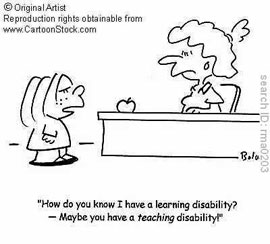
In a nutshell, I think the concept of learning disabilities is a way for school staff to absolve themselves of blame for their students' failure to learn to read. A belief in learning disabilities makes it possible for teachers to sleep at night, since the alternative - that they didn't teach the students well enough - is too upsetting.
Of course some students find it harder to learn to read, just as some students find it harder to learn carpentry or chess. Yet, given good teaching, patience, and hard work, almost everyone can achive an adequate or better level of performance in almost any field - from reading to ballet to physics to drawing. Our newsletter archives contain a number of articles on so-called learning disabilities (scroll down).
Regards, Aunt Malkin
February 22, 2010 by .(JavaScript must be enabled to view this email address) at 08:34 AM
This article in The Atlantic Wire tackles the question of what school boards should be looking for in new hires. At present, most teachers are paid more for extra educational qualifications and additional years of teaching experience, even though these attributes have little or no relationship to teaching effectiveness. (For a meta-analysis of studies with this finding, click here and scroll down to pages 10-12.) The Atlantic Wire article is on the long side, all of it interesting and thought-provoking, but the real meat of it is on the third page where it is revealed that the teacher candidates who are most likely to become effective teachers have the following attributes.
NO
- Additional degrees
- More than three years of teaching experience
- Additional qualifications
YES
- A track record of perseverance
- Satisfaction with their lives
- High grades
- Leadership achievement
February 21, 2010 by .(JavaScript must be enabled to view this email address) at 06:33 AM
In response to yesterday's posting, a commenter advanced the theory that the reason that student writing has deteriorated in Canada is that, unlike many other countries Canada attempts to keep all of its students in school for the longest possible time, as opposed to having an élitist system that educates only its brightest and best to high levels.
However, the OECD's Highlights from Education at a Glance 2009 suggests that this explanation is not correct. On page 19, the top graph ranks the OECD countries according to the percentage of young people graduating from upper secondary education. Canada falls just below the OECD average, with lower graduation rates than 16 other countries. The top graph on page 21 ranks the OECD countries according to the percentage of young people who are first-time graduates of university-level education. Here Canada ranks well below the OECD average, with lower graduation rates than 19 other countries.
This suggests that the non-élitist theory doesn't adequately explain why student writing has deteriorated in Canada. Other theories are welcome.
February 20, 2010 by .(JavaScript must be enabled to view this email address) at 10:49 AM
This column by a professor of English makes the case that the quality of writing in his classes is declining. He illustrates his point by reprinting several passages written by average grade 9 students in New York about 50 years ago. Here's one example.
"At present I am learning the mechanics of the devices that handle the communications of this day and age. Later on the class will delve into a subject of much importance today, and in which I am especially interested - the atom. I hope to learn much in this unit. After that the class will go on to another topic that holds my interest, the prolongation of life or the conquest of disease."
Ontario parents might find it interesting to compare this passage to an excerpt of student writing from last year's grade 10 literacy test. This passage was ranked in the top (of six) category and is reproduced exactly as written.
"Part time-employment for students is a highly speculated and interesting topic. I feel every student should have a part-time job in highschool. To begin with it allows students to earn a type of income. Secondly it gives students a sense of independence to be out in the work force. Finally I feel it would be a good idea to earn work experience which will better their chances of getting a decent job in the future."
Of course, nothing is proved by taking isolated passages like this and comparing them. Nor can we draw any conclusions from the spelling and grammar mistakes in the latter passage, as the former passage may well have been edited. Yet there is a qualitative difference between the two passages which we find very suggestive - the vocabulary, the tautness and complexity of sentence structure, and the awareness of the larger picture - all contribute to a more mature and literate writing style.
Here's another example of grade 9 writing from the past.
"The drab clothing and scenery helped to set an unpleasant, solemn atmosphere and helped to annoy the captive audience a little bit more. Annoying the audience was probably what made this such a compelling moment in theater. With the lights, the sharp, harsh pounding of the gavel, and the drab atmosphere I began to realize I wasn't being entertained and I wasn't having a happy time of it, but rather I was being told the truth, the cold, blunt, horrifying truth."
February 19, 2010 by .(JavaScript must be enabled to view this email address) at 09:11 AM
The Thomas B. Fordham Institute reports that there are 2,817 "private public" schools in the US - publicly-funded schools that serve hardly any low-income children. These private public schools are located in "wealthy urban enclaves or well-heeled suburbs". And although their doors are effectively closed to poor children (because poor families can't afford to buy a house in the schools' catchment areas), these schools are fully funded by taxpayers.
While there are far fewer of such schools in Canada than in the US, there is no doubt that they exist here as well. So the next time you hear someone grumble about "exclusive" and "élite" private schools like Upper Canada College, you might point out that Canada's private public schools are actually more selective than its private private schools, since most, if not all, of the truly private schools offer scholarship to dozens of low-income students. Why would anyone support public funding for private public schools - but not for private private schools?

 Subscribe to our Blog

