
SCHOOL FOR THOUGHT
December 31, 2011 by .(JavaScript must be enabled to view this email address) at 07:09 AM
There’s an interesting discussion going on at Kitchen Table Math about how a strong ability to memorize can mask crucially-important learning deficits - which come back to bite students later on. In this case, the discussion is mostly about spelling/reading deficits. This related Kitchen Table Math posting lists a bunch of resources to deal with this problem. And here’s a link to our quick and easy test for establishing a student’s approximate spelling level in the first place.
December 30, 2011 by .(JavaScript must be enabled to view this email address) at 11:25 AM
Judging by the comments, there was so much interest in
yesterday’s posting that I am encouraged to post another excerpt from Pension
Ponzi. This excerpt (pp. 56-58) is relevant to Doug’s statement that “the lump sum value of a teachers pension is
about $500 000 only in the sense that a private person would need about $500
000 in the bank to produce an annuity equal in value to the average teacher’s
pension”.
- When it started in 1917,
the OTPP [Ontario Teachers’ Pension Plan] offered teachers who had been working
for 40 years a pension of $1,000 per year. It was not until 1933 that that
amount was increased to $1,250. In 1945 the pension was increased to a maximum
of $1,500 for teachers who had 36 years of service and were 65 (men) or 62
(women) years of age. By 1954 teachers had eliminated the $3,000 annual cap on
pensions and the pension was based on the last 10 years’ average salary.
- None of this could be considered
particularly spectacular although signs of things to come were evident. In 1965
retirement with a pension was allowed at age 55, a full 10 years before most
Canadians could retire. After that it was a matter of ratcheting up the annual
pension income that would be received. The OTPP pension was no longer a simple
means of staving off poverty in old age, but became a tool to find new ways of
creating wealth for retiring teachers.
- In 1971 survivors were
added to the pension plan, so that if a
teacher on pension passed away before his spouse, his spouse would continue to
receive a pension, usually about 50 per cent of the previous total, until she
died. In couples where both husband and wife were teachers, the survivor got to
keep both pensions when the spouse died. In 1971 it was still common for one
parent to be the main breadwinner and the other parent to be at home raising
children, so the spousal survivor benefit made a lot of sense, preventing
homemakers from becoming penniless widows upon the untimely death of their
partner. Today, of course, it is rare to find a home in which both parents are
not fully employed, but this spousal benefit has never been removed from any
public sector pension.
- New pension ‘windows’ were
opened up. These windows allowed teachers who had not yet qualified for their
full pension to get one based on a combination of minimum years of working and
age. For example, the first window in 1986 provided for an unreduced pension
for pension plan members who were aged 55 with at least 10 years of service. In
1998 the ‘85’ factor was introduced as a ‘temporary’ measure and was converted
a few years later into a permanent benefit. It allowed anyone who had a
combination of years worked plus age totalling 85 to retire on full pension.
For example, a 55-year-old teacher with 30 years and a 65-year-old teacher with
20 years of classroom time would both be fully qualified for a pension. The
most recent OTPP goodie was to base pensions on the highest or best five years
of salary, rather than on average earnings. This again is a benefit that does
not occur in the private sector and substantially raised pension income for
retired teachers….
- Based on the current
salary grid in the province of Ontario, many teachers will be retiring with a
salary in excess of $90,000 per year. The salary grid is the practice of
automatically advancing up the pay scale by moving to a new job classification or
getting an increased salary based on simply having worked another year in the
same job, doing the same work. A school board may claim to be limiting union
raises to 3 per cent; this figure applies to the annual base salaries in the
contract but in reality, the total cost is higher become some employees have
moved up to the new grid level of seniority or have been promoted to the next
pay level. The total compensation may reach 5-6 per cent even though the
announced ‘contract settlement’ was for only 3 per cent. Politicians use the
lower number to promote themselves as representing the taxpayer by ‘holding the
line’ on staff costs. Then the multiplier effect of the additional benefits and
pensions based on the true salary increases kicks in as well. So when you read ‘3
per cent wage increase’, think 5-6 per cent out of your pocket and into theirs.
A 70 per cent pension will give them a pension income starting at around
$63,000 per year, including CPP.
- These levels of income are
well above the average worker’s wage in Canada of around $46,000 per year. Not
the worker’s pension, mind you, the worker’s wage. These pensions put retired
teachers into the top 20 per cent of senior incomes….
- An employee retiring at age
55, with a $63,000 pension has a life expectancy of another 29.8 years.
Assuming that the pension is adjusted for inflation at 2 per cent, the retiree
will receive over $2.5 million in pension income based on normal life expectancy,
and at the end of 29 years will have an income of more than $110,000 per year.
Currently there is a dramatic trend to teachers living over 100 years of age.
These employees will earn $4.6 million, with about $856,000 coming from the CPP
program assuming indexing of 2 per cent.
December 29, 2011 by .(JavaScript must be enabled to view this email address) at 08:45 AM
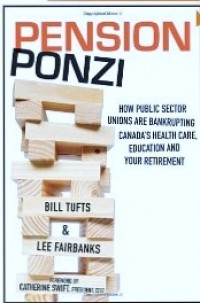
The latest addition to our lending library is Pension Ponzi: How public sector unions are bankrupting Canada's health care, education and your retirement. Written by a pension expert and an award-winning journalist, this is a very readable exposé of the huge gap between the wages and pensions of public sector workers and private sector workers. Because of their gold-plated retirement packages, many public sector workers will collect more income in retirement than they earned during their working careers. Meanwhile, the 80% of Canadian taxpayers who don't belong to a public sector union - most of whom have no true pension at all - get the privilege of paying for it all. Nearly every one of the public sector union pension plans is underfunded to the tune of hundreds of billions of dollars, and taxpayers are legally on the hook to make up the difference, as well as any investment losses. One example: the Ontario Teachers' Pension Plan, according to The Globe and Mail, is actually $35 billion short of being able to pay its commitments.
From the back of the book: "This book will open your eyes to one of the greatest legal asset re-allocations in the history of the world. Some call it pension envy, some call it pension apartheid. We call it a Pension Ponzi plan, an unsustainable funneling of money from one group of Canadians to another. Canadians are being bilked out of their hard-earned money and cheated of secure retirements in order to gold-plate the pensions of those who have engineered the system in their favour."
Read more here about the different trajectories of Canadians with private sector jobs versus Canadians with public sector jobs.
December 28, 2011 by .(JavaScript must be enabled to view this email address) at 08:57 AM
It's hard to believe, given all the fuss in Ontario when John Tory proposed the extension of funding to non-Catholic religious schools, but four Canadian provinces have been funding non-Catholic religious schools for years and years - Alberta, BC, Manitoba, and Quebec - without any noticeable problems. Indeed, with the exception of Manitoba, these provinces tend to do very well on comparisons of student achievement.
Now Saskatchewan is quietly planning to join the club, according to this article in the National Post. Although the usual suspects are of course opposed, the new policy appears to be attracting little notice otherwise.
What's up with Ontario? Are Ontarians more xenophobic than other Canadians?

December 27, 2011 by .(JavaScript must be enabled to view this email address) at 08:49 AM
There are a lot of new regulations in Ontario, governing everything from mandatory security guards at functions where alcohol is served to requirements for safety equipment in boats to mandatory sexual harassment training to how thorough auditors have to be and on and on. Here's a libertarian take on the new regulations that control what kinds of foods and beverages may be sold in schools. H/T to AS
I reproduce here some examples of the unanticipated side effects that have cropped up in other similarly-regulated jurisdictions.
- Last week, Van Nuys High School juniors, Iraides Renteria and Mayra Gutierrez told the LA Times, they considered the new school fare "nasty, rotty stuff," as they pulled three bags of Flamin' Hot Cheetos and soda from their backpacks – which they very well may have purchased from one of the junk food “dealers” on campus.
At Van Nuys High, a Junior ROTC officer and an art teacher have been caught selling candy, chips, and instant noodles to students.
- Following the passage of the Texas Public School Nutrition Policy, which banned candy, enterprising students at Austin High began selling bags full of candy at premium prices, with some reportedly making up to $200 per week.
- Similarly, young entrepreneurs at one Boca Raton (Florida) middle school make runs to the local Costco and buy candy bars, doughnuts, and other high-calorie snacks in bulk. They then offer these goodies for sale in an environment that has supposedly eradicated such goodies.
- An eighth-grade student body vice president in Connecticut was forced to resign after buying Skittles from an underground "dealer."
- The U.K. has also seen its share of black market trade in banned foods, snacks, and beverages, with schools in Oxford, Dorset, and Essex reporting healthy underground markets trading in food contraband. The plots ranged from kids selling McDonald's hamburgers in playgrounds to bicycle-riding entrepreneurs hauling bags of soft drinks and milk chocolate for sale.
December 26, 2011 by .(JavaScript must be enabled to view this email address) at 07:12 AM
Guest Editorial by Frank Gue, a member of the SQE board and a retired engineer
In the December 17 issue of The Economist entitled The One-Shot Society, one reads "[South] Korean education results are the envy of the world." A few pages later appear the words: "[South Korea] cannot become creative with a school system that stresses rote learning above creative thinking."
Without discussing the separate subject of pressures and suicides, one must note that these two statements are incompatible. Every human creative accomplishment springs from a platform of rote learning with which it is inextricably linked when one operates creatively.
Consider a jet airliner, than the designing of which there are few activities more creative. Its engineer, thinking at a very high, abstract level, speculates: "We could improve fuel efficiency if we ... " and there floods into her consciousness a veritable tsunami of rote learned facts and formulae that are instantly available from her well-stocked mind. Into this rote-learned stew she blends the new, creative, original idea that ends up as a faster, more comfortable, less expensive method of flitting about the globe as we so casually do. Without her rote-learned knowledge of such abstracts as centres of gravity, lift, and drag, of leverages and aerodynamic centres, and a thousand similar things, her creative processes would never have a chance.
How did she get there? Certainly not by avoiding rote-learned multiplication tables as some Western elementary school students are forced to do, sometimes with tears of frustration, when they perform a fiddly finger-counting exercise in order to multiply 6 x 7.
So don't casually dismiss rote learning as you drive home tonight on the correct rote-learned side of the road, signaling your turns in a rote-learned manner, obeying signs the meanings of which you have rote learned, and ............
December 25, 2011 by .(JavaScript must be enabled to view this email address) at 09:27 AM
I didn't want anything saccharine, and this fills the bill nicely, trust me. I do hope you and yours experience similar Christmas joy.

December 24, 2011 by .(JavaScript must be enabled to view this email address) at 12:27 PM
Dear Santa,
SQE boys and girls have been very good and so very patient, so this year we wish for:
1. A genuine, authentic phonics program for the Trillium List.
2. Less centralized control from Mowat Block and more control at the school around the block.
3. That kids would get the education they needed in the first place, so they wouldn't have to do a "victory lap" fifth year of high school.
4. Freedom for parents to choose from a variety of schooling options.
5. And mostly, Santa, SQE wants every child, no matter his or her learning difficulties, to succeed in school.
If not this year, then soon, Santa, soon...
Merry Christmas from SQE to all our supporters and contributors!
December 24, 2011 by .(JavaScript must be enabled to view this email address) at 08:44 AM
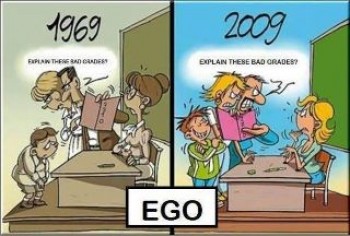
As usual, the truth ought to be somewhere in between the two extremes.
December 23, 2011 by .(JavaScript must be enabled to view this email address) at 11:25 AM
This is not strictly-speaking on topic, but it's so funny I just had to write about it. Today's Globe and Mail has an editorial about a computer censor that got carried away with its task of inserting asterisks for strategic letters in naughty words - for example, s**t or "b*****d. But then the axe fell on Alfred Hitchc**k, and the British soccer team A***nal (Arsenal).
The Mop and Pail suggests a few more candidates for sanitation - cockatoo and dicker - but perhaps our faithful readers can suggest a few more. Here are a few ideas to prime the pumps - b*****plate, b***on, tromb***r, embarra**, and ent*ty.

 Subscribe to our Blog

