
 Subscribe to our Blog


Teaching practice, SES, School Choice = No more excuses
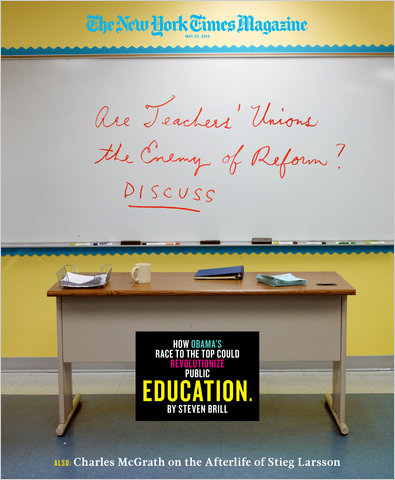
Many School for Thought readers have brought the NYTimes article on Obama's Race for the Top to our attention. Teachers' Unions' Last Stand is a long essay outlining how the need for improvement, accountabilty and the demand by parents for school choice has lead to the Race for the Top program. The article also explains how Democratic politicians have changed their tune when faced with a growing constiuency that wants school choice.
"The teachers' unions have become accustomed in recent years to fighting off reform efforts by Republicans and think-tank do-gooders. They ignore the rhetorical noise, while sticking to the work of negotiating protectionist contracts with the politicians who run school systems and depend on their political support. But what happened last month in Washington could signal a new era in which the unions have to worry that Democrats, like Washington's mayor, Adrian Fenty, not only won't yield in contract negotiations but will also support laws and programs aimed at forcing accountability."
On the SES argument, the article outlines two schools with identical populations, even having kids in both schools from the same family, but getting very different results:
"Same building. Same community. Sometimes even the same parents. And the classrooms have almost exactly the same number of students. In fact, the charter school averages a student or two more per class. This calculus challenges the teachers unions' and Perkins's "resources" argument - that hiring more teachers so that classrooms will be smaller makes the most difference. (That's also the bedrock of the union refrain that what's good for teachers - hiring more of them - is always what's good for the children.) Indeed, the core of the reformers' argument, a'd the essence of the Obama approach to the Race to the Top, is that a slew of research over the last decade has discovered that what makes the most difference is the quality of the teachers and the principals who supervise them. Dan Goldhaber, an education researcher at the University of Washington, reported, "The effect of increases in teacher quality swamps the impact of any other educational investment, such as reductions in class size.'
This building on 118th Street could be Exhibit A for that conclusion.
'I've got one child in a charter and have had two in public schools,' says Bernice Wynn, who runs an optician's shop on Lenox Avenue with her husband, and whose daughter, Tiana, is in the Harlem Success Academy. 'There is no comparison. Tiana is in first grade and already reading chapter books and writing stories.'"
In order for states to be eligible for Race for the Top funding, they will be assessed on a number of criteria and teacher accountabilty is a big one. No more will tenure trump good teaching. In fact, teacher colleges will be part of the accountabilty equation.
What does all of this mean for Canadian schools? Well, we are probably about 10 years behind U.S. reforms. We are still looking at class size when other jurisdictions, like California, have "been there, done that" a decade before with all usual complications. Malcolm Gladwell's negative comments about Ontario's experience with class size caps, made right in front the Premier, must have made quite a few educrats squirm. Gladwell, who has made a career out of looking at outliers and tipping points, was right. Student achievement depends on effective teaching.
This study looks at the link between teaching practice and student academic performance:
Abstract:
"Quantitative studies of school effects have generally supported the
notion that the problems of U.S. education lie outside of the school. Yet
such studies neglect the primary venue through which students learn, the
classroom. The current study explores the link between classroom
practices and student academic performance by applying multilevel
modeling to the 1996 National Assessment of Educational Progress in
mathematics. The study finds that the effects of classroom practices,
when added to those of other teacher characteristics, are comparable in
size to those of student background, suggesting that teachers can
contribute as much to student learning as the students themselves."
Highlights:
"Quantitative research on whether schools matter has generally supported the notion that
the problems of U.S. education lie outside of the schools. Some research finds that when
the social backgrounds of students are taken into account, school characteristics do not
seem to influence student outcomes, suggesting that schools do not serve as avenues for
upward mobility, but instead reinforce existing social and economic inequalities"
However, "The study finds that classroom practices indeed have a marked effect on student achievement and
that, in concert with the other aspects of teaching under study, this effect is at least as
strong as that of student background. This finding documents the fact that schools
indeed matter, due to the overwhelming influence of the classroom practices of their
teachers."
"The first hypothesis, that, of the aspects of teacher quality, classroom practices will have the
greatest effect, is confirmed by the models."
"Another important interrelationship involves the trade-off between teacher quality
and teacher quantity. Smaller class sizes are negatively associated with teachers majoring in
their relevant subject and in receiving substantial amounts of professional development,
whereas teacher major and time in professional development are positively associated with one
another. These relationships suggest that schools tend to choose between hiring more teachers
or investing in improved teacher quality through recruiting teachers with better preservice
training and providing teachers with more and better in-service training."
So for Canadian students, a lower family income doesn't have to doom them to poor expectations and/or failure. They are certainly challenged, but with effective teaching practice combined with parental school choice to find it, there is hope.