
 RSS Feed


SCHOOL FOR THOUGHT
It doesn’t have to be this way
Most people are very accustomed to the current model of education delivery - big box schools led by a principal and overseen by their school board - but this is only one possibility - and by no means necessarily the best possibiity.
For example, this article talks about a Denver school without a principal - it's led by its teachers - and apparently there are some 60 other similar schools throughout the US. The Swiss have been doing it this way for years - see this article from our archives - and it turns out that there are a number of benefits, including the ability to funnel more money to the classroom.
SCHOOL FOR THOUGHT
Sunday at the Movies (Math Teaching)
New research yields the surprising (to some) discovery that hard-to-teach students learn better with teacher-directed instruction.
SCHOOL FOR THOUGHT
Who will guard the guardians?
Today, Margaret Wente is writing about The Brave New World of 21st Century Learning, referring to "an alarming education fad frequently known as '"1st century learning'". But education leaders have been pushing
"...emphasis on creativity, innovation and digital literacies with more discussion of broad concepts and big ideas and less emphasis on factual knowledge. Courses will be personalized to suit students' learning preferences. Classes will be student-centred and feature far less direct instruction and far more project and group work. Teachers will be expected to act as guides to self-directed learners. Technology will feature heavily in the classroom. Grades and testing will be downgraded..."
for at least 50 years. Every 10 years or so, parents and classroom teachers start speaking out against education leaders' nonsense - because none of this stuff actually works - and so then education leaders try to repackage their aging sow's ear as a silk purse and keep on pushing the same agenda under a different name. The latest iteration happens to be called 21st century learning.
It's still not clear to me why this particular education fad is so appealing to education leaders, but in the final analysis their motivations really don't matter.
The important questions are:
- WHY CAN EDUCATION LEADERS CONTINUE TO FORCE THEIR AGENDA DOWN THE THROATS OF PARENTS AND CLASSROOM TEACHERS?
- WHY DO THEY HAVE SO MUCH POWER?
- WHO HAS CEDED THEM THIS POWER AND WHO CAN TAKE IT AWAY FROM THEM?
After 50 years of this nonsense, it's time to cut the Gordian knot.
SCHOOL FOR THOUGHT
Helicopter Parents
Many times when I used to try to advocate for my children by asking for better teaching methods and more rigorous standards, I was dismissed as being overprotective and overly ambitious on my children's behalf. I still don't think this was accurate or fair, as the things I was asking for would have benefitted all of the children at the school, as opposed to just my own children. So it's important to make a distinction among the various categories of interfering parents.
Here is an interesting column by a Toronto teacher about the effect of overprotective parents who advocate on behalf of only their own children, asking for things like higher marks, special privileges, or more lenient discipline. Not only are these parents' actions harmful for the class as a whole, lowering standards and academic integrity, but also they harm their own children, making them less able to withstand adversity and overcome obstacles.
It's also worth noting that the first category of parents (those who want changes for all the children) tend to be chewed up and spit out by the system, while the second category of parents (those who want changes for only their own children) tend to be heeded. Too bad it's not the reverse. H/T DH
SCHOOL FOR THOUGHT
Math Push-Ups
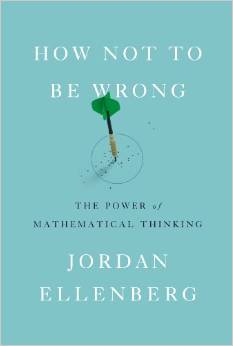 I have just started reading How Not To Be Wrong: The power of mathematical thinking by Jordan Ellenberg and I already like it a lot. Here's an excerpt from the introduction (pp. 2-3) where the author explains why students need to spend hours practising mundane and boring mathematical computations.
"Mathematics is not just a sequence of computations to be carried out by rote until your patience or stamina runs out - although it might seem that way from what you've been taught in courses called mathematics. These integrals are to mathematics as weight training and calisthenics are to soccer. If you want to play soccer - I mean, really play, at a competitive level - you've got to do a lot of boring, repetitive, apparently pointless drills. Do professional players ever use those drills? Well, you won't see anybody on the field curling a weight or zigzagging between traffic cones. But you do see players using the strength, speed, insight, and flexibility they built up by doing those drills, week after tedious week. Learning those drills is part of learning soccer.
"If you want to play soccer for a living, or even make the varsity team, you're going to be spending lots of boring weekends on the practice field. There's no other way. But now here's the good news. If the drills are too much for you to take, you can still play for fun, with friends. You can enjoy the thrill of making a slick pass between defenders or scoring from distance just as much as a pro athlete does. You'll be healthier and happier than you would be if you sat home watching the professionals on TV.
"Mathematics is pretty much the same. You may not be aiming for a mathematically oriented career. That's fine - most people aren't. But you can still do math. You probably already are doing math, even if you don't call it that. Math is woven into the way we reason. And math makes you better at things. knowing mathematics is like wearing a pair of X-ray specs that reveal hidden structures underneath the messy and chaotic surface of the world. Math is a science of not being wrong about things, its techniques and habits hammered out by centuries of hard work and argument. With the tools of mathematics in hand, you can understand the world in a deeper, sounder, and more meaningful way."
SCHOOL FOR THOUGHT
Helping parents help their children
From time to time we get requests from parents for money so they can bail their kids out of a bad education situation. Usually, the child has some sort of special needs and is drowning in his current setting, but sadly SQE has no money to help these kids. Until yesterday, all we could do was suggest that they move to Arizona where the parents of special education students can get about $10,000 from the government each year to spend on their children's education - for example, to pay for private school tuition, therapy, or tutoring.
Now, we can suggest they move to Arizona OR Florida - because last Friday the governor signed into law a similar program for Florida special needs students. more
This would be so easy for the Ontario government to do. For one thing, it would save money - since the government currently spends more than $10,000 per year on the province's special needs students. For another, it would make the parents of special needs students very happy (and likely to vote for the government come next election). Thirdly, it's the right thing to do because it would give a hand up to some of the province's most vulnerable citizens.
And lastly, it would be wonderful for SQE, because then we would have something to offer the desperate parents who call us and cry over the telephone.
SCHOOL FOR THOUGHT
White Elephant School Boards
School boards were invented to make schooling democratic, and the new invention worked well back in the days when Ontario was mainly rural - because typically there was only one school board per school, meaning that members of the community had excellent access to the decision-makers. But with the advent of urbanization and the amalgamation of school boards, this became less and less true, and over the years the school boards have become expensive anachronisms.
Marcus Gee has a column in the Globe and Mail about the Toronto District School Board (which is perhaps the most egregious example of the resulting dysfunctionality, but most other Ontario school boards are trying hard to become every bit as dysfunctional). Something not mentioned by Marcus is the fact that some of the Tedious Board's administrative staff are laid off each summer so that they can collect EI. But this is only one of hundreds of similar shocking abuses.
Marcus wonders out loud what to do about the problem, but he doesn't think of the most obvious one: get rid of the boards. Abolish them, eradicate them, eliminate them, exterminate them, obliterate them, well you get the idea. Absent the school boards, and schools could return to their former autonomous state and democracy could once again be the order of the day - although funding and evaluation functions should still be carried out by the Ministry of Education.
SCHOOL FOR THOUGHT
Technology is going to transform the educational landscape
GUEST BLOG BY TOM BEREND, SQE DIRECTOR
If you traveled back in time to just before the Internet caught on and tried to tell people about our new technologies, no one would believe you. After all, it's less than 25 years ago. Today, you can find out anything through your mobile phone ("Beam me up, Scotty?"). There's a free instantly-updated mega-encyclopedia built by citizens in their spare time (Wikipedia). There are major businesses without offices or employees. And the list goes on.
But Alvin Toffler's Future Shock is still with us. The past 25 years will be boring, boring, boring compared with the NEXT 25 years, as if almost nothing had happened!
However, there is one exception - education. It has barely changed in the last 25 years. However, interesting things are starting to happen.
For example: we recently heard from a mom who was in a 'school co-op'. What is a co-op? Maybe five moms who happened to meet in prenatal yoga and kept in touch, or who live on the same street. They decide that they are going to jointly home-school in their own little private school.
How can they afford to do this? Easy to imagine that one of them commits full-time, and the other couples provide a parent one day a week. Or each couple commits someone one day per week, and maybe some of the grandparents want to help. In BC, and Alberta, they would be eligible for small government grants to help fund this, or about $25K per year. More than enough to cover renting a space, buying computers and books, and paying for some amazing field trips.
But that doesn't make a school. That's where the Internet comes in. The co-op has free or almost-free access to amazing curriculum resources - better than what the schools use. The kids will get the same attention as homeschooling, a 5-1 student-teacher ratio that no school can afford. They will have infinite libraries on their tablets, pen-pals around the world, and access to lectures from the best professors on the planet. Enough different adults that discipline and teaching momentum can be maintained.
This is all stuff we have NOW. Now imagine some future technology - http://www.edutopia.org/blog/five-future-education-technologies-nick-grantham.
Ontario already has about 20,000 homeschoolers, with more every day - in part because technology is making it easier and more attractive. And frankly, declining public school performance is having the same effect. It's time for Ontario to follow Alberta's and BC's leads and support parents directly.
From the taxpayers' point of view, homeschooling saves thousands of dollars per child. And of course, the kids learn more. A win-win situation.
SCHOOL FOR THOUGHT
Sunday at the Movies (Fundraising)
This video will make you think about charitable fundraising in a new way. Hopefully, it will inspire you to put the Society for Quality Education over the top in its Drive to 25. In case you haven't heard, a major Canadian foundation has offered us a matching grant of $25,000 and we've just gone over $21,000. It would be great if you could help us get the rest of the way. more information on how you can help
SCHOOL FOR THOUGHT
Medley of Reader Tips
It turns out that teaching handwriting may pay big dividends after all. H/T TB
New hope for aging boomers with memory retrieval problems (less flippantly, new understanding of memory may lead to pedagogical breakthroughs) H/T JE
A new US report slams teacher pre-service training, saying among other things that "failure in the US to produce sufficient numbers of STEM graduates can be traced directly back to elementary math preparation". H/T TH
Halifax is starting to learn about the importance of phonics H/T DW
Alberta is improving its math curriculum H/T KC while Nova Scotia is worsening its math curriculum H/T TH and Manitoba treads water H/T DW