
 Subscribe to our Blog


SCHOOL FOR THOUGHT
Schools should be a slave to history
GUEST BLOG BY MARJORIE GANN. Marjorie Gann is a retired elementary teacher. The book she co-authored with Janet Willen, Five Thousand Years of Slavery (Tundra Books, 2011) is available through Amazon and Indigo. Its accompanying Teacher’s Guide is available for download at th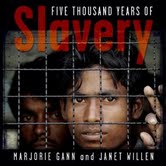 e Teacher Resources page on the Tundra Books website and at www.fivethousandyearsofslavery.com. Gann and Willen’s forthcoming book, also for young readers, is No Middle Way: Women Against Slavery (Tundra/Random House Canada, 2014). It tells the story of 14 women who fought against slavery.
The film 12 Years a Slave, which won the People’s Choice Award at the 2013 Toronto International Film Festival, has garnered rave reviews. I’d put off seeing it until last week, when I met Janet Willen, my co-author of Five Thousand Years of Slavery, in Maryland. We wanted to see 12 Years a Slave together because we tell its story in our book. It’s about Solomon Northup, a free Northern black kidnapped into slavery in Louisiana, where he languished for 12 long years until he was released in 1853. We were interested in how director Steve McQueen would adapt his story for film.
This he did brilliantly. The film is true to Northup’s memoir, and does a remarkable job conveying the brutality slaves were subjected to on a regular basis. What puzzles me, though, is the surprise of many viewers at the level of cruelty in the film. Why, I wondered, does slavery’s brutality surprise anyone? What did they learn about slavery in school? With African-American Studies firmly established as a legitimate discipline, with Black History Month mandated for every school in Ontario, are people still bamboozled by the Gone With the Wind version of the American South?
Students should leave school with a clear picture of what slavery was, and that picture is not pretty. More than that, they deserve a rounded picture of slavery, because slavery was not an exclusively American phenomenon. It existed in every culture and at every period of history, and it persists in many parts of the world to this day. The book I wrote in 2011 with Janet Willen paints that picture. Aimed at students age 10 and up, Five Thousand Years of Slavery devotes four of its twelve chapters to slavery in the Caribbean and the United States. The other eight chapters range the globe: the Ancient Near East, Greece and Rome, medieval Europe, the vast Islamic world, Africa before European contact and after the transatlantic slave trade ended. Readers learn what Buddha taught about slavery in India, how Chinese parents sold their daughters into bondage, and how pirates captured slaves in the Sulu and Celebes Seas in the nineteenth century. They learn that children are sold to work at carpet looms in Pakistan, and that Canada’s Craig Kielburger founded Free the Children to end the practice.
The rightness of slavery went unquestioned from the dawn of human history until the mid-eighteenth century, when a few brave Anglicans and Evangelicals in England began to question it. Five Thousand Years asks why this happened, and points to the two pillars of Western culture that nurtured the first human rights movement in history: the Judeo-Christian religious tradition and Enlightenment thought. Without minimizing for a minute the brutality of slavery in the Americas, it gives credit where credit is due.
Schools should teach real history, not cultural myths, and real history relies on primary sources. Five Thousand Years contains a lot of these:
• an Egyptian papyrus account of adopting a slave girl’s children
• an eyewitness report on the sacrifice of a Viking slave girl at her master’s funeral pyre
• a fourteenth-century Italian merchant’s order for a slave girl to clean and cook for him
• Frederick Douglass’s reminiscence of being taught to read by his owner’s wife
Teaching about slavery fits the Ontario curriculum. Slaves came to Canada with the Loyalists, and Upper Canada was the first jurisdiction in the British Empire to pass an antislavery law (introduced by Lieutenant Governor John Graves Simcoe in 1793). Canada took in slave runaways after the American Revolution and the War of 1812, and was the terminus of the Underground Railroad. Grade Fours study ancient societies, Grade Sixes learn about child labour and human rights, and Grades Seven and Eight discuss the Underground Railroad.
The film 12 Years a Slave is too graphic for elementary students to watch, but the story of slavery is embedded in human history and should be taught honestly. It is not a romantic story of Scarlet O’Hara and her loyal mammy. It is a story of human beings treating other human beings as property, and runs through all of history to the present day. We should teach it the way we should teach all of history – accurately.
SCHOOL FOR THOUGHT
Whom are Ontario politicians more interested in helping - disadvantaged kids or themselves?
Everybody wants to help disadvantaged kids do better in school, and so lots of jurisdictions have tried all kinds of early childhood intervention programs. After all, it looks as if the parents of these kids aren't doing a very good job and it feels intuitively right that well-educated and well-meaning outsiders can help disadvantaged kids overcome their bad start in life.
But facts are stubborn things, and here is a rundown of the track record of early childhood intervention programs to date - including a newly-released study from Tennessee.
The lack of success of most of these other early childhood intervention programs did not bode well for Ontario's universal full-day kindergarten program, and so it came as a surprise to those in the know when the Ontario Minister of Education reported stellar success last September. Curiously, the research reports had not yet been released when the Minister made this announcement, an almost unprecedented way of handling announcements. However, all became clear when the independent research reports were released in late October - and careful reading revealed overall inconclusive or even negative findings for the province's early childhood intervention program. more
As the author of the first linked-to paper says, "Poor children deserve effective programs, not just programs that are well-intentioned." To which I might add, disadvantaged children deserve not to be the pawns of ambitious politicians. Furthermore, given the one and a half billion dollar annual cost of Ontario's program, I would add that taxpayers too deserve not to be the pawns of ambitious politicians.

SCHOOL FOR THOUGHT
Burning Bridges to the Mennonite Community
When John Tory sunk the Conservative ship over the issue of public money for religious schools, little attention was paid to the fact that some religious schools (other than Catholic) were already receiving public funding. Eden High School in St Catharines is one such school, and Three Bridges School in St. Jacobs is another. However, the Ontario government clearly doesn't care about being fair, as it continues to fund schools for Catholic children while doing its best to ignore the fact that it has been twice condemned by the UN for religious discrimination.
Now the Waterloo County Board of Education is proposing to close Three Bridges School - at least ostensibly for financial reasons, not religious ones. Luisa D'Amato has an interesting column on the proposed closure, pointing out that most of the children are likely to switch to Mennonite parochial schools and be lost to the larger public commuity. As Luisa writes, "The only contact we'll have is the occasional glimpse as we buy produce at a farmers' market or go for a drive out in the country. Like ghosts, they will be among us, and yet invisible."
Obviously, the Waterloo County Board of Education could afford to keep Three Bridges open if it wished to (by for example switching to a church basement and having the principal teach full-time). But there doesn't seem to have been any contemplation of such options. It seems likely that the board is a bit uncomfortable having a Mennonite school as part of its portfolio. But surely it would be preferable to keep some contact with these old-order Mennonite children - as opposed to no contact.
SCHOOL FOR THOUGHT
The Sky’s the Limit
Contact North offers a platform of more than 18,000 on-line courses, with content from 24 universities and colleges across Ontario. This is a well-thought-out website and looks awesome. H/T TB
SCHOOL FOR THOUGHT
If back-to-basics math is on the table, can systematic phonics be far behind?
In the category of I'll-believe-it-when-I-see-it comes this snippet from the minutes of the Ottawa Catholic School Parents' Association. The last item in the report by Julian Hanlon, Director of Education for the Ottawa Catholic School Board, is as follows: "The Ministry of Education is considering back to basics math, as problem solving math may not be working."
We would be grateful to any of our readers who know Mr. Hanlon if they could talk to him and find out more about this tantalizing prospect. H/T JD
SCHOOL FOR THOUGHT
Sunday at the Movies (Milton Friedman)
Today I'm giving you a clip of Milton Friedman answering questions about freedom and market economies. The man's brilliance and crystal-clear thinking shine like a beacon. The clip is not directly relevant to our discussions, but it does inform the issue of for-profit education providers.
SCHOOL FOR THOUGHT
They like us, they really like us!
Our blog has been nominated for a Canadian weblog award! more We are one of nine nominated in our category. The contest is juried, so no need to vote or anything like that. On December 1, we will find out if we made the top five and then on December 7 whether we are in the money - so to speak. I'm not sure what we get if we win, but who cares - it's just nice to be recognized! Keep your fingers crossed!
SCHOOL FOR THOUGHT
Be afraid, be very afraid
It's amazing how centuries-old education notions can be repackaged over and over again and presented as something new. Jean-Jacques Rousseau (1712-1778) was the first to promulgate romantic ideas like the virtue of the natural human and the vice of direct teaching. His ideas have been tried out thousands of times ever since, never once succeeding.
In another iteration of the apparently never-ending iterations, the director of the Hamilton-Wentworth board wants to put children from different grades into the same classroom so they can tackle "problems such as water shortages and world hunger, earning credits not just in world issues, but also science and geography". more
Meanwhile, back at the ranch, Ontario's premier wants to find ways to "make education go beyond the 3Rs" and "find space to focus on higher-order skills like creativity, collaboration, community and critical thinking". The province will release its new vision for education in the new year. more
SCHOOL FOR THOUGHT
Union Rules
Well, things have been a bit quiet around here, so what do you think of this New York charter school that has decided to close its doors "because operating under union work rules has made it impossible for it to provide students with a decent education"?
SCHOOL FOR THOUGHT
Detroit hasn’t given up
GUEST BLOG BY BEV KOSKI
I still visit Detroit a lot. Despite all of the negative press, it's still a beautiful city, and at one time it was deemed one of the most beautiful cities in the world. Many times when I've visited the city, I've seen the school buses lined up for children's school trips. The majority are black children--very quiet and polite.