
 Subscribe to our Blog


SCHOOL FOR THOUGHT
Sunday at the Movies (Choice)
Here's a thought-provoking TED talk about choice in general. It suggests that choice is not automatically all good, but rather is culturally based and nuanced. In other words, choice can be good, but it needs to be carefully managed.
SCHOOL FOR THOUGHT
Credo: Charter Schools Are Starting to Fulfill Their Promise
Charter schools - free (in both senses of the word) public schools - have not been as successful as their proponents might have wished, nor as unsuccessful as their opponents might have wished. The opponents of charter schools were quite gleeful about a 2009 CREDO study that had some negative things (as well as some positive things) to say about the performance of the approximately 5,000 charter schools then in existence. Now, four years later, a new CREDO study is much more bullish on the approximately 6,000 charter schools now in existence (more). I guess this means the opponents of charter schools will change their minds now (not). (Hint - their opposition is based on reasons other than the performance of charter schools).
Here are the main takeaways from the new CREDO report, as summarized by Andy Smarick in the Thomas B Fordham Institute's weekly newsletter.
- Contrary to public perception, only 56 percent of charter students live in urban areas; the rest are in suburbia, rural areas, and small towns.
- More than half of the charter kids studied live in poverty—higher than the district school rate. A growing number of Hispanic and low-income families are choosing charters.
- Among the sixteen initial states, charters have improved significantly in both reading and math. They now outperform traditional public school (TPS) peers in reading (about eight days more of learning per year) and are on par in math. (Figure 22 nicely shows these improvements.)
- The performance of new charters lags that of longer-standing charters.
- Looking at all twenty-seven states, the average charter student starts further behind academically than his TPS peers.
- Importantly, charters are producing large academic gains for the most historically disadvantaged students, notably low-income Hispanic and African American students and English language learners.
- Enrollment among these groups is growing; in other words, the groups of students that most benefit from charters are increasingly finding their ways into charters.
- However, there continues to be wide variation in performance within the national charter sector. Some schools outperform peer district schools, some do about the same, and some lag behind. But these proportions have been trending, since 2009, in the right direction for the charter sector.
- One continuing disappointment: CMO-run schools aren’t doing as well as they should. We’re all aware of the great CMOs, but too many states have allowed middling or poor charters to replicate, causing overall CMO performance to lag.
- Perhaps most striking is the enormous variation in charter performance from state to state. Some state charter sectors are helping their kids learn dozens of extra days worth of material annually. The best results are now found in D.C., Louisiana, Massachusetts, Michigan, New Jersey, New York, Rhode Island, and Tennessee. (By contrast, the performance of Nevada’s charters is shameful.)
- I suspect it’s no coincidence that the states with great charter performance have independent authorizers (no more district authorizing!).
- The report compares the additional learning kids get from their states’ charters to their respective states’ NAEP scores. Two major findings jump out: In Massachusetts and New Jersey—states with high statewide NAEP scores—the charter sectors still best their TPS counterparts.
- In D.C., where NAEP scores are woeful, the charter sector is offering kids remarkably higher-performing options.
- Per Figure 42, the longer kids stay in charters, the more they learn compared to TPS peers.
- Lastly, the report offers five scenarios for closing low-performing charters. The upshot is clear: Get serious about shuttering failing charters, and the sector’s overall performance skyrockets. (It would have been nice if they had also shown the sector-wide influence of various scenarios for growing the best charters.)
SCHOOL FOR THOUGHT
Education Leaders Should Be Awarded Zeroes Themselves
I'm quoted in this column in the KW Record yesterday. It concerns the "new" ministry/school board no-zeroes policy. As you might guess, I'm not a fan.
Here is feedback from Tony Lea, athlete, former teacher of physical education, and current executive director of the KW St. John's Ambulance Association.
"Like you, I was once again taken aback, appalled and annoyed to read that our Education Decision Makers have got it wrong. They continue to reinforce a concept that does not exist in the real world – namely, that one cannot fail. But if one cannot fail, then de facto one cannot succeed.
"This political view point is of course really affecting my subject of Physical Education. Apparently our future parents/ leaders/ entrepreneurs/ athletes are to get a Participation Certificate when ‘competing’ in Track and Field.
"Years ago, when I was teaching at Farnham College in Surrey and was nationally known for being the originator of the ‘A’ level in Physical Education, I was invited to join a national committee that wanted to take the object of competition and aggression out of certain sports - e.g. there would be no ball in soccer/rugby/tennis; and no shuttle cock in badminton. The players would just run around and perform the Human Movement without actually hitting or striking the object of aggression. Upon completing the movement, the player would say, “To You!” and this ridiculous process would be completed again and again, until someone decided it was time to sit down and study the dandelions.
"NUTS!! These people are NUTS!"
SCHOOL FOR THOUGHT
Moving On
Well, it seems that not many of you are interested in thinking about what schools' primary goal is/should be - perhaps because you think it's self-evident. But of course what is self-evident to one person is not self-evident to another person, leading to cross-purposes and confusion and disappointment. How else can one explain the rush to shut down schools like Parkview and St. Francis of Assisi that had attained excellence, along with sky-high levels of teacher and parent satisfaction? In any case, it's clearly time to move on.
For the rest of this week, I will revert to our one-a-day format. Actually, today will be a bonus day - as I start working on my tip backlog.
- Manitoba is reverting to a more sensible basics-first math curriculum, due largely to the efforts of the WISE Math group. Apparently, sometimes you can fight city hall. more HT/DW
- A new report on teacher training in the US finds it to be an industry of mediocrity. It's the same in Canada. more HT/Chas
- A Seattle teacher has been shunted aside by political correctness. Reading this story will clarify why most teachers just go along to get along. more
- Blindly memorizing algorithms paves the way for subsequent progress. more H/T Chas
SCHOOL FOR THOUGHT
A Rephrased Question
GUEST BLOG BY JESSE WHITE, AKA MAD TEACHER
Jesse is an ex-teacher in BC who was one of those fabulous teachers Mirka speaks of. Jesse's attempts to deliver an excellent education to his students were thwarted by the bureaucracy and, as a result, Jesse resigned from his teaching position.
We have seen an open forum where participants have been asked to identify what the single primary goal of education should be. The question paraphrased could be stated as: what end should have precedence in the wide variety of (typical or atypical) school goals? To say that the responses to this query were unfocused is an ... understatement. Responses included:
-hierarchical lists of generic school 'goals', common to those the ministry and teachers' union also call for
-a 'hot-topic' review of the history of school, qua John Gatto parroting
-nihilistic, blunt and contradictory claims from the school of no hope
-some cut/thrust and riposte style 'debate', which ultimately led nowhere
- the decidedly status quo argument from need, courtesy of Doug
- direct from the ministry quotations
- citations of education journals along with some of Nancy's indomitable research checking
- a distributary regarding solfege singing
Why do the 27 responses to a straight forward question wander in, out, and around the actual question? Why are the few responses that do attempt to answer the question unlike one another? Why are some responses more of the hydra-like lists of multiple goals ?
The reason is a simple one, and it carries with it a kind of confirmation of the purpose of this blog as a whole. The reason that the answers are mixed up and of polarized stance is because every person has their own ideas and they desire to be free to exercise their opinion. Free to pursue their own 'thing', free to cite Pisa scores, or refer to learning the solfege. Free to even disregard Malkin's question, and instead make ad hoc references and declarations. In other words, free to choose.
Unfortunately, there are some folk that feel their individual right to choose is not enough, and they seek to choose for everyone. These folk aim to take others' freedom away for their own good, or for the good of the collective so the story goes. These folk believe that the wisdom of their collective trumps individual thought. Furthermore, they think that some people need to be coerced into doing what the collective thinks is right. These folk think coercion -force - is a justifiable action to take against those who choose to think differently. The epistemology behind the collective, (and a majority is a collective) is force.
The use of force is anti-reason. Force has the power to make one subscribe to unreality, but not the power to make the unreal real. A gun cannot make 2 + 2 = 5, but it can certainly make someone proclaim it to be so. Reason is destroyed when force is introduced.
"What should the goal of education be?" is a collectivist question. Collectivists will line up to tell you what the answer is. The question cannot be answered by advocating one collective in place of another. Can we instead ask: " Should you and I be free to choose what the goal of our child's education is?"
SCHOOL FOR THOUGHT
The End of Education (with apologies to Neil Postman)
I have often thought about how some parents can be quite satisfied with the very same school that other parents are very dissatisfied with. To some extent, of course, it may reflect the different experiences their children had at the school as a result of their own personal characteristics and the teacher they drew. But another factor is undoubtedly the fact that different parents want and expect different things from their children's school.
If, for example, you are in the mood for comfort food - maybe meatloaf and mashed potatoes and rice pudding - and wander in to a fine dining fusion cuisine restaurant, you're probably not going to be very satisfied with your meal.
Like restaurants, schools are also specialized. In Ontario, the dominant specialization is the child-centred orientation. This specialization has as its primary goal the cultivation of children's creativity and higher-order thinking proficiency. And so, at least to the extent that Ontario schools succeed in achieving this goal, the parents who agree with this priority tend to be satisfied with their children's school.
However, there are lots of other possible goals. Here are a few.
- Integration of children from all walks of life, resulting in a cohesive society
- High academic achievement
- Babysitting for as many days and hours as possible
- Mental and physical fitness
- Cultivation of leadership ability
- Career preparation
- Development of global citizens
- Moral and spiritual guidance
Of course, none of these goals is mutually-exclusive, and it is possible for schools to work towards multiple goals. However, I am interested in schools' PRIMARY orientation.
Your mission, should you choose to accept it, is to identify which goal you think schools should have as their priority. Piranhas, attack!
SCHOOL FOR THOUGHT
Sunday at the Movies (Aims of Education)
This link leads to a number of TED talks on various people's personal views of what and how kids should be taught. These videos will serve as an intro to tomorrow's grand theme for the week - namely, what the goal of education ought to be.
SCHOOL FOR THOUGHT
The children’s needs must come first
Yesterday, we were treated to a very common logical fallacy - the ad hominem argument, which is an argument made personally against an opponent instead of against their argument. So when Doug attacked Michelle Rhee's reputation yesterday, instead of addressing her claims, his comments were irrelevant to the argument. Furthermore, the ad hominem argument implies that if Rhee's claims had been made by, say, Mother Theresa or Al Gore, then they would have been acceptable and correct.
Interestingly, Rhee reveals in her book that she is a lifelong Democrat and had a hard time accepting the need for school vouchers when she became the school chancellor in Washington, DC. Her mind was changed, however, when she met with families who had no choice but to send their kids to a bad neighbourhood school. In her book (pp 250-251), Rhee writes: "I just couldn't look mother after mother in the eye and deny their children the opportunity I wanted for my own children. It would have required me to say, 'Gee, I'm sorry, you're just going to have to suck it up. I know your elementary school is a failing school, and your child will probably not learn how to read, but I really need five more years to fix the system. And while I'm fixing the system, I need you and your neighbors to be really patient. Hang in there with me. Things will get better, I promise.'
"If someone said that to me, I'd have said, 'You may need more time to fix the system but my kid doesn't have time. She has only one chance to attend first grade, and if she can't learn to read by the end of first grade, her chances for success in life will be compromised. So with all due respect - heck, no!'
"After my listening tour of families, and hearing so many parents plead for an immediate solution to their desire for a quality education, I came out in favor of the voucher program....
"Here's the question we Democrats need to ask ourselves: Are we beholden to the public school system at any cost, or are we beholden to the public school child at any cost? My loyalty and my duty will always be to the children."
SCHOOL FOR THOUGHT
Believing in Teachers
I'm currently 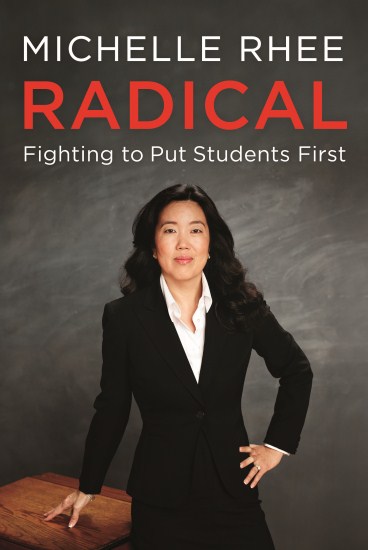 reading Radical: Fighting to put students first by Michelle Rhee. Ms Rhee was a Teach for America teacher who discovered that it was possible to transform the lives of her ghetto students - and then became enraged because most ghetto students are just being written off.
After acknowledging that it is extremely diffiicult to teach disadvantaged students and that schools should not be expected to solve all of society's ills, Ms Rhee says that teachers can - and should - make an enormous difference in their students' lives. Here's an excerpt from pp 209-210.
"The research is very clear: teachers make a real difference. In fact, of all in-school factors, the quality of the teacher in front of the students every day has far and away the greatest influence on student achievement.
"According to a 2011 report prepared by the Center for Amerian Progress and the Education Trust, 'Students who have three or four strong teachers in a row will soar academically regardless of their racial or economic background while those who have a sequence of weak teachers will fall further behind...'
"Many argue back, 'But that's a measure of in-school factors. Compared to the factors outside the school, teachers don't play as large a role.
"I would ask, 'What is our job as educators?' I would argue that we, as educators, cannot be focused on the external factors. There are social service agencies and programs that exist to help families deal with problems beyond the schoolhouse. Educators should, while acknolwedging those circumstances, focus relentlessly on what can happen when we have the children in the clssroom.
"If we believe that the external factors are simply too difficult to overcome, then why do we have schools? In a city such as Washington, D.C., if we believe schools can't make a difference, shouldn't we have just shut down the school system and used the $1 billion annual budget to enhance social services and fix poverty?"
SCHOOL FOR THOUGHT
A Troika of Education Articles
Today, I'll do a round-up of some of the interesting tips that have been piling up.
From DW, hopeful news from Seattle and Manitoba showing that pushback from education consumers has yielded dividends in math pedagogy.
From JE, an article about collective bargaining and teacher quality. JE especially recommends the comments.
From Chas, a blog about the dominance of Asian students.