
 Subscribe to our Blog


SCHOOL FOR THOUGHT
A Bush in the hand is worth two in the States
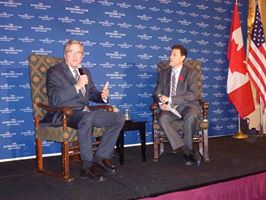 Yesterday, SQE was honoured to be a part of bringing Jeb Bush to Toronto. In the photo, Jeb is being interviewed by Steve Paikin.
Like every education reformer I have ever met, Governor Bush turned out to be a fine human being who cares deeply about children. Despite his family connections and personal accomplishments, he remains very grounded and very genuine.
In his speech, Governor Bush outlined the measures he took as Florida governor to raise educational achievement there. If I were to have a criticism of his speech, it would be that he didn't brag enough about the improvement he brought about there. Florida students scored near the top in the latest international assessments (TIMSS and PIRLS), up with the Asian tigers and better than Finland.
Here are the six steps Governor Bush highlighted as being the most crucial in turning the state around.
- Focus on early literacy]
- Abolition of social promotion from grade 3 to grade 4
- School choice
- Accountability
- Merit pay
- Higher standards
Florida children are indeed fortunate. Let's hope that Ontario politicians can see their way clear to give the province's children the same benefits.
SCHOOL FOR THOUGHT
Chartering a path to the future
Sometimes the individual stories get lost in the sturm und drang of the school choice wars, so here's the story of how one student's life was affected by his charter school. Coupled with the latest study of charter school effectiveness, it makes one wonder why anyone could oppose charter schools.
SCHOOL FOR THOUGHT
You can’t get there from here
GUEST BLOG BY TOM BEREND, SQE DIRECTOR
Those opposing school reform point out that Finland does not use high-stakes testing, and has a well-paid, unionized public-school system and universal pre-kindergarten - much the same as Ontario does. The blame for our educational failure is laid on poverty and poor parenting, and the proposed way forward is treat teachers with more respect, eliminate high-stakes testing, and spend more everywhere.
But as Amanda Ripley points out in her book The Smartest Kids in the World, that completely misrepresents the evolution of the Finnish educational system. Not that long ago Finns were dirt-poor and largely illiterate, and struggling with a third-world education system staffed with mediocre teachers.
"... the first phase of reforms in Finland were painful, top-down, accountability-based measures. Finland, it turns out, had its own No Child Left Behind moment, one that today will sound familiar to teachers in the United States and many other countries. In the 1970's, Finnish teachers had to keep diaries recording what they taught each hour. National school inspectors made regular visits to make sure teachers were following an exhaustive, seven-hundred-page centralized curriculum. Central authorities approved textbooks.Teachers could not be trusted to make their own decisions.
"During the same time period, the Finnish government did something else too - something that had never happened in the United States or most other countries. The Finns rebooted their teacher-training colleges, forcing them to become much more selective and rigorous. As part of the broader reform of higher education, the government shuttered the smaller schools and moved teacher preparation into the more respected universities. It was a bold reform, and not without controversy. Opponents argued that the new system was elitist and would, as one editorial warned, "block the road to our rural youth when their inner calling beckons them to a [teaching] career." Some university leaders objected, too, fearing that the inclusion of such preprofessional, practical training might dilute academic standards for the departments and lower their institutions' prestige. Interestingly, these same arguments were also made in the United States whenever anyone tried to make teacher training more selective.
"Still, Finland was desperate to modernize, and the country's leaders agreed that education was the only thing that could save their country from being left behind. The more I read the history and talked to Finns who understood it, the more I admired the common sense running through the story. The Finns decided that the only way to get serious about education was to select highly educated teachers, the best and the brightest of each generation, and train them rigorously. So that's what they did. It was a radically obvious strategy that few countries have attempted.
"Then, in the 1980s and 1990s, something magnificent happened. Finland evolved to an entirely new state, unrealized in almost any country in the world. It happened slowly, and partly by accident, but it explained more about Finland's success than almost anything else.
"With the new, higher standards and more rigorous teacher training in place, Finland's top-down, No-Child-Left-Behind-style mandates became unnecessary. More than that, they were a burden, preventing teachers and schools from reaching a higher level of excellence. So Finland began dismantling its most oppressive regulations, piece-by-piece, as if removing the scaffolding from a fine sculpture.
"The government abolished school inspections. It didn't need them anymore. Now that teachers had been carefully chosen and trained, they were trusted to develop a national core curriculum, to run their own classrooms, and to choose their own textbooks. They were trained the way teachers should be trained, and treated the way teachers should be treated.
"In the early 1990s, an economic crisis accelerated this evolution, ironically enough. Because of a deep recession, Finland's local authorities needed to slash spending. Education budgets had to be cut 15 to 20 percent. The only way local officials would agree to deep cuts was if they got something in return. So, national leaders agreed to grant even more autonomy to the locals, more than most other countries had ever dared to. This liberation only worked because of all the changes that had come before. By then, the Finns had engineered a robust system with highly educated, well-trained teachers and relatively coherent (and high) standards. Once that system was in place, the accountability checks and balances were superfluous. School leaders and teachers were free to write their own lesson plans, engineer experiments within their schools to find out what worked, and generally design a more creative system than any centralized authority ever could."
SCHOOL FOR THOUGHT
If you really want to do good, you have to do good well
It's been a while since we've done this, but today I want to kick off a week-long discussion on the topic of state-provided schooling for preschoolers, (As I typed "preschoolers", I realized that we're going to have to change the term we use for three- and four-year-olds because these days most of them are schoolers, not preschoolers. Let's call them "pre-kindergarteners".)
This article focuses on probably the most important deficit that low-income children have - impoverished vocabularies, compared to their more affluent peers - and suggests that the vocabulary gap will be diminished by publicly-funded pre-kindergarten. Efforts are underway to give pre-kindergarten teachers the tools to enhance their students' vocabularies.
In Ontario, it is my impression that education leaders don't really have a handle on why poor children struggle in school - their impoverished vocabularies and funds of general knowledge - as well as having parents who are less likely to be in a position to compensate for schools' shortcomings by providing tutoring as needed. Instead, Ontario education leaders appear to think that just rubbing shoulders (playing with) with their more affluent peers will magically remove poor children's learning difficulties. It won't.
However, carefully-targeted prekindergarten programs can go a long way towards overcoming poor students' learning deficits. Unfortunately, Ontario's ruinously-expensive universal prekindergarten program is not carefully-targeted and is therefore unlikely to make a significant difference in its students' lives.
Please discuss. H/T TB
SCHOOL FOR THOUGHT
An Open Letter on Open Government

Dear Premier Wynne,
We were cautiously optimistic to read your open letter to the people of Ontario announcing your Open Government initiative promising "engagement, accessibility and welcoming new ideas." When your party formed the government ten years ago, the Society for Quality Education contacted the newly appointed Minister of Education to introduce our organization and offer insight and information on quality education practices in order to improve student achievement. As an education stakeholder, we had always met with every Minister of Education from the David Peterson Liberal government, on through the Bob Rae NDP government, to the Mike Harris PC government--until the current Liberal government, your government, took power. At least when you were Minister of Education we actually got a very nice "thanks, but no thanks, the Minister is too busy" letter from your assistant, the only response we ever received, and that a year after our first letter to you.
Can you blame us if we are not exactly confident that, via the Open Engagement Team and whatever inevitable website portal through one is supposed to give "feedback" (and to capture an email contact list, no doubt), our "engagement" will actually get to you? Our message may be one you won't want to hear, but heck, here goes. The following is from our November 2012 Open Letter to Ontario leaders:
It's not fair to taxpayers.
For the sake of future generations we need to deal with Ontario’s massive deficit.
And, of course, to cut the deficit, we will need to cut government waste, and that includes cutting the wasteful practices so prevalent in our education system.
The Drummond Report, for instance, recommended cancelling all-day kindergarten and removing caps on class sizes.
These are good ideas and should be implemented, but there are other areas where we can cut costs and at the same time improve student learning.
That’s why I am writing. My group, the Society for Quality Education, has identified several ways in which our educational system can be made more cost efficient and better for students.
For instance, the following agencies should be eliminated or curtailed:
Literacy and Numeracy Secretariat (LNS)
This expense is worse than useless; the secretariat’s activities are ideologically biased and they only depress student achievement in Ontario.
Ontario College of Teachers (OCT)
A pawn of the teachers’ unions, this agency is almost totally worthless.
Ontario Curriculum Centre (OCC)
This agency oversees the Trillium List, a list of textbooks approved for use in Ontario classrooms. The Trillium List includes only textbooks that meet the ideological bias of its administrators: for example, there are no phonetic readers or sequential mathematics texts on the list. Ontario children would be far better off if the Trillium List (and the Ontario Curriculum Centre) did not exist.
Another option is to reduce the expense of Ontario’s 13 faculties of education, especially given that most if not all of them are indoctrinating their students in the same flawed ideology that already dominates the Ontario educational landscape.
If the government were to authorize alternative teacher training, including private institutions, it would not only save money but open up the possibility that better teacher training would become available to prospective teachers.
Lastly, there’s one way to save the government money and to improve parent satisfaction and to improve student achievement.
I am talking about tuition tax credits/school vouchers for independent schools.
At present, the Ontario government spends more than $12,000 per student on primary and elementary education. If the government chose to offer a tuition tax credit/school voucher of $6,000 to independent school students, it would save about $6,000 per student.
Plus, the potential exodus of students from publicly-funded schools would galvanize those schools into improving their service.
The bottom line is the Society for Quality Education believes huge savings can be realized in the education portfolio – while at the same time improving student achievement.
In addition, make more detailed education data more accessible. All education data from school board spending, graduation rates, staffing, class sizes, to EQAO results and more, by board and school, should be all in one place. Our www.SunshineOnSchools.ca site is a good example of what such a resource could look like and should be accessable to parents and taxpayers in a timely, coherent fashion. Sadly, our website hasn't been updated, because YOUR MINISTRY's INFORMATION IS NOT UPDATED ON YOUR OWN WEBSITE.
And finally, if after ten years in government, you don't already know how to be open and accountable, then why are you asking now?
We would be pleased to provide fuller information on request. Too bad it's ten years too late.
Sincerely,
Society for Quality Education
P.S. As you can see by the poor spelling by your own staff, you REALLY need to pay attention to SQE...
SCHOOL FOR THOUGHT
Brace yourself for IMPACT
Pretty much everyone except for the teachers' unions agrees that good teachers should be paid more than bad teachers. I mean, that's a no brainer. But the catch has always been the difficulty of identifying the good teachers. It's tricky, for sure.
Happily, there's a new kid on the block called "IMPACT", a system for evaluating teachers that "dramatically improves observations, makes use of student performance, rewards excellence, and has meaningful consequences for persistent low performance. And, according to a new study, it's working. more more
Given new research about how important classroom teachers are, it's really important that we be able to identify, retain, and reward them. So IMPACT is very good news for students.
SCHOOL FOR THOUGHT
Sunday at the Movies (Mental Illness)
Here's a TED talk that will keep you watching. There are some unfortunate attempts at creating a spooky atmosphere but, hey, it's almost Hallowe'en. And the speaker very effectively suggests we be wary of psychological diagnoses.
SCHOOL FOR THOUGHT
Let the record speak for itself
Over and over again, we hear the claim that the research evidence on private school vouchers is "mixed" and that the trouble with private school vouchers is that they leave some students behind in weakened schools. This column - yet again - refutes these claims. The fact is - the research evidence is not mixed, not even close.
Now I will be the first to agree that we education reformers have left ourselves vulnerable to attacks along these lines - because we have been making inflated predictions about the gains that school choice would yield. Sadly, so far, the gains have not been overwhelming (possibly due to the watered-down nature of the school choice initiatives). However, let there be no doubt. School choice programs have been of some help to the students who participated in them. And that's surely a reason to make them available to more students.
SCHOOL FOR THOUGHT
University is not for everyone
This column in today's Globe and Mail addresses the education mismatch in Canada. Because so many kids are encouraged to go to university, we have too few skilled workers and a lot of university graduates who can't find jobs. An additional problem, which the column doesn't mention, is that it has made it impossible for universities to dedicate themselves to purely intellectual pursuits. H/T JE
SCHOOL FOR THOUGHT
Don’t make the logical error known as “selection on dependent variable”
Jay Green has a great blog today on the logical error known as "selection on dependent variable". He quotes Russ Whitehurst as follows.
"A while back, I read a journalistic account of a small island off Italy in which people live to be quite old. Could it be because they sleep late, or drink lots of wine, or live a communal existence, or don’t eat refined sugar? Unfortunately there is no way to know based on the information provided in the article if it is one or more of the lifestyle characteristics the author identified as distinctive, or whether something else is going on. Even the claim of unusual longevity is questionable since there is no birth registry. And taking everything at face value, maybe there are other places in Italy in which people live as long or longer with different lifestyles."
If you just substitute the word "Finland" for "Italy" and "where children do well on the PISA tests" for "in which people live to be quite old", you will get that those who "make policy recommendations based on the Finland du jour should be made to hold up a giant sign that says 'I do not understand the basic research methods of the field in which I claim to be an expert'."
"It is a matter of basic logic that one cannot know what causes success only by looking at a successful place (or set of successful places). You cannot know whether any factor contributes to success without also considering unsuccessful places and examining whether that same factor tends to be more present or absent in successful relative to unsuccessful places."