
 RSS Feed


SCHOOL FOR THOUGHT
Competition makes people competitive
In the US in general and California in particular, the school districts are smaller than in Ontario, meaning that there are way more of them and that it is generally feasible for parents to drive their kids to a school in two or three different districts. This article explains how the Riverside Unified School Distict declared itself a District of Choice, meaning that parents in other school districts could send their kids to a Riverside school without any red tape. As a result of this and some other school choice options (like a science and technology middle school and a virtual school starting at grade 3), the district has attracted almost 1000 new students and reversed its trend of declining enrolment. Roughly 30 other California school districts have followed the Riverside Unified School District in declaring themselves Districts of Choice, and of course none of their neighbours likes the "poaching" of their own students. In fact, one school district, Rowland Unified School District, took Walnut Valley Unified to court - and won! But generally speaking, the poached districts pretty much have to suck it up and start competing.
Of course in Ontario, the school boards are too big for this scenario. However, in Ontario we have contiguous public and Catholic school boards, along with the interesting anomaly that non-Catholic parents can send their kids to Catholic high schools but not to Catholic elementary schools. So I formed the hypothesis that there would be a wider achievement gap between the province's elementary Catholic and public schools compared to the achievement gap between the secondary Catholic and public schools - due to the greater degree of competition between public and Catholic school boards at the high school level. I compared last year's average grade 3 math EQAO scores of all the public schools with the average grade 3 math EQAO scores of all the Catholic schools and found a difference of 3.96 percentage points. I then compared last year's average grade 9 math EQAO scores of advanced students between public and Catholic school boards, and found a difference of 1.27 percentage points - bearing out my hypothesis.
In both comparisons, btw, the Catholic school boards were superior, with approximately 66% of Catholic students passing the grade math 3 test compared to approximately 62% of public students, and approxiately 82.5% of Catholic advanced students passing the grade 9 math test compared to approximately 81% of public advanced students.
SCHOOL FOR THOUGHT
Odds and Ends
My reader tips have been piling up - so today a bit of a hodgepodge.
Education and Skills for Life - an OECD report that emphasizes the critical importance of giving young students a good foundation H/T EF
Homeschool Domination - some impressive facts about homeschooling H/T TB
Ontario Math Petition - as an apparent result of public pressure, the NDP and Liberal parties have added math reform to their platforms, 2000 more signatures requested H/T TM
My latest Huffington Post article
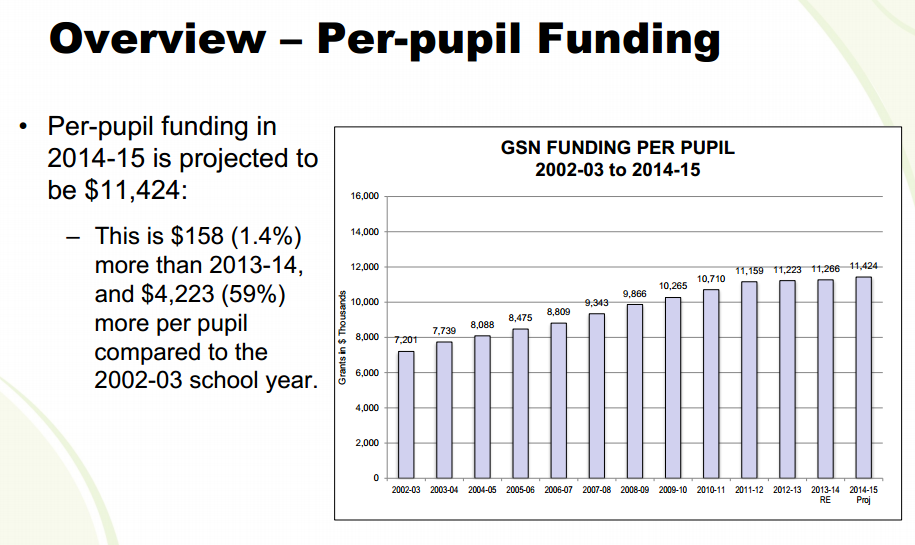
Ontario 2014-2015 Student Grants H/T TB
SCHOOL FOR THOUGHT
Moo
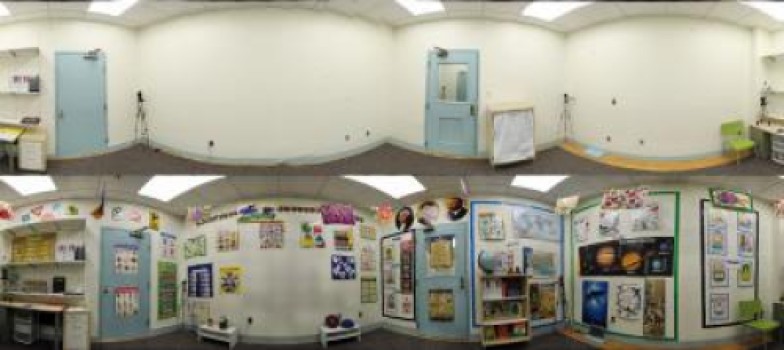 There are a lot of sacred cows in education, and beautifully-decorated classrooms are a good example. This one has been around for a long time - when I went to teachers' college in the sixties, we were actually taught how to decorate our classroom, with special attention to bulletin boards, although there was no mention of how to, say, teach kids to read. And once I was teaching, when visitors came to our classrooms they tended to take our measure on the basis of our decorations. Sometimes you would even be allowed to use your professional development day to work on your bulletin boards. In other words, classroom decorating was really really important.
Now comes a study that suggests that students would learn more if their classrooms were barren. It turns out that decorations are distracting. Go figure. H/T TB
SCHOOL FOR THOUGHT
Here’s the case of a teacher who is asking for the wrong things
As Tunya has told us, in BC the teachers are engaging in job actions amid a bitter contract dispute. Among other things, the union is asking for smaller class sizes, and so a Kelowna grade 1 teacher has written a blog explaining why she thinks this is necessary.
Let's start with the accepted facts that this is a class of 23 grade 1 children, and the teacher has a full-time certified education assistant. The teacher thinks she needs fewer students and more support from specialist teachers.
As evidence, the teacher cites a child who is crying because she didn't have any breakfast, the child who lacks suitable footwear, a boy who screams for unknown reasons, a child with divorced parents whose dad forgot to send a lunch with her, a boy whose cat just died, a child who lost a tooth, some boys playing rough in the corner, and an abnormally-shy child.
It seems to me that as a teacher I could have dealt with most of these mini-crises fairly easily, with the exception of the screaming boy. That boy doesn't belong in a mainstreamed classroom. Other than that, any normally-competent adult, especially one with a full-time assistant, should be able to anticipate/handle them fairly routinely. For example, the teacher might always have some supplementary food and some slippers on hand, assign a buddy to the abnormally-shy child, talk to the detoothed boy about the tooth fairy, and so forth. Easy peasy.
Some classroom routines would also help. If the children have a task to do as soon as they arrive in the classroom, that should elminate the problem of the boys who are playing rough in the corner.
In summary, this blog doesn't at all convince me that the BC teacher should get what she is asking for. However, it does convince me that she would benefit from some professional development and that the screaming boy should not be in her classroom.
SCHOOL FOR THOUGHT
At a minimum, Full-Day Kindergarten Should Not be Hurting Kids
GUEST BLOG BY TOM BEREND
You may have seen Charles Pascal's letter to the Toronto Star. ln his letter, Dr Pascal makes the claim that Full Day Kindergarten (FDK) is helping students, and that it has long-term economic benefits to the province. The measure that he uses for 'helping' is 'Vulnerability', which is assessed by the 'Early Development Instrument' (EDI) and measures stuff like whether the kids can climb stairs, use the washroom independently, hold a pen, tell a story about their day, follow instructions, get along with peers, and identify 10 letters. However, Dr Pascal misstates the benefits of FDK for improving 'Vulnerability' and misrepresents the economic benefits.
First, the claim that students are improving. Here's Ontario's official report on FDK, along with a much more readable summary by Maclean's Magazine. The Ontario study essentiall found that FDK helped the poorest, neediest kids, but HURTS the rest. It used EQAO data to measure 'needy-ness', since the poorest-scoring schools tend to be in the poorest neighbourhoods. I'll use their terminology of 'needy' and 'less-needy'. What the researchers found was that physical health and social competence were generally improved for needy kids in FDK, but actually declined for less-needy kids. Much the same for language and cognitive development - except that only needy boys benefited while needy girls got no benefit. The needy kids also gained in communications and general knowledge, but here at least the less-needy didn't fall back.
In French-speaking schools, emotional maturity was lower for all FDK students, with less-needy students doing the worst. The needy were helped in communications, and general knowledge, while the less-needy sharply declined in those areas. In other words, if your child's schools district is okay or better, then FDK will actually lower your child's preparedness for grade 1, and the economic linkage claimed by Dr Pascal suggests that your child will continue to lag for the rest of his life. And, unlike the claim about the effectiveness of FDK, this economic claim has teeth.
For the economics, Pascal was relying on Kershaw et al. (2010) "The Economic Costs of Early Vulnerability in Canada". Kershaw's datasets clearly show the relationship between kindergarten EDI scores and later achievement, but the broader economic consequences are based on modeling an assumption linking economic benefits and reducing vulnerability. And, amusingly, Kershaw's assumption about that linkage rests on two Hanushek papers, one with the name "It's not just going to school, but learning something while there that matters." - yet Eric Hanushek is reviled by the education establishment for his focus on efficient use of resources and disciplined approaches to teaching. Which are, of course, the two main criticisms of Ontario's play-based kindergarten implementation.
A rigorous FDK program with academic content and targeted on helping the neediest kids would be a wonderful thing. Unfortunately, Ontario's FDK program is hugely expensive and mostly harmful, both to our kids and to our economy.
In his letter, Dr Pascal accuses Tim Hudak of 'double-talk'. At best, that suggestion is ironic.
SCHOOL FOR THOUGHT
Teaching Reading is not Rocket Science
Siegfried Engelmann, the creator of Direct Instruction, has for 20 years offered to give $100,000 to anyone who can produce a five-year-old virgin (a kid who has not been screwed by learning that 'buh' is for baby) with an IQ of 80 or more who can't be taught to read in a timely manner. Mr. Engelmann still has his money.
Now comes a study that may cause Mr. Engelmann to modify his bet. Researchers at Southern Methodist University worked with 65 students with IQs that ranged from 40 to 80 and succeeded in teaching every one of them to read at at least a grade 1 level. The teachers used .... systematic phonics. more
Even a rudimentary ability to read opens up the possibility of an independent life for these kids - they can read food packages, follow instructions, even get simple jobs that need some reading ability.
If all children with an IQ of 40 can be taught to read at a grade 1 level, then all children with an IQ of 80 or more can become fluent readers. NO MORE EXCUSES. H/T TB
SCHOOL FOR THOUGHT
Sunday at the Movies (Human Potential)
Today's speaker is a stand-up comic with cerebral palsy who in a very entertaining way demonstrates that everyone can can. For more about beating the cerebral palsy odds, click here.
SCHOOL FOR THOUGHT
Showdown or Shakedown?
It may be that this article is available only to Globe and Mail subscribers, which would be unfortunate because it's very interesting. The article reports that the Ontario teachers' unions are making strike plans because their contracts expire this summer. Obviously, the teachers' unions already hate the Conservative Party, which is promising to cut lots of education jobs. But the Liberals and even the NDP's don't appear to offer much joy to the teachers' unions either: the thing is, the province has a huge debt and deficit and there is no more money. It looks as if a strike is inevitable.
But the most interesting aspect of the Globe and Mail article is the comments. Here's a link to the comments page, just in case it's not behind the firewall. Remember, this is the Globe and Mail, not the National Post. Here are a few random examples, out of hundreds: "I am so tired of being held to ransom by privileged, elite earners that feel entitled to a pay raise"; Quite simply, one of the main reasons to vote Conservative. Do you like the "gun to the head" narrative from the union?"; "The solution starts with right-to-work legislation.There should be no public sector unions"; "Time to let the teachers strike better still lock them out."' "Pure greed." And I selected one other comment as the title of this post.
The Ontario teachers' unions would be wise to do a reality check. H/T DW
SCHOOL FOR THOUGHT
The Class is Half Empty
When governments quote a statistic - for example, 77% of the province's students passed Ontario's grade 11 Literacy Test - most people accept the statistic at face value. But, as this paper points out, a great many low-performing students have already dropped out by grade 11. And, because the vast majority of these drop-outs would have failed the Ontario Literacy Test, the true percentage of successful students is likely sixty-something percent.
(Full disclosure - the linked-to paper is primarily making the point that, because the majority of drop-outs are disadvantaged students, existing assessment techniques tend to understate the extent of socio-economic disparity, but I have chosen to use their argument to also point out that existing assessment techinques tend to overstate the extent of student success.
For the sake of argument, let us postulate that the true perentage of successful students on the Ontario Literacy Test is 67%. I now invite you to take a look at some sample test questions. Of course we have no way of knowing how well students have to perform in order to pass this test, and so we can't be sure how literate one needs to be in order to pass it. Even so, it seems to me that it should be possible for Ontario to prepare more than two-thirds of its students well enough to pass this test. H/T TB
SCHOOL FOR THOUGHT
Even children quickly tire of a diet composed solely of dessert
Common Sense Media surveyed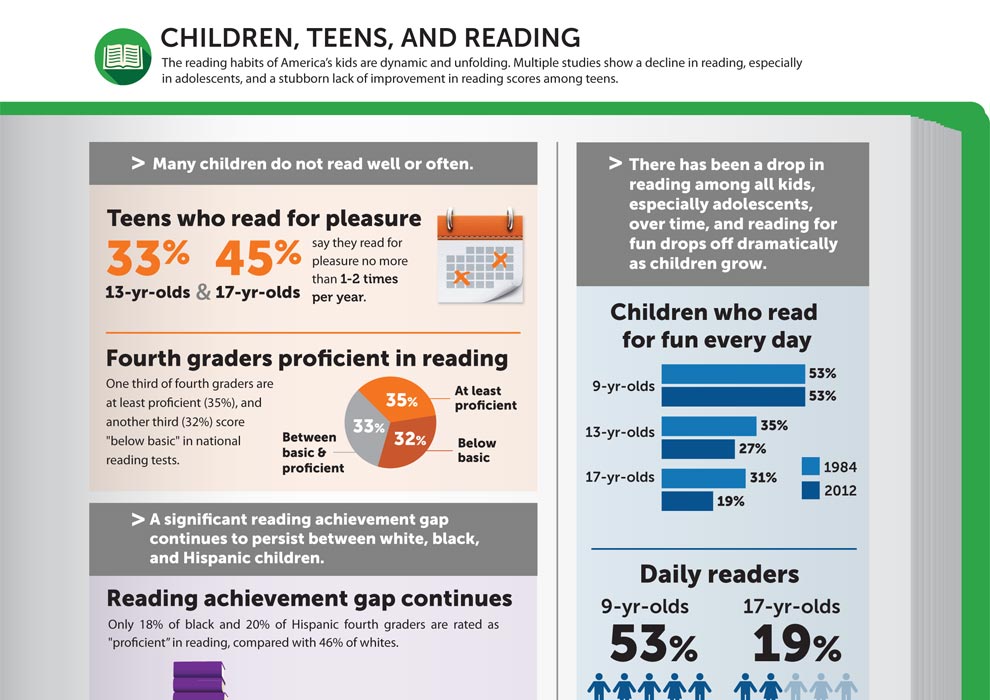 American children's reading habits and found a decrease in the percentage of students who read for pleasure. more
Clearly, educators' strategy of engaging their students by providing them with sensational and trendy reading material is not working.
It's true that decodable readers are not great literature, but they get the job done in short order, opening the door to all kinds of literary possibilities.
Instead of working so hard to motivate children to read, teachers should focus on giving their students the ability to read fluently.
Once this has been accomplished, there are hundreds of wonderful books, classic and modern, that will engage children by means of their enduring qualities.