
 Subscribe to our Blog


SCHOOL FOR THOUGHT
Myth Number One: Facts prevent understanding
In Seven Myths About Education, the first myth is that facts prevent understanding. The author begins by explaining how this myth grew up - past thinkers like Jean Jacques Rousseau, John Dewey, and Paolo Freire - who obviously did not have access to the scientific research of the last half-century.
"Rousseau, Dewey and Freire were wrong to see facts as the enemy of understanding. All the scientific research of the last half-century proves them wrong. The modern bureaucrats and educationalists who base policy and practice on their thinking are wrong too, and with less excuse, as they have been alive when evidence that refutes these ideas has been discovered."
In working to develop a machine with artificial intelligence, scientists had to understand human thought. They learned that the facts stored in long-term memory are crucial for cognition.
"Long-term memory is capable of storing thousands of facts, and when we have memorised thousands of facts on a specific topic, these facts together form what is known as a schema. When we think about that topic. we use that schema. When we meet new facts about that topic, we assimilate them into that scheme - and if we already have a lot of facts in that particular schema, it is much easier for us to learn new facts about that topic.
"Critics of fact-learning will often pull out a completely random fact and say something like: who needs to know the date of the Battle of Waterloo? Why does it matter? Of course, pulling out one fact like this on its own does seem rather odd. But the aim of fact-learning is not to learn just one fact - it is to learn several hundred, which taken together form a schema that helps you to understand the world. Thus, just learning the date of the Battle of Waterloo will be of limited use. But learning the dates of 150 historical events from 3000 BC to the present day and learning a couple of key facts about why each event was important will be of immense use, because it will form the fundamental chronological schema that is the bais of all historical understanding."
...............
"As we have seen, the popular Bloom's taxonomy suggests that knowing is a lower-order skill, while analysing and evaluating are higher-order skills. The metaphor of lower and higher skills leads to two false conclusions. First, it suggests that knowledge is somehow less worthy and important. A better metaphor than the lower/higher one is that used by E.D. Hirsch. He sees the relationship between knowledge and skills as being like a scrambled egg. You cannot unscramble an egg, and you cannot unscramble knowledge and skills. I also like th metaphor suggested by my colleague Joe Kirby, that knowledge and skills are like a double helix, progressing in tandem from surface learning to deep learning. Rather than characterising passive fact-learning as surface, and active skill-practice as deep, we should understand that knowledge and skills are intertwined, and that skill progression depends upon knowledge accumulation."
SCHOOL FOR THOUGHT
Seven Myths About Education
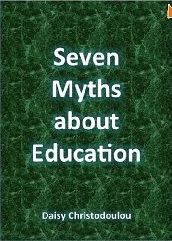 I'm reading Seven Myths About Education by Daisy Christodoulou. As well as being an experienced classroom teacher in England, Ms Christodoulou is an academic researcher with an impressive grasp of educational research. Let me continue in her own words (I can't give you page references because this is an e-book, sorry.)
"My central argument is that much of what teachers are taught about education is wrong, and that they are encouraged to teach in effective ways. After I had been teaching for 3 years, I took a year out to do further study. I was shocked to stumble across an entire field of educational and scientific research which completely disproved so many of the theories I had been taught when training and teaching. I was not just shocked, I was angry. I felt as though I had been misled.
"I had been working furiously for 3 years, teaching hundreds of lessons, and much information that would have made my life a whole lot easier and would have helped my pupils immeasurably had just never been introduced to me. Worse, ideas that had absolutely no evidence backing them up had been presented to me as unquestionable axioms."
In her book, Ms Christodoulou identifies seven myths that have so permeated the education thoughtworld that they exert an unconscious influence on virtually everything that happens in classrooms. Just as a company that has inculcated anti-profit beliefs in its employees is unlikely to succeed, so too do these myths make it impossible for students to achieve high levels of learning. I consider this truth so important that I plan to devote a blog to each of the seven myths over the next little while.
First up - Myth Number 1: Facts prevent understanding.
SCHOOL FOR THOUGHT
Quality Learning Approach
GUEST BLOG BY LEA HUBER
We live in Australia and I am writing to see if any of your readers know anything about the Quality Learning Approach. In the USA, especially Alaska, it is known as the Re-Invent Schools Coalition (RISC) and I suspect the QLA is a subsidiary of RISC.
We recently learned that a Quality Learning Approach was implemented in our grandchildren's school six months ago without parents being aware of it. I have not been able to find any independent evaluations of the approach within the school frameworks. Ultimately, the approach appears to focus on teacher satisfaction under the guise of students achievement. For example, the eight-year-old and upwards children are given worksheets at the beginning of each week in numeracy and literacy and instructed to work through them on their own. If they have any questions, they are to ask four peers before going to the teacher. The children are then required to self-assess their work. If they do not complete the work satisfactorily, they are required to do it at home on the weekends without parental support. To date, parents have been kept completely in the dark.
The whole concept raises numerous concerns regarding the psychological impact on students, monitoring and evaluation - not to mention community trust and involvement.
Do any of your readers know of any recent research that compares direct instruction with this teaching approach? If so, I would be most interested to learn of it.