
SCHOOL FOR THOUGHT

August 12, 2010 by .(JavaScript must be enabled to view this email address) at 06:55 AM
London education officials were thrilled by the huge turnout to their three-week summer literacy camp for kids who struggled with reading in grade 1. Clearly, it doesn't take much to make them happy! Click here for the story.
It's hard to say which is more depressing - the evidence of how many grade 1 kids are in trouble or the probability that they are being set up for a second failure. For the programs being offered at the summer literacy camp promise to be just more of the same, involving "items that can be used to help kids learn to read without all the work".
We'll say it again: these kids need to be taught how to read. It involves careful teaching and hard work. There is no royal road to learning.
August 11, 2010 by .(JavaScript must be enabled to view this email address) at 09:18 AM
If Alberta schools are looking for a way to lose their first place in Canadian school achievement, maybe this is how they will do it. This National Post article reports on a new program at an Airdrie, Alberta elementary school that would see grade two students picking their own major, essentially streaming young students into areas of their own interest. According the the school's principal, the goal of the program is to improve classroom engagement. If they need to do this in grade two, they have a bigger problem.
Apparently someone read Malcolm Gladwell's Outliers and thinks that this is how you go about getting 10,000 hours of practice. The problem is that the school has totally misunderstood the concept.
Children will be surveyed in kindergarten and grade 1, and along with parental and teacher input, will be placed in their area of interest. Frankly, from what I read in the Post article, this amounts to 10,000 hours of social indoctrination rather than making sure kids get 10,000 of reading and/or math practice. For instance:
"For the humanitarian/environment stream, for example, Grade 3 teacher Carla Pierce plans to teach graphing from a humanitarian perspective by having students chart various countries' wealth. A math class might involve an assignment in which children calculate waste accumulation, while a big-picture view will be provided by such guest speakers as the social-change organization Me to We."
As you would expect, parents are not happy with the proposed changes.
For homework, I'm assigning the school administration the task of re-reading Gladwell's Outliers chapter, Rice Paddies and Math Tests, about Asian students' math achievement. Success comes from hard work and 10,000 hours of practice, practice, practice in an extended school day, week, and year so that by middle school Asian students are ahead of their North American counterparts by at least a year.
August 11, 2010 by .(JavaScript must be enabled to view this email address) at 08:45 AM
Most people would probably consider it cheating if a student used his or her mobile device to find the answer to a question on a test. Not so this teacher. This blog posting argues that we should redefine cheating, since when a student is driven to look up an answer it's actually the teacher's fault - for not adequately preparing the student and/or for setting an inadequate test. Classrooms, argues this teacher, should not be "so focused on memorization and instead require deep, meaningful interactions with learning".
By extension, then, we should think it just fine if 16-year-olds are allowed to look up the answers for their driving licence test: after all, it doesn't really matter whether or not they know offhand what that big red octagonal sign means. Similarly, airline pilots can always check the manual to discover the emergency procedures when the plane suddenly starts to nosedive and brain surgeons can go to the reference library to find out what to do when they accidentally nick an artery.
The point is - there is a lot of basic information that needs to be hard-wired into our brains, accessible for instantaneous and automatic use. To suggest that we need to choose between memorization and meaningful learning is to present a false dichotomy, since meaningful learning cannot take place in the absence of memorized basic skills and knowledge.

August 10, 2010 by .(JavaScript must be enabled to view this email address) at 08:20 AM
I'm going to have to see a therapist about my addiction to poking fun at the teachers' unions. I know I'm sick, but it's so easy and fun.
Here's the latest, as explained by Jay Greene in his inimitable way. It concerns the US government's decision to take $26 billion out of its food stamps budget and give the money to the teachers' unions instead. The Milwaukee teachers' union apparently plans to spend their share on a prescription benefit for Viagra. So it seems it's not just the economy that's going to be stimulated!
August 09, 2010 by .(JavaScript must be enabled to view this email address) at 09:23 AM
The changes to Ontario's sex education curriculum made headlines last April, and as a result the controversial changes were withdrawn, but the rest of the curriculum revisions are going ahead as this CBC story explains. Ontario schools will be tackling, either for the first time or else at a younger age than previously, a number of delicate issues such as cyberstalking, alcohol and drug abuse, gambling, the use of defibrillators, and race-based violence.
It's hard to put my finger on exactly why, but much of this stuff makes me uneasy. Perhaps it's because I worry that kids will be losing their innocence too early and be exposed to issues they lack the maturity to process well. Maybe it's the realization that the new content will subtract even more time and emphasis from what is after all schools' fundamental mission of teaching academics. And, since it appears that most schools are not exactly doing a stellar job of teaching academics, I'm not convinced that the new material will be presented properly either. Topics like this need sensitive handling, and unfortunately I have noticed that the kind of teachers who are attracted to teaching this sort of stuff are not necessarily the people I would like talking to my own kids about it.
August 08, 2010 by .(JavaScript must be enabled to view this email address) at 01:02 PM
For some reason, this announcement from the Ontario government about the honour it is conferring on Leah Morris for her good work in promoting adult literacy reminded us of the following poem by Joseph Malins.
'Twas a dangerous cliff, as they freely confessed,
Though to walk near its crest was so pleasant,
But over its terrible edge there had slipped,
A duke and full many a peasant.
The people said something would have to be done,
But their projects did not at all tally.
Some said 'Put a fence 'round the edge of the cliff,'
Some, 'An ambulance down in the valley.'
The lament of the crowd was profound and was loud,
As their tears overflowed with their pity;
But the cry for the ambulance carried the day
As it spread through the neighbouring city.
A collection was made, to accumulate aid,
And the dwellers in highway and alley
Gave dollars and cents - not to furnish a fence -
But an ambulance down in the valley.
For the cliff is all right if you're careful,' they said;
'And if folks ever slip and are dropping,
It isn't the slipping that hurts them so much
As the shock down below - when they're stopping.'
So for years (we have heard), as these mishaps occurred
Quick forth would the rescuers sally,
To pick up the victims who fell from the cliff,
With the ambulance down in the valley.
Said one, in a plea, 'It's a marvel to me
That you'd give so much greater attention
To repairing results than to curing the cause;
You had much better aim at prevention.
For the mischief, of course, should be stopped at its source;
Come, neighbours and friends, let us rally.
It is far better sense to rely on a fence
Than an ambulance down in the valley.'
He is wrong in his head,' the majority said,
'He would end all our earnest endeavour.
He's a man who would shirk this responsible work,
But we will support it forever.
Aren't we picking up all, just as fast as they fall,
And giving them care liberally?
A superfluous fence is of no consequence
If the ambulance works in the valley.'
But a sensible few, who are practical too,
Will not bear with such nonsense much longer.
They believe that prevention is better than cure,
And their party will soon be much stronger.
Encourage them then, with your purse, voice and pen,
And while other philanthropists dally,
They will scorn all pretence and put up a stout fence
On the cliff that hangs over the valley.
Better guide well the young, than reclaim them when old,
For the voice of true wisdom is calling.
'To rescue the fallen is good, but 'tis best
To prevent other people from falling.'
Better close up the source of temptation and crime
Than deliver from dungeon or galley
Better put a strong fence 'round the top of the cliff
Than an ambulance down in the valley.
August 07, 2010 by .(JavaScript must be enabled to view this email address) at 12:12 PM
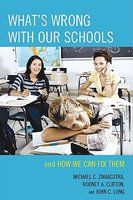
The latest addition to our lending library is What's Wrong with our Schools: And how we can fix them, by three Manitoba educators. The book is intended mainly for parents who know that their kids aren't doing all that well in school but don't really understand why. It's a very sane, commonsensical treatment of a complicated topic, full of been-there-done-that wisdom and practical explanations for parents who are scratching their heads over school practices that don't make sense to them.
Here's an excerpt from the chapter entitled "Direct Instruction is Good Teaching" (pp. 108-109)
"It is revealing that virtually all romantic progressive educators use direct instruction methods when they are trying to convince teachers to adopt their child-centered methodologies. For example, Alfie Kohn, one of the strongest critics of direct instruction, gives dozens of lectures every year trying to persuade teachers not to lecture. Why does he not abandon the lecture format when it is apparently so ineffective? The reason is obvious. Kohn only has a short time to convey his ideas and he realizes that the most effective way of doing it is in a formal presentation that he has composed and organized. Is it not somewhat ironic that Kohn condemns lecturing as an outdated teaching method while lecturing to his audience?
"What about the old-fashioned practice of lining desks up in rows so that the students are facing the teacher who is at the front of the classroom? Kohn also dislikes this practice. In fact, he claims that any classroom with desks in rows should make parents worry about the quality of the education their children are receiving. Moreover, he says that the classroom where rows of desks face the teacher encourages students to think that teachers are the only source of information and the only reliable interpreters of the subject matter. In his mind, students in these classrooms become passive rather than active learners.
"But when Kohn talks to groups of teachers, how are they seated? You've probably guessed correctly; the audience is facing him and hardly anyone is sitting in groups talking to each other. The same thing is true at most teachers' in-service sessions where teachers hear the new ideas about modern methods of guiding students' learning. Even when speakers are arguing against the old-fashioned methods, like direct instruction, the audience is almost always sitting in rows facing the speakers who are almost always standing on a stage. Obviously, everyone seems to accept that the speakers have something useful to say and the audience is expected to be quiet and pay attention to them."
August 06, 2010 by .(JavaScript must be enabled to view this email address) at 07:28 AM
On the front page of today's The Globe and Mail is this article about how kids learn more if they attend a year-round school. It seems that kids who have a two-month summer break forget more than kids who have only a one-month summer break. So does the Society for Quality Education favour the conversion of all schools to year-round status? Give us a break!
There are thousands of innovative ideas floating around, most of which will probably improve outcomes for some students. Here are a few ideas, just for starters: Chinese immersion schools, all-girls schools, hockey schools, traditional schools, special-needs schools, International Baccalaureate schools, Montessori schools, distance schools, science schools, technology schools, music schools, great books schools, computer schools, religious schools, self-study schools, remedial schools, Waldorf schools, late-start schools, and business schools. Of course, all of these options can be combined with other options, including year-round status. Schools should never be an all-or-nothing proposition.

August 05, 2010 by .(JavaScript must be enabled to view this email address) at 08:00 AM
The astonishing story of the Detroit car industry's comeback should come as no surprise to anyone who understands the power of competition. Sleepwalking their way through the latter part of the 20th century, the Big Three almost went bankrupt when foreign car companies started flooding North American markets with less expensive yet superior cars. But now they're back!
I don't want to belabour this, but there is a lesson here for education reformers. Canadian publicly-funded schools are still being allowed to sleepwalk, and their service is mediocre and expensive as a result. Just as the Detroit auto-makers were originally protected from competition by tariffs and distance, Canadian publicly-funded schools are still being protected from competition by virtue of their full funding. If all parents were able to choose a non-public option (just as car-drivers were able to choose a non-Detroit option), their children would be better off and the public schools would improve as a result of the competition. As long as the publicly-funded schools continue to enjoy a virtual monopoly, they are unlikely to improve.
To say that publicly-funded schools must be protected from competition betrays a lack of confidence in public educators.
August 05, 2010 by .(JavaScript must be enabled to view this email address) at 07:07 AM
Looks like the KIPP charters school in Washington DC are getting strong support from the private sector. This Washington Post article reports on a $5.5 million donation from Venture Philanthropy to expand the schools.
School for Thought has posted on KIPP's success with low-income students. The KIPP program is committed to extra learning time and strong standards. According to Malcolm Gladwell in his book, Outliers, KIPP tries to change the culture of learning.
Page 3 of 4 pages < 1 2 3 4 >

 Subscribe to our Blog

