Donate now

Privacy Policy

Protection of privacy is our first concern, and SQE does not sell or trade information provided by its subscribers or supporters. Your information is used to process donations and newsletter subscriptions, and to contact you about upcoming publications and events.

feed iconRSS Feed

Follow Us
Follow SQESocQualEd
on Twitter

Please note Downloads require you to have the Adobe Reader installed, you can get it here for free Adobe.com


Society for Quality Education

Subscribe to our mailing list

Seven Myths About Education

August 02, 2013 by .(JavaScript must be enabled to view this email address) at 06:18 AM

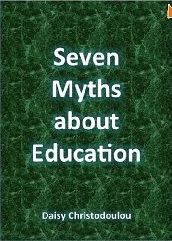
I'm reading Seven Myths About Education by Daisy Christodoulou. As well as being an experienced classroom teacher in England, Ms Christodoulou is an academic researcher with an impressive grasp of educational research. Let me continue in her own words (I can't give you page references because this is an e-book, sorry.)

"My central argument is that much of what teachers are taught about education is wrong, and that they are encouraged to teach in effective ways. After I had been teaching for 3 years, I took a year out to do further study. I was shocked to stumble across an entire field of educational and scientific research which completely disproved so many of the theories I had been taught when training and teaching. I was not just shocked, I was angry. I felt as though I had been misled.

"I had been working furiously for 3 years, teaching hundreds of lessons, and much information that would have made my life a whole lot easier and would have helped my pupils immeasurably had just never been introduced to me. Worse, ideas that had absolutely no evidence backing them up had been presented to me as unquestionable axioms."

In her book, Ms Christodoulou identifies seven myths that have so permeated the education thoughtworld that they exert an unconscious influence on virtually everything that happens in classrooms. Just as a company that has inculcated anti-profit beliefs in its employees is unlikely to succeed, so too do these myths make it impossible for students to achieve high levels of learning. I consider this truth so important that I plan to devote a blog to each of the seven myths over the next little while.

First up - Myth Number 1:  Facts prevent understanding.

Share this article

Comments

POSTED ON BEHALF OF DOUG

Nothing wrong with facts. Facts are a foundation but facts ONLY is a BIG problem.

Having read the book, they only one I basically disagree with is # 6 Projects are the best way to learn.

I would be happy to call it “projects are a critical or very important way to learn.” it doesn’t have to be ‘best way’.

Again, projects are important. Projects alone or projects overwhelmingly is a mistake.

There is some yin and yang to this whole thing you know.

Posted by Malkin Dare on 08/02 at 12:31 PM

There has been a lot of criticism and debate within the education establishment on the Seven Myths About Education and the author Christodoulou, herself gets a fair share.

On her blog, Christodoulou states - ” First, I try to explain clearly the theoretical evidence behind this myth. Second, I show the practical implications of the myth, and I show that such practice is prevalent in English schools today. Third, I explain why it is a myth. In the days before publication I will be giving a short summary of each chapter. Here are all seven.” - See more at: http://www.thecurriculumcentre.org/blog/2013/06/10/seven-myths-about-education-introduction/#sthash.svJYHaT0.dpuf

Now onward to the education and teacher blogs - My my, all this to avoid the discussion of the actual content of the book, the myths (to which the education establishment disputes) and the missing ingredient - the cognitive science and education research that completely disproves much of the educational theories on the go.

“There has been a lot said in support of Daisy Christodoulou’s book Seven Myths about Education, which has recently rekindled the old traditionalist/knowledge vs progressive/skills debate and has led to, depending on whose blog you read, many pointless or productive discussions (here’s what I think). I just don’t think the premise upon which she establishes her myths holds any water. I should better attempt to explain myself.”
http://www.josepicardo.com/2013/07/seven-more-myths/

The next one is using the old trick of - one must consider the time era of the education philosophies, the inequities of the historical period in question, while quietly dismissing the cognitive sciences and education research of the 21st century that disproves the 19th century education philosophies, to reinsert and reinforced the pedagogy and current education philosophies rooted in the 19th century in order to dismissed the Seven Myths about Education.

http://debrakidd.wordpress.com/2013/07/06/7-myths-about-education-an-alternative-view/

The comments are of interest, that attest to either the blindness of the classroom educators that they have seen no evidence of Christodoulou’s seven myths in the classroom, or the intolerance of the education establishment of being critical when looking within the education system on education theories, practices and pedagogy.

Posted by Nancy on 08/02 at 01:33 PM

Dear Nancy,

Thank you for including my post alongside Debra’s in your comment. Debra’s is by the way much better informed, cogent and persuasive. Mine is more rushed and only questions the existence of the myths prior to reading the book that justifies them.

I have no doubt that Daisy’s book is indeed a valuable read. My post (I cannot speak for Debra) simply aimed to draw attention to the fact that one could make up any myth and then find find arguably anecdotal evidence (Daisy is indeed a sharp educationalist with an incisive eye for all matters educational, but she only taught for three years prior to moving on to policy advising) and expert opinion to back them up.

She also appears to contradict herself sometimes. For example, her myth seven says “Teaching knowledge is indoctrination” and she then writes in support of teaching knowledge and facts, yet she then regrets the fact that when at university “ideas that had absolutely no evidence backing them up had been presented to me as unquestionable axioms”. So I suppose it depends whose knowledge is passed on then. You can see how incredibly political and polarising this debate can become. 

We must also remember that Daisy is a former University Challenge champion. Memorising facts works for her. She’s really, really good at it. It works for her. She’s an astonishingly successful learner and person on many levels. But that doesn’t mean that it would work for everyone or that educational policy ought to be based on it. I think the short time she spent in the classroom before moving on to policy making and having found expert support (almost patronage) in Hirsch may have led her to believe that the seven myths she expounds actually exist. I disagree, as you noted in your comment.

My own teaching style - which works very well and produces not only very good exam/academic results but also learners who develop a life-long interest in languages (my subject) - is more constructivist-influenced, although I don’t really like such labels. I also learn best this way, which probably isn’t surprising. Because it works for me. I find hands-on, collaborative, project-based, and task-based learning produce the most successful outcomes. Because it works fin my classroom. But that doesn’t mean I think it would work best in everyone’s classroom.

Therefore I’m sure I will take away many valuable insights from reading Daisy’s book but I have reasons to believe I will not have a road to Damascus moment. In the meantime I’ll work on trying to be less blind and intolerant. And I will not - not for one moment - make any assumptions as to what your own shortcomings might be.

Best wishes

José

Posted by José Picardo on 08/04 at 12:33 PM

Dear Nancy, you misquote and misunderstand me. Your myopic interpretation did amuse though.

Posted by Debra Kidd on 08/04 at 02:35 PM

Dear Debra and Jose,  I chose your blog articles for the reason for the content, which was not filled with over the top rhetoric on Christodoulou and her new work on The Seven Myths of Education.

Both Debra and Jose, clearly defines themselves as progressive educators, that stand on the side its all about the SES variables of students. Jose, in one of his blog posting, he concludes - “.Optional languages in the state sector are not the cause of a relatively poorer education, but rather a symptom of a wider malaise. If the wealthier pupils are perpetuating their own cycle, the state sector is also perpetuating a self-fulfiling prophecy in which pupils from less fortunate backgrounds are denied the opportunity to improve their socio-economic standing.”
http://www.josepicardo.com/2010/08/the-languages-class-divide/

Debra Kidd, I let the Channel 4 newscast do the talking - “Debra Kidd on Channel 4 News while Michael Gove is “…behaving like a child…”
http://www.natd.eu/debra-kidd-on-newsnight-while-michael-gove-is-behaving-like-a-child/

Its obvious, both Debra and Jose have presuppositions of how children learn,  that represents the truth of the progressives.  Its really about rekindling the old wars of the progressives and the traditionalists based on the 19th century knowledge matrix by implying the 21st century knowledge and research in the learning and cognitive sciences has no place in the 21st century schools. Ergo,  Daisy Christodoulou. joins the legions of all shapes, sizes and of wanting the progressive public education system to join the 21st century matrix of knowledge, and where all children will reached their full academic potential.

On another blog called Critical Reader - “Christodoulou makes the point that when students do nothing but project-based group work, they are effectively restricted to topics already familiar to them because they have not actually been taught anything new. Moreover, when they attempt to research new topics without having the necessary background knowledge or the vocabulary to filter what information is relevant, accurate, etc., they end up either confused and frustrated or flat-out misinformed. (Christodoulou cites one student who, assigned to write a report on the life of Dickens, confused the author’s life with that of Pip, the protagonist of Great Expectations—I realize that sounds impossible for anyone who hasn’t worked with with weak readers, but trust me, I’ve seen kids fall prey to similar types of confusion. After the first five or six times, I stopped getting surprised.) “
http://thecriticalreader.com/blog/itemlist/tag/Daisy Christodoulou.html

Myopic interpretation?  I tend to get hard-headed when the overly political and progressive education system embedded in the 19th century knowledge matrix, are declaring using authoritative expressions, that simply dismisses the 21st century cognitive and learning sciences, its research and the development of education practices outright. The authoritative expressions rooted in the 19th century education knowledge matrix are reinforced by the practitioners of the progressive school of thought, that are offering the old education practices and solutions with new window dressing of the 21st century, without the 21st century knowledge matrix.

Debra Kidd on the Channel 4 newscast, dismisses outright the assessment of children regarding phonemic awareness. Will Debra Kidd dismissed the outcome data streams regarding low literacy levels and the vast majority of the dyslexic students that sit at the bottom of the achievement charts? It would appeared she would, since she is obviously against assessing for phonemic awareness based on nonsense words. Pray tell, how else would one test for phonemic awareness without using the learning and science research of the 21st century that was absent in the 19th century knowledge matrix? 

If Daisy Christodoulou is so wrong, why haven’t the progressives advanced their arguments based on the students who have not been well-served by the progressive education system rooted in the 19th century knowledge matrix of pedagogy practices and education philosophies. I leave off with an example, that illustrates the 7 myths and their existence in the classrooms. If the 21st cognitive and learning sciences were present in the classroom, we would not be having this conversation.
http://www.dailymail.co.uk/news/article-2224101/James-Middleton-How-I-battled-crucifying-dyslexia-read-Kate-Williams-wedding.html

Note: James Middleton had some advantages that are not afforded to students in the progressive public education system. Also note, in the typical education model,  immersed in progressive education policies and pedagogy practices rooted in the 19th century knowledge matrix, the learning struggles of students are rarely identified using the 21st century methods based on the cognitive and learning sciences.

Posted by Nancy on 08/05 at 09:16 AM

Ah Nancy, you were doing so well, and then you go and quote the Daily Fail. Dear oh dear. Such is the quality of your “evidence”.

Watch this TED video which highlights in the opening seconds just how reliable the Mail is http://www.ted.com/talks/ben_goldacre_battling_bad_science.html

If you like comedy (I’m not sure whether you do just from reading your rather dogmatic comments….) you might enjoy this one too

http://www.youtube.com/watch?v=UPEzM2oV-PY

By the way, Daisy is not so wrong, she’s just not that right either.

And also, did you just try to insult me by calling me progressive? How very dare you? wink

Posted by Jose Picardo on 08/05 at 09:38 AM

Oh, Nancy. I dismissed the practice of testing phonemic knowledge through nonsense words when children actually from deprived backgrounds sorely need to boost real vocabulary. I support phonics as part of a reading strategy - particularly synthetic phonics. Could you also please point to any article either by me or about me that says I am a progressive? Unless of course, you mean that I believe that children have the right to high quality education which is structured to suit their needs? You really need to read more closely before writing. I’d also point it that using the Daily Mail as evidence is somewhat akin to quoting the National Enquirer!

Posted by Debra Kidd on 08/05 at 10:30 AM

Part 1

One would think being called progressives would not be a slap in the face, but who knew? A quick Google search, would progressives preferred to be called progressive postmodernism pragmatists? One educator, James M. Kauffman (born December 7, 1940 in Hannibal, MO) is an American who has made significant contributions to the field of education, specifically special education. He has authored or co-authored several books and many journal articles in the fields of special education, education reform, child psychology, and child development and has served in various editorial capacities.”  http://en.wikipedia.org/wiki/James_Kauffman

One book he has written is called - Education Deform: Bright People Sometimes Say Stupid Things about Education   http://books.google.ca/books?id=pjF2CzkG_UkC&pg=PA281&lpg=PA281&dq=progressivism+postmodernism+in+education&source=bl&ots=wSnk3wNb1T&sig=cs655wkcgkbyaY114AL5VxIMoRo&hl=en&sa=X&ei=xcwAUujlD-nkyQHB-YDgCg&ved=0CGgQ6AEwBzgK#v=onepage&q=progressivism postmodernism in education&f=false

He has a few things to say about the education establishment dismissing the cognitive and learning sciences outright.  There is quite a few educators that are well positioned within the public education system, that are quietly working away, to eliminate the toxicity within the public education system, that prevents learning and steady achievement. for all children. Daisy Christodoulou joins the ranks of a small but growing, distinguished body of educators within the public education system who are determined to bring in evidence-based practices based on the sciences of learning and the cognitive fields in the classrooms across the globe.

Debra, I have indeed read your bio, the education consultant company that you are associated with, and of course your articles and papers that you have authored. I do that as a matter of course, because as a parent I have been burned more times than what I would like to admit by the politics, the progressive education philosophies of many versions of the same kind, and the classroom pedagogies bordering on religious dogmatic fever in its implementation, without concern of the future outcomes of the students.

That said Debra, a child needs both phonemic awareness and vocabulary are essential components to learned to read, and vocabulary takes on a prominent importance starting in grade 4. Of course, no doubt Daisy’s book will speak of it, but I be leaving links at the bottom on the world’s top researchers in the science of reading and learning. I am no expert, but I was forced down this pathway because of a public education system who had refused to correct my child’s reading, writing and numeracy problems, and if not for my advocacy, would not be entering university this fall. Far too many children of different sizes and shapes have become victims of a public education system who are loathe to come out of the 19th century and into the 21st century.

Children of the Code - it will take you a year to combed the research and the science. The front page - http://www.childrenofthecode.org/

Children of the Code, was a lifesaver for me, and lucky for me it made its debut in 2003.

Dr. Keith Stanovich - Cognitive Science: The Conceptual Components of Reading & What Reading Does for the Mind  
http://www.childrenofthecode.org/interviews/stanovich.htm

I took the time, to dig up the article of Stanovich and Cunningham.  Quite the read, and an eye opener for classroom educators.
http://www.aft.org/pdfs/americaneducator/springsummer1998/cunningham.pdf

Dr. G. Reid Lyon - Converging Evidence -  Reading Research
What It Takes To Read    
http://www.childrenofthecode.org/interviews/lyon.htm

Posted by Nancy on 08/06 at 09:01 AM

Part 2

On Stewarding Healthy Learning web site, a sister site to Children of the Code, should be sufficient to give Debra and Jose pause, and perhaps reread Christodoulou’s book with a new perspective and insight. That is if they truly want ALL children to have a quality education that includes knowledge, skills and abilities that enables and prepares the students for their young adulthood, and throughout their life.

The Front page - http://www.learningstewards.org/

What does it mean that most of our children are CHRONICALLY IMPROFICIENT in the skills most critically important for success in school?
http://www.learningstewards.org/what-does-it-mean-that-most-of-our-children-are-chronically-improficient-in-the-skills-most-critically-important-for-success-in-school/

What is Reading?
http://www.learningstewards.org/what-is-reading/

Higher Vocabulary ~ Higher Intelligence ~ Higher Income = Reading Matters
http://www.learningstewards.org/higher-vocabulary-higher-intelligence-higher-income-reading-matters/

As for the Daily Mail - I could have used other sources, since it was big news across the globe in the dyslexia circles. My point was and still is that the current education practices and policies of the education system steeped in the 19th century knowledge and pedagogy matrix, all dyslexic children should be formally identified at grade one, and not at the age of 11. But James Middleton is one of the lucky ones, because he did get identified….........the vast majority in Canada and the other Commonwealth countries do not get formally identified. Progressive practices and pedagogy rooted in the 19th century is a guarantee and a curse to children who are born with the dyslexia gene.  How classrooms from coast to coast can missed the dyslexic signs of primary students is beyond me. I am quite happy to send the hard copies of my youngest child’s work of the primary grades, as I have done in the past to other educators.  http://www.helpingeverychildtoread.com/index.php/success-stories/famous-dyslexics/entrepreneurs/item/james-middleton

Of course, there is always the 40 year old dyslexia organization in merry old England, who is still plugging away of trying to improved the academic lives of the identified and unidentified dyslexics in British schools.

http://dyslexiaaction.org.uk/files/dyslexiaaction/dyslexia_still_matters.pdf

And the home web site - http://dyslexiaaction.org.uk/

Now as for the sense of humor, I certainly do have a keen sense of humor, and some would say - the dry wit of the British. However, I reserved it when it comes down to the serious business of educating children in the 21st century, in a public education model steeped in 19th century education practices that still writes off children as academic or non-academic. There is nothing remotely humorous about children struggling in learning in today’s schools, nor the dismal future academic outcomes of children and their lives in the public education model.

Posted by Nancy on 08/06 at 09:02 AM

I could not resist, and its in the defense of knowledge and people like Daisy, who have excellent memory processes. After all, the top achievers in any classroom will have two things in common. Excellent memory processes along with excellent to good reading, writing and numeracy skills. They also do academic tests very well, Its a good thing, the public education schools will have approximately 30 % of students of this type, and as such does school very well. Its very difficult to transformed the other 70 % into stellar students using progressive methods rooted in the 19th century.

Laura Snyder: The Philosophical Breakfast Club
http://www.ted.com/talks/laura_snyder_the_philosophical_breakfast_club.html

Ken Jennings: Watson, Jeopardy and me, the obsolete know-it-all
http://www.ted.com/talks/ken_jennings_watson_jeopardy_and_me_the_obsolete_know_it_all.html

Posted by Nancy on 08/06 at 05:18 PM

Did not read the book nor will I.  English system - have family there - discuss the differences between the two systems in detail at dinners etc.
SEE this is anecdotal evidence also know as a “man who statistic”.  I knew *a man who* drank from sunrise to sunset and smoked a pack a day and lived to 100 years spry and fit to the last day .

I do know that a inner city school that I was a staff member of hosted a large contingent of teachers and administrators from England .  They came to learn from us .  They wanted to know how we over come the same sort of socio-economic hurdles that their students face and get the results that we do.  I was one of the lead organizers for their day long visit and they were absolutely astonished on the level of student engagement, the sense of community, and measurable success parameters.

Canada, and even Ontario has some real skin in the game!

cheers.  Mirka

Posted by Mirka on 08/06 at 07:13 PM

Leave A Comment

Be polite and respectful. Stay on-topic. State your position clearly and write succinctly. Provide support for claims. Don't hog the microphone. Strong opinions are OK, but outrage is not. Don't post just to upset others.

Name:

Email (required but not displayed):

Emotions

Notify me of follow-up comments?

Submit the word you see below: