Donate now

Privacy Policy

Protection of privacy is our first concern, and SQE does not sell or trade information provided by its subscribers or supporters. Your information is used to process donations and newsletter subscriptions, and to contact you about upcoming publications and events.

feed iconSubscribe to our Blog

Follow Us
Follow SQESocQualEd
on Twitter

Please note Downloads require you to have the Adobe Reader installed, you can get it here for free Adobe.com


Society for Quality Education

The Roots of Public Education Failure
The Roots of Public Education Failure
January 24, 2011 by .(JavaScript must be enabled to view this email address) at 10:25 AM

Things have been a little quiet around here lately, and so I thought I would try to shake things up by writing something controversial. Today, I want to talk about how and why public education is failing so many students, despite the many caring and hard-working educators who work in it. My hypothesis is that it's the fault of the centrally-planned nature of public education.

This long-but-fascinating article explores the theories of a Nobel-prize-winning economist most people have never heard of - F. A. Hayek - who argued that central planners' interventions lead towards totalitarianism. If you don't have time to read the whole article, be sure to at least read "The Pretence of Knowledge", "The Synoptic Delusion", and "The Abstract Order". Here's an excerpt:

"Intellectuals were under a dangerous self-delusion that mastery of our social and economic life lay in their grasp. Deeply-troubled by what he saw, Hayek set out to expose the rational-sounding claims of the salivating planners for what they were, the oldest scam in marketing: bait and switch. Planners promised a world in which the public's needs and desires would be satisfied more efficiently and with less waste and human misery than ever before. The reality, Hayek knew, would be that people's lives would be planned to satisfy the needs and desires of the planners, and that ultimately, if left unchecked, the economic waste and the loss of economic freedom would be devastating."

I suggest that the more education systems are centralized, the more unresponsive, wasteful, and ineffective they become.

Comments

You must have mental telepathy, Aunt Malkin.

Bigness, bureaucracy and schools have been with us in Canada since the days of Egerton Ryerson. Indee, it a core theme in my upcoming book.

You and your commenters would likely find this recent post of considerable interest:

http://activehistory.ca/2011/01/bigness-bureaucracy-and-schools-what-can-we-learn-from-history/

Yes, you can trace it back to the origins of our own school system.

Posted by Educhatter on 01/24 at 02:53 PM

“What first made Hayek a household name in opposition circles was his clear-eyed analysis of the dynamic of totalitarian society, how it can begin with the best of intentions to reconstruct society for the greater good of humanity and end up enslaving humanity in the service of society’s worst elements.”

A prime example is the public education systems, especially in Western countries, Economists of today, are taking a special interest in public education systems and their structure. More importantly, the philosophy that lies underneath is the same that lies behind socialism and communism. How it has permeated into all areas of education, to where today only a fraction of the students are well-rounded students with a solid foundation of the basics, to which knowledge can blossom. Another aspect of a centralized education system, is the lack of development of critical thinking skills for students that leads to good thinking skills.

I believe what Hayek has stated in his theories, that socialism is very destructive, because it ignores the individual in favour of the group. It forces individuals to think as a collective where opinion becomes facts, and facts become useful only to support the many different opinions. Where policy decisions are based on ideology, personal opinion, subjective thinking that leads to faulty decision making. Within the public education system, it is evident through every aspect of education.

“Pseudo critical thinking is more or less inevitable in the educational bureaucracies, given the way we have traditionally arranged and ordered things. This is illustrated, as we have seen, in the way the American educational establishment goes about designing assessment. Unfortunately, faulty assessment leads to faulty teaching, which leads to more faulty thinking in society, in business, in politics, and in everyday social life. The California Department of Education is a model case of American educational bureaucracy at work and the new California reading and writing assessment instrument is the typical resultant bad practice. Good thinking is now a fundamental human need. And though it will take generations to fully evolve from a society in which pseudo critical thinking is dominant to one in which sound, fairminded, ethically-informed reasoning is dominant, every step in that direction will reduce the amount of suffering and injustice that exists and increase, by degrees, human well being and quality of life. It is our intellectual and moral responsibility to make some contribution to this evolution. Though we are only at the beginnings of this evolution, the irresistible dynamic of accelerating change and intensifying complexity will eventually force it upon us. I hope we learn our lessons sooner rather than later, that the price of waste and unnecessary human misery may be as little as possible.”
http://www.criticalthinking.org/articles/pseudo-ct-educ-establishment.cfm

Posted by Nancy on 01/24 at 08:20 PM

It is interesting to see the assumption that proletarian societies had proletarian school systems.  Here is a link to an article about an elite math and science school that was founded in the former East Germany:  http://www.dw-world.de/dw/article/0,,1658722,00.html

Remember, the Eastern Bloc countries knew they were falling quickly behind the West in terms of science and technology - and they were doing all they could to catch up.  Germany provides an interesting point of comparison between the two educations systems - the democratic west, and the planned east.  Here is an interesting quote from the article:

“The shock of the first PISA results in 2000 still sits deep in Germany. The home of some of history’s greatest scientists and mathematicians—Alexander von Humboldt, Albert Einstein, Werner von Braun—was wallowing in mediocrity. The university revolt of the 1960s which swept across West Germany resulted in watered-down, less-strict educational standards.

That revolt never hit the GDR. Now people wonder if something can be learned from it.”

In other words, our egalitarian, progressive, western education system created the watering down effect.  The planned, rigid, centralized education system of the east didn’t allow that to happen.

What does all this mean for your thesis?  Well, schools are not a hotbed of communism - neither are the unions.  We have a democratic society that has devolved down to the simple appeal of the lowest common denominator - whatever will get them votes.  As long as that is the case, you will continue to see a weak, effete and aimless education system that appeals to all and to no one at the same time.

Posted by Wayne Scott Ng on 01/24 at 09:44 PM

Finnish Autonomy = Results

There are a number of reasons Finland scores so well – highly trained and revered teachers, less time in the classroom, etc.  Please see this week’s special report to CBC news from Robert Smol just back from Finland.

Another reason for good performance is the autonomy local schools and school boards have to spend as they see fit. 

“You have to follow the national core curriculum but how you do it, whether you want more teachers or more computers, is a local decision on the part of the school board.”

Read more: http://www.cbc.ca/canada/story/2011/01/21/f-vp-smol.html#ixzz1C23lLO4t

That certainly fits in with the observations of Malkin about the problems with central planning and bureaucratization. 

The reason Alberta does rather well is because school-based management applies.

And the reason New Zealand does rather well is because each school has its own individual school board – school based management again.

Posted by Tunya Audain on 01/25 at 02:20 AM

If you want to generate more discussion here may I suggest that Doretta post more often. Looking back at the posts that generated lots of responses Doretta’s have done so. I think it’s largely because she writes a bit differently. 

I also think with provincial elections on the horizon for many provinces including Ontario opening up discussion to the truths and spin about what’s what and who’s who on that score would relate more to those things we have a hope in changing rather than lingering on those issues that in Ontario aren’t on our radar or that of any political party coming in to the next election.

Posted by Chuck on 01/25 at 11:24 AM

p.s. I should add that I do appreciate Malkin’s links and comments but the whole discussion at pretty much all of the education discussion blogs these days is a real turn off when the discussion centres around simply linking to more studies by more experts when seriously the real life experiences in Ontario at least aren’t on discussion radar.

Where did everyone go? Could be another cyclical thing I suppose but one would think that if the system were so broken that we’d be hearing more of an outcry. Can we assume that governments are doing a great job of papering over what’s really wrong with the system, or are the reform groups losing focus?

Posted by Chuck on 01/25 at 11:32 AM

“Education reformers” can tinker around the fringes forever, debating nuances and policies and strategies and so on; yet after all that effort, nothing significant will change. OR, they can swallow their fear, do the research themselves, and mentally face the true elephant in the room: the fact that many—most?-‘education people’ are invariably socialist/communist type thinkers—whether or not they themselves even realize it! That’s how deeply these ideas have permeated our society, by the ‘back door’, as it were.
There are even enough so-called ‘reformers’ who are true believers in collectivist ideas—the very ideas which are poisoning our children’s souls.

The scoffers will scoff, but that’s where the true dividing line lies: between those who espouse these ruinous ideas, and those who fight against them. The dividing line is not between so-called “education establishment” people and “education reformers”.

What else can you think, when the TDSB itself TELLS YOU it is teaching your kids, my kids, “Social Justice”? What does that mean? Does anyone care to investigate?
Here’s what it says at http://www.tdsb.on.ca/_site/viewitem.asp?siteid=15&menuid=32838&pageid=27956
“The term Social Justice hasbeen defined in various ways and for various ends. According to the TDSB SocialJustice Action Plan, “Social Justice is a specific habit of justice that isbased on concepts of human rights, equity, fairness, and economicegalitarianism….Social justice is, in plain terms, the movement towards amore socially just world through the actions of a group of individuals workingtogether to achieve its goals.”
Much important work has been engaged in order to help students understand theirplace in their community and in the world through engaging students in what isdeemed to be social action. More work, however, needs to be done in workingwith marginalized communities locally and globally. Questions arise as to howthis can be done most effectively, particularly when work fosters and is drivenby sympathy and charity rather than solidarity and support. Focus needs to beplaced on addressing structural and systemic issues that contribute toinjustice, and on working with communities in order to address and redressthose injustices. “

Sounds benign, right? That’s what they want you to think. But it’s not. Google reveals much, or here for instance is one example from many possible. Van Jones, recently of the White House, explains the term in his own words:
http://www.therightscoop.com/van-jones-explains-social-justice

I believe that the reason many children are failing is that their minds, encountering this vicious poison, fall into turmoil and despair. They realize on some level of their being that what they are being told is lies and hatred encoded in another form; yet they lack the knowledge, experience, and authority to analyze, understand, and reject what they are being fed.

Hence they close in, shut off, sink or slink away; and victory is gained over more souls.
The schools are engaged in relentless indoctrination of young people, not education; I have witnessed this first hand with my own two children. Yet no one seems to even notice this or particularly care.

How’s that for controversial?

Posted by Paul on 01/25 at 02:04 PM

Paul,

I’m sorry - controversial is one thing, conspiracy theory is another.

People on this site like Nancy, Jo-anne and many others have clearly made the case that when students do not a good grounding in the basics - literacy, numeracy, grammar and so on, then they will, in your words, “:..  fall into turmoil and despair.”

You can believe as you will.  I can tell you, from talking to teachers all over the province for the last 25 years, there is no communist take over plot.  You may feel that,”...‘education people’ are invariably socialist/communist type thinkers—whether or not they themselves even realize it!” 100%, categorically untrue.  Sorry.

Are there some teachers who are socialist or communist believers?  Sure. in fact, the best example is one Doug Little.  He prided himself on his leftist thinking.  However, on dozens of threads on this site many people took him to task for not speaking for the average teacher.  Some even used the term ‘outlier’ to describe Doug and his views.  You can’t have it both ways here - either Doug is an outlier or the norm in your view.  The people on this site will have to begin to decide what they want.

They have given us many articles about the importance of every child receiving a good grounding in the basics.  Now, they want to go out in ‘left’ field with a whole new theory of why our children are failing.  (Sorry - couldn’t resist the pun wink)

Posted by Wayne Scott Ng on 01/25 at 03:14 PM

I bumped into this a while back, and how the origins of social justice came into being within the public education system.

It is called Freiran Pedagogy. 

“While reminding that Paulo Freire was born and grew in extremely poor circumstance, and that he wrote Pedagogy of the Oppressed to educate those who had suffered from poverty economically, ignorance intellectually, exclusion politically and culturally in Brazil, we can say that it might be a good chance to plant the seed of a new perspective for liberation through education all over the world. However it cannot be ignored that he and his perspective on education were expelled together from Brazil in which both of them were born and developed. Ironically Paulo Freire was welcome by the other countries like Chile, Mexico, Guinea-Bissau, the United States, Canada, the WCC (Switzerland), England, etc. And his radical thought on educational transformation has challenged other social terrains which necessarily require to be transformed.”

Sounds great eh?  The real bad part is to have people either worked against their best interests or to maintained the social/economic structure.

“In North America, Europe and Australia, new social movement which is proposing “war of position” within civic society has adopted Freire’s educational thoughts as both theoretical and practical strategies. Those who are participating in new paradigm of social movement since 1960s have problematized existed social relations between men and women, rulers and citizens, adults and children, teachers and students, the rich and the poor, the White and the Black, employers and employees, and oppressors and the oppressed. The most important issue among them is equity. The industrialized societies in the Western became realized the mystification of economic development which was the only aim to be pursued so far. Compared to Latin America and Africa in which Freirean pedagogy would be emphasized for breaking away from both political and economic oppression, the industrialized societies tend to adopt Paulo Freire as a tool for political empowerment. “

http://web.gseis.ucla.edu/~pfi/PF-Freirean_Pedagogy.html

PDF file - Demystifying Pseudo-Freirian Development:
The Case of Laedza Batanani

http://legacy.oise.utoronto.ca/research/edu20/documents/demystifying pseudo freirian development ross kidd 1982.pdf

“This mobilizational, educational and collective action process required a new approach to non-formal education. The organizers rejected the existing approach of merely providing services and information; they felt this reinforced dependence and individualism rather than encouraging self-reliant and collective action. They wanted to get
away from the elitism of agricultural extension services, finding a means of involving
all rural villagers and not just the wealthier farmers or cattle-owners.1 They also saw this as an opportunity for a collaborative inter-agency approach—a positive move away from narrowly sectoral programming and lack of co-ordination and co-operation among extension workers.2.”

In this case study dated 1982, “Although it started as an attempt to develop popular education
organized by rural villagers themselves, it has become on the whole just a new gimmick
for top-down message-oriented campaigns run and controlled by government extension
departments.”

Even though the above study is an older one, much of what is being across the world in social justice is not to educate people in the third world, or for industrialized countries to help those who cannot, but Freiran process is to maintain the power structure by controlling the information flow and knowledge. In North American education systems, the Freiran processes falls in neatly with the socialism ideology, and unions, ministries, boards have strong control over the social justice agenda.

Can’t have parents volunteering to teach the reading process, or even basic arithmetic facts,

“Unions have a long history of promoting justice. The B.C. Teachers’ Federation, for example, engages in many social-justice initiatives that “focus on poverty, child and youth issues, race relations, gender equity, homophobia and heterosexism, bullying, environmental issues, globalization, and violence prevention,” as well as on aboriginal education.

The task for progressives is to condense social-justice programs into a frame that can be clamped onto education and can challenge the hateful rhetoric of the Glenn Becks of the world..”
http://www.rabble.ca/news/2010/05/war-public-schools-rages

The only trouble with the teachers’ unions is that their social justice is used as a tool to keep their political power and influence. They don’t much care about social justice and if any of their programs are effective. Nor do they care if one child or many are poor readers. as along as the children followed the social justice menu, and not one of freedom and individualism.

Posted by Nancy on 01/25 at 04:24 PM

No, Wayne, it is not just numeracy and grammar and so on that children are missing. What utter nonsense. Those are important, but they are only technical components, one aspect of learning. There are much more important parts which are entirely absent nowadays.

What the children are missing are the classical “great ideas to live by” which used to infuse the school system, the curriculum. They used to be in the teachers, and the teachers passed that on to the children. Inspiration, wisdom, true knowledge, that sort of thing. Or great western enlightenment traditions. That is what real teachers should do: inspire children to live great lives and discover how to unfold their God-given individuality and talents.

Instead, they are taught by leftists who see the great hope for humanity in collective and government solutions. You know, so-called “progressivism” which leads nowhere but backwards. So, what these beautiful young children’s minds do not need is merely “ a better grammar robot”, which is what it seems you are discussing.

And, I’m sorry you are sorry Wayne. I’m sorry you are evidently uncomfortable with what I wrote and need therefore to dismiss it in knee-jerk fashion: you write the inevitable, dismissive response: “conspiracy theory”. You lead with a put-down, which explains all.

I am no conspiracy theorist. Just an ordinary person. Nobody said there is some kind of organized cabal meeting behind closed doors. That is simplistic, a caricatured cartoon of a conspiracy, which you set up to easily knock down. I did not say something simplistically stupid Wayne, such as that they meet secretly to organize the teaching of Stalinism or something.

The real world is not like that. It is more subtle. There are fashions of thought and movements through time. Currents. I am not the only one saying this, by the way.

You only have to have children in school, to see how they are being relentlessly “collectivized” in their thought. There is no primacy given to the development of their individuality, their personality, their individual critical thought and morals. Thinking for themselves, developing themselves, that is all cast subtly as “selfishness”. Everywhere and at all times, they are urged to submit to the group-think, to the other, to obedience to the group, to government. To mindlessly swallow all the radical and mind-numbing nostrums of “social justice”, “equity”, radical environmentalism, and all the rest. The endless concealed and not-so-concealed criticism of so-called “capitalism”, America, the west. The twisting of history and outright omissions. Such as, for example, when my daughter’s grade 9 teacher shows them a film on Hiroshima, which—somehow—completely omits the context of how that terrible event came to happen: the relentless racist murdering Japanese military regime, which would not quit and was preparing every last person in Japan to die fighting when the Allies invaded. It’s all there, in history, and if the ‘teachers’ truly wanted to teach the vaunted ‘critical thinking’ they are always bleating about, they would allow all points of view and discussion on this and a million other topics also. But the fact is, they don’t. The vast majority of teachers I have ever met are leftist in their thinking. Which means they more or less agree with socialist and collectivist ideas—whether or not they realize it themselves, as I said earlier.

One could go on and on with the madness inflicted on children—eg the insanity of ‘forced volunteerism’..the “30 hour famine” which is an abomination…or Craig Kielburger’s groupthink “me to we” being pushed in schools…Earth Hour…it’s endless, as I said! But if you and similar-thinking others do not see the point, and think those are all good things to inflict on children, and want to dismiss what I bring up with smug and smiling condescension, then be my guest. Go right ahead. My post was not for you.

I note also with interest that you do not even address my main point, and my references—ie to this being core to TDSB, on their site in broad daylight! So it’s not just “some teachers”. The fact that you’ve spoken to teachers for 25 years, by the way, proves nothing whatsoever.

Posted by Paul on 01/25 at 04:40 PM

Minimalism is a bigger threat to public education than any of the other “isms.” 

While there is plenty of evidence that “social justice” dives curriculum reform, much of the actual teaching/learning material promotes respect for individual rights. Once can decry “black armband history” and daily object lessons in oppression without jumping to the conclusion that it is evidence of creeping socialism or worse.

Educational progressivism has two strains—one focuses on promoting student-centred learning, the other actually advances bureaucratic efficiency and social order. Post modernist critics now rail against “the liberal order” as much as conservative-minded school reformers.

The rise of the bureaucratic education state alarms post-modernists for different reasons. They believe the system serves the interests of the bourgeois middle class of professionals seeking to impose social control over the mass of students and aiming to eradicate public engagement in schools. Sorting out the contradictions and finding common ground is closer than most of the most vocal posters might imagine.

Posted by Educhatter on 01/25 at 05:18 PM

Educhatter,

Thank you for your responses in this thread.  I would be interested in your reaction to the counter-argument I advanced above.  You are writing a book about the detrimental effects of central planning/power in the educational system.  It is interesting to note that on many threads in this blog, when referring to the dismal state of our schools, most people here point to China because it produces students well-versed in the basics. Students who are eager, bright and ready for a challenge.  And yet China would be the epitome of centrally run/centrally planned education.  The same held true for East and West Germany (if you read the article I referenced) - the state-run/centrally planned East German system had a better record of producing good students than the liberal. democratic West.

Conclusion:  Strong central planning appears to produce better, not worse students.  Your theory (and I am assuming Ms. Dare’s) would appear to fly in the face of factual evidence.

What may be Ontario’s problem?  How about Gordon Gekko’s “Greed is good” mentality?  Most teachers (myself included - hence the pseudonym) are not going to risk our $90K jobs openly bucking the system.  Principals and VP’s making $100-110K have even less incentive (especially when you consider they leave union protection behind).  Superintendents and Directors making between $120-200K certainly wouldn’t.  What about all those people in Mowat Block? - not on your life.

Therefore, could I suggest (I do humbly mean suggest) a refinement to your thesis?  Running an Education system based on pleasing the electorate by appealing to the lowest common denominator is very detrimental to producing quality graduates.  Imposing a centrally planned power structure on top exacerbates the problem.  Centrally planned systems can be beneficial if the one clear goal is to produce students who are truly well educated.

Posted by Wayne Scott Ng on 01/25 at 06:25 PM

Edubabble: you write glib catch phrases, but give no specifics. What is this ‘common ground’ which you speak of?

And the material which you claim creates respect for individual rights: examples?

How can such a system teach ‘respect for individual rights’, when it doesn’t respect the individuality—the individual rights—of the individual kids? Tell children from their earliest years, relentlessly, that the planet is dying, that our western society (and they themselves, by implication) is bad and greedy; that we are polluters and despoilers and so on (and on and on); and that they, the children, must grow up and become activists and go out and fix these problems…THAT process, ladies and gentlemen, is what I call indoctrination, and to do that to children who simply want to learn the positives of life, is most emphatically NOT respecting the individuality of children.

It is a dreary, shameful, and evil thing to do to children in the name of ‘education’.

Tell them, instead, all the glories and benefits of the internal combustion engine. Bet your kids never had THAT taught to them…

To truly foster ‘respect for individual rights’, school would first need to help young people discover their OWN true individuality. Having found that prize, in their young years, they could and would then turn outward, and truly understand that others are individuals such as themselves, with rights also. That was what we were taught in school when I was a boy: and it was perfectly fine and effective. If all this ‘progressivism’ is so great, why have things progressed BACKWARDS so much from the school days I recall in Montreal, in the 1960’s?

We do not see this ‘teaching of respect for individual rights’ in actual practice. It’s a noble-sounding theory, and that’s all. We see the exact opposite, the suppression of individuality, combined with mind-numbing indoctrination. They removed as much as possible. Why don’t they have shop class, and home economics any more? My own children asked me this, unprompted. They want to learn! But no. The school must be Greened, and Social-Justice-ized. No time for learning how to sew. Or fix a car. Or weld. Or how bank accounts work. Or a million other real things which would help real children grow up and lead real lives and have real skill and mastery and individuality.

The masquerade is this: they pretend to create ‘respect for individual rights’ while inculcating the exact opposite tendencies with all the confusing leftist mind-rot. What else is the purpose of ordering children to volunteer, if not to ensure that they will never voluntarily-volunteer again? They removed the voluntary, spontaneous charitable generous impulse from the children’s hearts. Tore it out…while pretending to teach charity and goodness. Shame on them!

“Student-Centred Learning” = code for ‘leave them floundering and confused as hell as they wander around aimlessly trying to sort things out for themselves’. Anyone who uses such nonsense phrases is suspect.

Posted by Paul on 01/25 at 06:39 PM

“While there is plenty of evidence that “social justice” dives curriculum reform, much of the actual teaching/learning material promotes respect for individual rights. Once can decry “black armband history” and daily object lessons in oppression without jumping to the conclusion that it is evidence of creeping socialism or worse.”

Educhatter, I eat my hat if schools promote respect for individual rights, or for that matter society as a whole. Group rights will often over ride the individual’s rights in a lot of aspects in a school environment. A simple definition in the Wikipedia states, “Group rights are rights held by a group rather than by its members separately, or rights held only by individuals within the specified group; in contrast, individual rights are rights held by individual people regardless of their group membership or lack thereof. Group rights have historically been used both to infringe upon and to facilitate individual rights, and the concept remains controversial.[1][page needed] Group rights are not straightforwardly human lefts because they are group-differentiated rather than universal to all people just by virtue of being human.”
http://en.wikipedia.org/wiki/Individual_and_group_rights

Socialism tenets is creeping in all areas of society. One just has to go to the UN site, to see that. Where parents are no longer parents, but caregivers, or the moral authority of the state.

Below is a link titled, Understanding Authority in Classrooms: A Review of Theory, Ideology, and Research
http://rer.sagepub.com/content/77/1/4.long

It does give more insight and is worth the read.

“In an ethnographic study conducted in high school social studies classes, Linda McNeil (1981, 1983, 1986) analyzed the dynamic created by teachers faced with bureaucratic mandates such as heterogeneous classes. Teachers engaged in “defensive teaching”; that is, they watered down curricula into “simplistic . . . information that required no reading or writing by the students, little or no student discussion, and very little use of the school’s resources” (McNeil, 1983, pp. 115–116). Students encountered minimalist teaching, and they responded with minimal individual effort. Additionally, although students were outwardly compliant to get competitive grades, inwardly, they resisted the knowledge delivered by teachers. Teachers perceived students’ passivity as apathy requiring greater control, and a vicious cycle of defensive teaching and students’ internalized resistance undercut authority and learning. ”

Posted by Nancy on 01/25 at 07:25 PM

Odd, I thought that on this site as well as others, people were discussing just how poorly students are doing, yet their sense of entitlement is breathtaking.  They will confront teachers and demand higher grades.  They will seek to define their own learning goals, their own deadlines and so on (cf: “Ivory Tower Blues”).

Here’s the problem:  Sense of Entitlement comes from a hyper-awareness of their rights (or their rights as they define them).  In fact, students have been taught individual rights ad nauseum.  Individual responsibility - not so much.  Contrary to what you may believe, not a month will go by without some student informing me at the top of their lungs in front of the class what their ‘rights’ are.

Posted by Wayne Scott Ng on 01/25 at 08:12 PM

I wonder if an overemphasis on one’s “rights”, without being told on one’s “responsibilities” isn’t part of the culture of being a “victim” that seems to be increasingly the norm…

Posted by John L on 01/25 at 09:30 PM

” Sense of Entitlement comes from a hyper-awareness of their rights (or their rights as they define them).  In fact, students have been taught individual rights ad nauseum.  Individual responsibility - not so much.  “

I disagree that it is from a hyper-awareness of their rights.  Isn’t the increasing demands from students informing teachers that it is their rights, a symptom of a larger problem in society. The problem is that our provincial and federal governments, including the agencies of government, do not do a very good job to provide the rights of children.  As a result children see what is being stated, and what is provided are two different realities.  So children are bound to become hyper-aware of their rights, everytime they see another child being favoured. When my child was in grade 6 and 7, at one point the accommodation of a quiet room for tests, were dropped because other parents were upset with the increased grades my child was receiving. It was the high achievers in the class that was upset, and wanted the same treatment as my child, and if not my child should take tests with the rest of the classroom. Trampling of children’s rights is quite common throughout society, and as the Canadian Children’s Rights Council states: “The Canadian Children’s Rights Council believes that a truthful complete review of the rights of Canadian children would be embarrassing to the government of Canada.

Interestingly, the issue of the lack of enforcement of Canadian children’s rights is fast becoming the focus of the hearings.

The failure of the provincial, territorial and federal governments to provide for the rights of Canadian children is quite evident.”

http://www.canadiancrc.com/Senate_Canada_Hearings_Child_Rights_UNCRC.aspx

Add the equity policies within the public education system, that are supposely teaching equality are actually underminding individual rights, in favour of the group.

“Senator Sharon Carstairs stated:
“....we know that this is just the tip of the iceberg in terms of the denial of educational opportunities to children in this country, whether it is because they have fetal alcohol effect, whether it is because they have autism, whether it is because they have attention deficit disorder, the whole gambit.

Those children are not given an equal opportunity within the Canada’s education system. I recognize that education is a provincial responsibility.  No one recognizes that more than I.  I taught for 20 years.  However,  I also feel that we have a responsibility under our equality provisions to say that there are essential guarantees for Canadians, and they cannot achieve that guarantee if, at the first moment of entering a school system, that guarantee of equality is not recognized.”


Wayne, next time a student is screaming out this is my right, respond back by asking why and what are your reasons. Probably get a blank stare, or a very lame reasoning.

“They will confront teachers and demand higher grades.  They will seek to define their own learning goals, their own deadlines and so on (cf: “Ivory Tower Blues”).”

It has been my observations but do you not think it is with a certain set of students, not all.  With my youngest, a certain set of students and their parents were quite happy when my child was in SE classes, but not so happy when she was back in regular classes, acing tests with accommodations. As a parent, I was not so happy because my child’s individual rights to an education was dependent on other variables that had little to do with the best interests of my child, but someone else’s best interests. Over riding my child’s rights to keep someone happy or in some cases, to ensure the smooth operation of a school or the board itself.

Posted by Nancy on 01/25 at 09:54 PM

Nancy,

My examples had nothing to do with accommodations.  My experience with SE students is that they are among the most respectful of the class.  Most will come and speak to me outside of the classroom to work around their needs.

The students that complain the loudest are those that got good grades in elementary school for - let’s face it - really doing nothing at all.  Yet constantly reassured by their teachers that they are wonderful students.  Then they hit secondary with, as we have said, no real skills and they start to experience failure - and that is unpalatable to them.  So they will seek to blame anyone for their situation.

I’m not sure where you are standing on this issue, but no one ought to have a right to high marks; no one ought to have a right to a university/college education.  If you believe they do, then you are siding with Dean Little.  However, the only people I feel have the right to high marks are those that worked hard and diligently learned the material - maybe I’m getting too old for this.

Posted by Wayne Scott Ng on 01/25 at 10:25 PM

I stated a certain set of students, but I was afraid to specified, like you had stated,  the ones that received good grades. Last week, my child brought her first 93 % in an English test, and I am planning to frame it, since it is likely it will be the only English test/exam that will be higher than a 75 %. She wrote an excellent essay, where structure, grammar, was all in place, and she did one thing that few other students did, answered the question. Guess what, the other students with good grades, was a bit upset and was angling for increases in their grade. The major complaint was that they had more pages written than my child’s two pages and should received more marks for writing more. The secondary complaint, was the multiple choice questions that were really difficult ones, because they needed to know the material well to do well.

As I only know too well with my child, failure is part of her life. When she does fail a test, she is disappointed with herself, and than with a little help from the teachers and myself, redouble her efforts by adjusting what she is doing The 93 % was earned, and at the very least I could do is frame it, so it would remind her that hard work does pay off, even in one of her worst subjects.

I do agree that no one is entitled to high grades, nor are entitled to go to post secondary. It has to be earned, and students need to be taught the processes in order to reach their full potential. Rather difficult to do, under the present philosophy and policies of public education. More so with a child like mine who really only needed good instruction on the basics, for achievement to take place, but never received it back in the early days.

As Paul has stated, “We do not see this ‘teaching of respect for individual rights’ in actual practice. It’s a noble-sounding theory, and that’s all. We see the exact opposite, the suppression of individuality, combined with mind-numbing indoctrination. They removed as much as possible. Why don’t they have shop class, and home economics any more? My own children asked me this, unprompted. They want to learn! But no. The school must be Greened, and Social-Justice-ized. No time for learning how to sew. Or fix a car. Or weld. Or how bank accounts work. Or a million other real things which would help real children grow up and lead real lives and have real skill and mastery and individuality.”

And I would add, no time to learn the basics in reading, writing and numeracy. No time to ensure each and every child reaches mastery in the basics, before advance concepts are introduced. It is the underlying philosophy of the public education system, that is causing the major problems in our schools.Children have no choice but to worked the system to their advantage, because they are taught non-stop in school that they are equal to anyone within the group, but as an individual, their individual needs and wants are considered selfish, if it rises above the needs and wants of the group, and the completing interests within the group.

Posted by Nancy on 01/26 at 07:49 AM

Here’s a little something else to sink our teeth into

http://www.youtube.com/watch?v=OhbEQazkNqQ

Posted by Chuck on 01/26 at 10:19 AM

I suppose I have been provided the answer to my original point. Besides Nancy (thank you Nancy), nobody is much concerned about their children being infected with “social justice” notions. In fact, they seem to think it is a good thing! Perhaps it is because more than a few commenters here (near as I can gather) are in the edu-business themselves. So they already drank the Kool-Aid…and it’s a waste of time writing more.

There is some hope still, that the general population will figure out what has happened.

Great link, Chuck.

Posted by Paul on 01/26 at 05:40 PM

Paul, don’t leave. I have always been dancing around the social justice policies and the other policies that actually promote more inequities among the student. You made it very clear tying the political with the education, and it could be the very factor that young people do not go out to vote. Even back in the late 60s and 70s, when I was young, everyone I knew went out to vote. With my youngest child, I clearly see what the social justice policies and other group-think policies have done to my child, and how difficult it was to overcome the influence of such policies. But I don’t blame the teachers nor do I think that the individual teachers have drank the kool-aid as you put it. The blame rest entirely on the union heads, the teachers’ colleges and the ministries of education.

It is not a waste of time to write in for any parent to expressed one’s thoughts on the education system. If anything, parents need to speak out more than anything to tell their stories. Pointing out the faults of the education system, makes educrats very uneasy that their rosy predictions are not at all rosy after all.

Posted by Nancy on 01/26 at 06:08 PM

Thanks for the concern Nancy. I do not leave entirely—still check in from time to time.

My post above simply means: if you suggest directly to people what the danger is, in a clear and rational way, and they dismiss it out of hand (“conspiracy theory” etc) or just ignore it, unwilling to even investigate, then it is a waste of time. There is no shared language, no connect. People get lost in words. You and I do not, we understand each other. But these others do not. They believe in the power of ministries and committees and statism. It is obvious.

I believe that for leftists who have invested their whole lives in a dream of some promised utopian land, which will arrive if they merrily continue down the Great Progressive Highway( but really to nowhere, or rather to societal chaos, misery, and murder, destinations which history shows those ideas always lead to), and who as teachers for example, have spent their careers enabling and acquiescing to the relentless progression and acceptance of these ideas—for those people, to sit down one night and realize that they were wrong, going all the way back through the years, is simply impossible. It would mean too much. Too many dominoes would topple. In order to continue every day and go back to the job, such teachers and people MUST believe in the continuing rightness of what they are doing. If they once truly saw it was wrong, they would have to quit, or perhaps go crazy.

Once the teaching field became the domain of leftism, as you said through unions etc, who as a conservative would ever enter the field? Or, if entering, would be able to continue without running into huge problems?

Yes, the teachers have their share of responsibility and blame for this mess too. They are simply the front-line workers, who directly feed these ideas into children’s minds.

Anyway—- I do not think change will come from arguing on blogs with people who are not looking for a different way to regard these matters. Change will come from above, or sideways, expectedly or unexpectedly, from larger winds blowing through society. One day, I pray, there will not be entire towers full of people busy all day drawing large salaries inventing new ways to torture children’s minds.

I have on my desk two textbooks (math and English) for Grade 5, from the 1940’s. They are perfectly good and clear. They could be used tomorrow. But why are they not? Why do we have endless towers and buildings full of people inventing new wheels, when it is not necessary to re-invent the wheel?

Yes, that is one good question, and the answers run far and deep.

Posted by Paul on 01/26 at 09:59 PM

“Change will come from above, or sideways, expectedly or unexpectedly, from larger winds blowing through society.”

Exactly Paul.  There’s also a need for those working toward change to get out of the echo-chamber to realize that when one strategy fails look for another one.

As was reminded me yesterday, working toward that change costs money. More money than SQE has or could conceivably have in the future. It’s also really still one small and largely unknown organization doing a lion’s share or work in a province that’s not budging.

Sometimes that plain talk and language you wrote about needs to make headlines in ways that it used to back when SQE was OQE, but saying that, as you again write, sometimes plain talk doesn’t do it either.

That several-pronged strategy that you wish for that would see change move also involves getting political and involves long term strategy and getting that plain talk and language into the hands of the people that need it most - parents and students on the ground.

Paul - you’re doing it on the People for Education discussion site by going into the shark tank to start introducing the language of choice to a group that’s largely fought choice and the ideals SQE represents for years.

I often think that the only way for the for the kind of sea change in education we’d like to see to happen it’s almost like we have to lead folks to it on the inside and make them think it’s their idea because the willingness from inside to resist anything that mirrors common sense is a huge problem and the barrier that stands in the way.

Paul and SQE have spent almost a quarter century trying to change the beast. Giving up isn’t that answer but how long can a few groups hold the public’s attention? Something’s missing.

Posted by Chuck on 01/27 at 07:41 AM

I may not have made myself as clear before as perhaps I thought I had, so please allow me one more try.

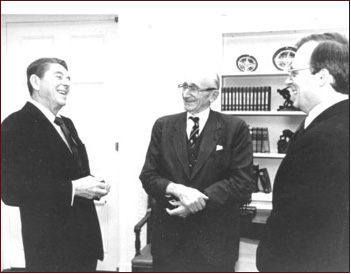
To begin with, Ms. Dare appears to have a penchant for Reagan-era politics.  This is the second article she has posted featuring Mr. Reagan and his friends.  In the first, she posted an article about Charlotte Iserbyt who worked in the Dept. of Education under Reagan.  There aren’t too many people to the right of her.  What’s wrong with that?  In her case, she is so blindered as to be unable to see clearly.  Here are some of the articles she has written lately:  UNITED STATES-RUSSIAN MERGER: A DONE DEAL? 2003 / Refuse The National ID Card! 2005 and REVOLUTION IN EDUCATION - SOVIET STYLE - 2005.  Gee, I wonder where Ms. Dare got her ideas for this article from?  Ms. Iserbyt’s articles are prominently plastered with advertising by the Tea Party - so, Paul, my reference to conspiracy theories had more to do with the tone/implication of the original article - your response was just the knee-jerk reaction Ms. Dare was looking for.  I did note, that Ms. Dare removed the article about Ms. Iserbyt, I was hoping she would do the same for this one.

So, we come to Mr. Hayak.  He was a philosopher who did his work long before Reagan.  In fact, if you read the references that Ms. Dare provides, you will find that it is based on books he wrote in 1944.  Let’s see, 1944 - that was almost 70 years ago - the height of Stalin’s power, the height of the terror - that’s the best you can do?  Do you really think people are so naive to believe that forces in play almost a century ago and thousands of miles (sorry, kilometers) away still influence Canada in the second millennium? Please.  Oh, and by the way, if you are interested in Mr. Hayak’s work, you will find reprints of his book for sale - by the Tea Party (I’ve read the ads).

Finally, communism in the schools - well, let’s tackle that one.  No one here (Ms. Dare included) has more to thank Ronald Reagan for than I.  My parents escaped the Eastern Bloc in the 1950’s, before the Berlin Wall was put up.  Much of our family remained behind - and were prisoners for more than 35 years.  We would visit them from time to time.  I’ve experienced communism - from the business end of an AK-47 - I don’t need lectures about being a communist dupe - Kool-aid or not.  I still remember hearing Mr. Reagan’s speech asking Mr. Gorbachev to “... tear down this wall.” and chills going up my spine.  But, I am in no way so blinded by ideology as to think it is still a threat today.

So, what is the problem?  Well, its not communism, as I’ve stated above (twice, please read).  Big, central government can work well for the education system.  More keenly than Ms. Dare, many of you have noted that it is the progressivist policies and theories that have become entrenched in our system.  Good for you, but progressivism and communism are not the same thing.  If you want an argument, just try calling Mike Harris a communist.

In conclusion, let me rephrase a quote from one of Ms. Dare’s favourite politicians:  “Ms. Dare, take down this article!”

Posted by Wayne Scott Ng on 01/27 at 08:56 AM

All Paul’s are not alike,nor are they even related. (Smile)

Public education has been “a failure” in many ways. It is, however, not that black-and-white as most veterans of the education wars well know. Most of the improvement (student retention, acceptance of differences and expanded special education) have come at a great cost and skewed the system.  We also recognize, in our heart of hearts, that testing has been appropriated by others and fallen far short of our expectations.

Engaging with (and mobilizing ) the public comes easier when you are asking the big, tough questions. We learned that from Maureen Beebe Somers back in the early 1990s. Preaching, hectoring or sarcasm can be lethal in the public arena.  It leads to further marginalization.

Having aid that, I recognize that my “missing decade” might explain why I am not so despondent. I remain a “happy warrior” and make no apologies for being that way.

Raising our game means responding to issues that really matter, rather than simply beating the same drum. If you want to achieve mainstream success and to actually influence educational policy, give the ideologically driven rants a rest or at least accept that it’s a minority viewpoint. Many who long for meaningful education reform are simply not hard core conservatives. (They also watch CBC, Fox News, The Globe and The Post before commenting on most topics. Some even sneak a peak at The Toronto Star)

All is not lost. Why? Because I have not met a radical education reformer yet (right or left) who actually likes the immovable, unresponsive bureaucratic education state!  We have the Fall of Sovietism to thank for that. 

Taking on People for Education may look like mischief-making. It’s really about getting inside their “echo-chamber.” Otherwise, we are simply talking to ourselves.

Posted by Educhatter on 01/27 at 09:36 AM

Something missing, that Chuck has stated is not missing in United States, as it is in Canada. Information freely flows in the United States, and in Canada this has not been the case since WWII. The ability to freely express oneself, especially on government policies at any level, Canadians pay a heavy price for doing so. In the world of public education in Canada, parents and their children are not given the correct information in the first place to make the connections between the completing interests both inside and outside of the public education system and how the completing interests impacts the education of a child. Even if a parent questions an aspect of the education system, they are met with the smoothing voices of the system communicating their messages and responses that they are the best ones to look after the best interests of their children.

On the Illinois Loop, there is a few letters from parents. A common theme among parents , is just that what do we know, we are just parents. “Still, our thinking was intimidated by the sheer authority of the public school establishment. My child wasn’t learning, but what did I know? The teachers and schools were the experts. I was just a mother, after all. Never mind that I had lived in four countries, had a B.A. in English, and was a former insurance investigator for fraud, product liability and medical malpractice. To them, I was just a mom.

And then one day, something happened. It was a small thing—a mom sort of thing, actually—one of those little epiphanies that make things suddenly, perfectly clear.

The school used tempera paint for art projects, which stains clothes permanently. My child was coming home with ruined clothes. When I complained, the teacher advised me to talk to the principal. I approached him with trepidation—who was I to bother the principal of the school with something as trivial as ruined clothes?

But I asked him: “Why doesn’t the school use washable paint?” His unbelievable reply: “There is no such thing as washable paint.”

http://www.educationreport.org/pubs/mer/article.aspx?ID=4623

Or another example in the latest post of SQE is a parent being thrown in jail. “An Ohio mother’s attempt to provide her daughters with a better education has landed her behind bars.  Williams-Bolar was convicted of lying about her residency to get her daughters into a better school district.

“It’s overwhelming. I’m exhausted,” she said. “I did this for them, so there it is. I did this for them.”


http://abcnews.go.com/US/ohio-mom-jailed-sending-kids-school-district/story?id=12763654

Central planning, as seen in the socialist texts and actual examples of countries, control the information flow in the same way as it is control in countries that have a purer form of socialism. By controlling the information flow, the public education system controls the knowledge, and it is the means to control change within the education system.

Today, a parent is jailed for breaking a regulation in the United States, and yet in a court of law, breaking regulations/laws in a centralized public education system, is far more important than the state of the public schools that cause a parent to break the rule. Individual actions and behaviour are to be penalized, just like the individual actions in a communist or a totalitarian state that all depend on a centralized structure. The freedom is taken away from the parents to decide what is best for their children, and the freedom is given to the public education system, because the educrats are the only ones that know what is best for their children.

Hayek article states, ” Mises’s argument was based on what he called the “impossibility of socialist calculation.” Central planners claim to be able to calculate, in advance, how many shoes and cars, schoolbooks and office buildings, doctors and carpenters people will need and then to produce that number at the right time, and put them in the right places. All this was to be accomplished, moreover, for nothing but the noblest motives — meeting genuine human needs — and without morally suspect markets whose mainspring is self-interest and whose lubricant is “wasteful” profit.”

The trouble with central planning in a public education system, that the structure is least likely to meet the educational needs of all of their students, but very effective in controlling the behaviours and actions of parents, their children and the lowest boys and girls on the totem pole, the front line educators. .

Posted by Nancy on 01/27 at 10:31 AM

Educhatter (can I call you Eddie?) and Nancy:

I wholeheartedly agree that the current education system is bureaucratic and unresponsive.  Not only that, but I have argued that many times myself.

However, the purpose of this site (at least I am assuming it is the purpose by the title) is seeking quality education for our children.  Arguably the best students in the world come from a country with an education system more bureaucratic and less responsive than ours. How do you respond?

Or, if you want to stick to the title of this site - since the best students in the world come from a planned, centrally organized eduction system, maybe our problem lies in the fact that our system is not bureaucratic enough and too responsive?

Still awaiting your response.

Posted by Wayne Scott Ng on 01/27 at 11:21 AM

“Or, if you want to stick to the title of this site - since the best students in the world come from a planned, centrally organized eduction system, maybe our problem lies in the fact that our system is not bureaucratic enough and too responsive?”

Too responsive looking after the needs of those who work within the system and the completing interests within the various arms of the system is a problem within a central planning organization. Parents, children, community and anything not directly related to the needs of the ones who work within the education system, become a completing interest for the scarce resources of the education system. Rather ironic, since the public education system’s duty is to educate our children, and yet parents and children are seen as an extension to work for the best interests of those who work within the education system. The centralized public education system cannot become more responsive to the needs of the parents, children and other outsiders, because the very nature of centralization and the planning does not allow freedom for variables that central planning has no practical control over. So controls are put on the wild cards with an assortment of rules, regulations, laws, and cultural norms, so the wild cards do not impede the successful implementation of education plans, policies and operations within the public education system. How successful the education plans, policies and operations are within a centralized public education system now rests within the public education system, a much smaller entity where central planners can now work to unite working for common goals.

If anything it is the common goals within a centrally planned public education system, that works against the individual child and their parents. The children and their parents are force to adapt to the system, regardless if it meets their needs or not. Needs are met only if it does not impede the common goals of the centrally planned public education system.

The public education system in Canada, is far too responsive for the needs of those who work within it.  And below is the latest example how those who work within it, can round up their wagons in quick fashion to defend their practices within the public education system. Making their arguments into very plausible, rational, and sensible sounding so people will act against their own best interests.

“Newfoundland and Labrador’s auditor general is criticizing the province for improperly rehiring hundreds of retired teachers, allowing them to collect pensions and salaries.”

Read more: http://www.cbc.ca/canada/newfoundland-labrador/story/2011/01/26/nl-ag-report-126.html#ixzz1CGLZjfK5

“But Lily Cole, president of the Newfoundland and Labrador Teachers’ Association says the reliance on pensioned teachers reflects poor recruitment and retention on the part of the provincial government.

“Some of these positions are in rural Newfoundland, and in order to get people to move their families and to go out to rural Newfoundland, we have to ensure that there is a good compensation package for them to do so. And we’re finding now that we’re not getting the teachers to go to these places,” Cole said.

“Now, having no qualified teachers in these areas, then we think a retired teacher who’s qualified to do that position is certainly adequate.”

Education Minister Joan Burke disagreed that there isn’t an adequate talent pool for school boards to draw on, and noted the minister of education signs off on hiring a pensioned teacher if boards can demonstrate there were no qualified non-pensioned applicants.

“There may be times when there’s a job available. It may not be in an area that’s necessarily hard to recruit, but it may be for a specialty position, for somebody to teach math, physics, chemistry or music. Sometimes you’re left with the decision to hire somebody who is not qualified but not collecting a pension, versus somebody who is qualified and collecting a pension,” she said, adding the minister of finance will now sign off on applications to rehire pensioned teachers.

Burke said it’s “absolutely necessary” school boards ensure they do everything to reach qualified applicants who aren’t drawing pensions.

“I will be communicating back to the boards about the importance of it, and I’ll be stressing that they need to do whatever they need to do to hire people who are not in receipt of pensions,” she said.

The auditor general says he doesn’t think ignorance of the rules is the problem.”

http://www.thetelegram.com/News/Local/2011-01-27/article-2175780/-Policy-not-followed-on-teacher-hires:-AG—/1

If this is not an example of a centrally planned education system, looking after their own best interests in protecting the system, I don’t know what is. It is certainly not looking after the education needs of the children, nor their best interests.

Posted by Nancy on 01/27 at 12:58 PM

Nancy,

I hear you, and agree with you.  However, EduPaul is not the only one who can use sarcasm.

I’m still awaiting his response.

Posted by Wayne Scott Ng on 01/27 at 02:17 PM

First: it’s possible that I am being confused with some other poster named Paul. For example, I have no idea of what ‘People for Education’ is, nor do I post there.

Anyway…Wayne, your response (the one where you referenced Reagan, Hayek, Tea Party etc) is, simply, a pathetic non-argument, and for someone who professes to be a teacher, deeply embarrassing. First, in that post you serially take the typical liberal ad hominem approach: insult and call names, instead of making an argument. For example, you sneeringly dismiss Reagan and Hayek, with the nudge-nudge-wink-wink inference that ‘anyone in his right mind would never agree with THOSE outdated people!” ..as if they have already been universally discredited.

Well, they have not been. Millions of people still revere those names, and more importantly, follow their ideas, and it’s preposterous for you to suggest otherwise: all you do is more clearly declare your leftist roots.

When I said your post was ‘embarassing’, I meant this: are you seriously going to claim that there is a linkage between the AGE of an idea, and its VALIDITY? Seriously? You claim to dismiss Hayek’s ideas simply because they are 70 years old or what have you. So tell us then, Wayne, what is the ‘best-before’ date on ideas? A day, a month? A year? Ten years? How long before they go stale and are discredited simply due to age?

Are the ideas in the US Constitution or Declaration of Independence, for example, now discredited and useless, simply due to being written so long ago?

Do you, Wayne, have only all-new ideas in your brain, or do you possibly still have some old ones kicking around?

That a teacher would even attempt this line of non-argument and pretend it is some sort of rebuttal—is embarrassing. You think no one will notice. That also is ridiculous and only makes you look foolish.

And all the more so, because you yourself show, in spades, the sneering “OH, PLEASE! Don’t bother me with THAT!” attitude of the education “experts” which Nancy so eloquently described, and which I have encountered so many times. It’s this thing which teachers and edu-people have, which says “anything I say is automatically right, because I am an EXPERT, while you are just a mere parent”.

That attitude, is what is outdated. It is the attitude of self-appointed elites, whether in schools, education ministries, or governments. People are wising up to the fact that they have stupidly been blindly following these ‘elites’ for far too long. It is these ‘elites’ (mostly fools, and from all political parties) who are leading us off the fiscal cliff, who have racked up truly TITANIC debts, all the while saying “trust us, trust us!”. Who is more the fool—the foolish statist big-government pied pipers, who promise us the Promised Land if we only fork over more and more and more money, or the sheep who follow these pipers?

They haven’t ‘centrally planned’ ANYTHING—but mass debt, ruin, and anti-intelligence. People are wising up. That’s what you see in the USA and it is surely following here. The reason it is ‘surely’ following is that the statist Pied Pipers have not delivered their Promised Land: they have only delivered us to the doorstep of bankruptcy. So like it or not, the problem must be dealt with: the money has run out. There is no escape. All levels of government are deeply in debt. Ordinary people—which is what the derided ‘Tea Party’ people are, unlike how they are portrayed by lying liberal media types—are astute enough to realize this. They are starting in mass numbers to realize how near the cliff edge is, and they will increasingly balk at trusting and following Collectivist Pied Pipers any longer. It’s just that simple.

Sooner or later, Canada will have its very own Chris Christie, who will face down the Edu-elites in this country, the Socialistocrats in the ministries and the teachers and teacher unions; and it will be a joy to watch, because their comeuppance is richly deserved. This is what people such as Wayne sense on some level, and they are scared. The very earth is beginning to shift under their feet, and the building tremours unnerve them.

Finally—Wayne, just because your family escaped from communism, is again no argument proving anything! Bully for you, but MY FAMILY ESCAPED COMMUNISM TOO. But unlike you, I am a proponent of limited government, and am implacably opposed to people such as you pushing socialist/big government ideas into young minds.

Nancy, thanks for the very interesting posts, and good luck.

Posted by Paul on 01/27 at 03:36 PM

I was responding more to Educhatter, in his last post. His comment, “Raising our game means responding to issues that really matter, rather than simply beating the same drum. If you want to achieve mainstream success and to actually influence educational policy, give the ideologically driven rants a rest or at least accept that it’s a minority viewpoint. Many who long for meaningful education reform are simply not hard core conservatives. (They also watch CBC, Fox News, The Globe and The Post before commenting on most topics. Some even sneak a peak at The Toronto Star)”

I can’t understand why anyone should give the ideological rants a rest, when it is obvious that the Canadian public education system is steep knee-deep in ideology and politics. People outside the system, are bombarded with the dogma and politics when dealing with the education system. Here is a personal example. Within two days of enrolling my child in a NL school, I was stopped at the door from walking my child to her classroom. No ifs, or buts or even the medical documentation from Ontario would move the school to allow me to walk her to her door, until my child had adjusted to do so on her own, and also riding a school bus.

As a parent, it told me the rules of the schools reigned supreme over any exceptions to their rules. The dogma came a week later, where the educrat from the upper levels met with me on the pretense of listening to me, when the real reality was to defend the actions of the school and protect the rules of the board. At this meeting I received the lesson of only qualified teachers know what is best for a child’s education. The documentation including the medical information from Ontario was ignored because doctors and other outside professionals could not possibly know what the educational needs of a child is, because they are not teachers. Even though I objected to this kind of reasoning, the final card that ended the meeting was none of this information was in her school file to where the former school had thought it was important to be part of her school file. Therefore my concerns, walking her to the door or any other issues about her education rests with the school, and not unqualified people like myself or other professionals such as doctors.

Parents and their children are exposed to the ideology, dogma, and other political crap within the education system on a daily basis, It is all dressed up in reasonable rational reasons,  made to look harmless in the best interests of the children. It is all about controlling the actions and behaviours and not a whole lot on an exchange of information and knowledge.

Posted by Nancy on 01/27 at 03:44 PM

Paul,

If you read Educhatter’s last post, he made reference to using the name elsewhere - I was not referring to you.  If you actually read any of my posts in this thread with an open mind, you would understand that I am not for big government.  In fact, it would appear that you have failed to comprehend the core issue surrounding this thread.

Ms. Dare has stated quite clearly that there is a direct link between communist philosophy and overly powerful bureaucracies and the poor quality of the students our education system produces.  The fact one of the last remaining communist countries produces better graduates than we do would be a serious flaw in her argument.

Nothing you have said. nothing Nancy has said has come close to dealing with that central problem.  I thought we were here to debate issues, you appear to find that offensive.  I find it interesting that neither Educhatter nor Ms. Dare have bothered to respond to my counter thesis.  It would appear as if SQE is as unresponsive as the education system it professes to criticize.  wink

Posted by Wayne Scott Ng on 01/27 at 04:42 PM

Mr. Wainscotting has raised a very good point: some of the world’s best students come from centrally-planned education systems. How can this be?

In Ontario, we used to have quite a good system, even though it was somewhat centrally-planned, but then it got infected with the child-centred virus. The good education systems around the world of course haven’t caught this virus (yet). So maybe centrally-planned systems do work well as long as they’re not diseased.

This theory is in accord with what Dr. Hayek wrote: central planning works for a while, but then it inevitably starts to get more and more out of whack. Perhaps it’s just a matter of time before Singapore and Japan start incorporating child-centred ideas.

Once a centrally-planned system becomes infected, it is very resistant to treatment. In the case of Ontario, the disease has progressed to the stage whereby the only realistic way to treat it is to dismantle the centrally-planned system. It’s kind of like treating cancer - powerful chemotherapy and/or radiation is/are required in order to conquer a very stubborn and deep-rooted enemy.

In a nutshell, my amended theory is - good centrally-planned education systems cannot last very long and, once they become infected, it is very difficult to treat them. The only realistic chance of success involves dismantling the central bureaucracies. Decentralized education systems, on the other hand, have a built-in resistance to disease.

Please accept my apologies for taking so long to respond. Is this amended hypothesis reasonable, do you think?

Malkin

Posted by Malkin Dare on 01/27 at 05:07 PM

A very big thank you Ms. Dare!  Especially considering I have been raising questions in staff meetings my whole career, and am waiting for answers for those to this day.  In comparison, a day wait is nothing - seems as if I was too hasty.  Sorry if I caused offence.

Your amended thesis is better, and I applaud your willingness to consider these ideas.  One last step though.  Centralized systems follow a strict chain of command.  Therefore, if you have a strong, competent leader(ship) at the top - you will have an excellent system.  Referencing the article on East Germany, that would explain why the communist system got better in education (not worse by your thesis).  Remembering that when Mr. Hayak’s work was done, the communist system was under Stalin’s terror - it was more important to save your neck, than do your best for the kids.  However, by the 1980’s, the communist system realized it was hopelessly behind and needed to catch up quickly.  I can’t speak for every Eastern Bloc country, but there were new ministers of education in charge, not of towing the party line, but producing results - ie: competent graduates.

Your organic answer seems a little too random (ie: at some point it will be infected.)  and too bottom up (ie: the virus causing illness in the host) to adequately describe an autocratic, top down system.  More plainly, and quite easy to see and prove:  A bureaucratic system works well with strong, competent leadership, and is totally unable to deal with weak, ineffectual leadership.

How would all this play out in Ontario?  Well just look at the stellar leadership we have had in our ‘Education’ Premier.  By the way folks, I’m being sarcastic again.  Can we not all see that weak, aimless and ineffectual leadership from the top causes a big bureaucratic ship to run adrift - and is that not what we have been talking about on this blog for months now?

To follow your thesis, Ms Dare:  on the other hand, a decentralized system is better able to cope on its own in the absence of any leadership, or, indeed, in the face of poor leadership.

Does that satisfy everyone?

Caveat:  a decentralized system is open to its own problems:  chiefly, poor leadership at the local level.  A decentralized system will suffer the same leadership problems as a centralized one, but the problems will be localized (al la Bluewater Bd of Ed.) rather than system-wide as we suffer now.

I thank you again Ms. Dare, this has been most enjoyable.

Posted by Wayne Scott Ng on 01/27 at 05:41 PM

“Caveat:  a decentralized system is open to its own problems:  chiefly, poor leadership at the local level.  A decentralized system will suffer the same leadership problems as a centralized one, but the problems will be localized (al la Bluewater Bd of Ed.) rather than system-wide as we suffer now.”

Would it not be tempered by interested citizens of the community, who would not tolerate poor leadership? Just wondering, because historically in the small rural community that I lived in, education of children has been around since 1800, without any centralization of education services, until the 1940s or so, The interested citizens made quick work with poor leadership inside the school and reward those who were good leaders. I suppose I have a bit more faith with people at the grassroots level, because they are less inclined to politicized the education process, at the expense of the children of the community.

Posted by Nancy on 01/27 at 06:23 PM

I agree with you 100% Nancy, and I too, have faith in our communities.  The sad experience we have had with trying to get rid of our director means that there a some other factors at play now that weren’t there 20, 50, 100 years ago.

The only reason our director is gone is because she decided to retire (although I suspect the general outcry was getting too much, maybe that’s more hope than suspicion).  Certainly, no one was going to push her out - not the parents, community leaders, not even the ministry.  The trustees?  Well they had signed her to a contract - an open-ended one.  No expiry date, no performance clauses, nothing.  It would have cost our Board millions to buy her out of her contract.  As it was, she was content raking in her $180K per year.

So, although the average Canadian community has the same spirit, the legal minefield we walk through today has created a different atmosphere.  Hence, I would say that in an decentralized system, you may run into the same problems locally.

Finally - here is where I hope you guys jump in and have a field day:  let me look in the mirror.  Like our director, teachers also have a permanent contract - it is open-ended, there are no performance clauses, we can walk away, or stay at will; we can listen to parents - or not (as usually is the case).  What if we put teachers on a renewable contract with clauses allowing for automatic renewal given meeting certain performance standards.  If such standards are not met, then the teacher would have to go on probation and take remedial courses to get up to speed, if not, no renewal.

How does that grab you?  Think that might make the system a little more responsive?  Now, at this point I feel I am being a little hypocritical.  I’m retiring in a few years, this discussion would be best taken up by young teachers whose future would be at stake.  But it is an interesting thought.

Posted by Wayne Scott Ng on 01/27 at 07:25 PM

Yes, the legal ramifications must be considered, to decentralized where the power, funding, and local autonomy is at the local community, and those above the local level, their jobs would be highly specialized providing the knowledge and information for specific groups. Unions would have to let go of forcing all to pay union dues, and let it be up to the individual teachers or a complete transformation of unions where their job is to look after the best interests of the teachers within the local communities and not as today where their reach is province wide.  Unions are necessary to prevent communities from taking advantage of teachers. Curriculum should be up to the local community, with broad outlines from the upper levels. As it is today, curriculum is micro-managed by the upper levels, to where the schools have very little say in bringing effective help for their students. For some schools it may be Direct Instruction for primary and elementary students, and for others something different that meets the needs of their students, but at the end of the day both groups arrived with good reading, writing and numeracy skills in the basics.

However, the textbook publishers, the unions, and the upper levels would have to change their tune by developing honest dialogue with the local communities, adapting themselves to the needs of the communities, and not as it is today, where the communities are adapting to the needs of the current education system.

If one took a look at local councils in our towns and cities across Canada, it is a far more open process because they see the impact of policies much quicker than a provincial government, and usually are very responsive to the basic needs of their residents. They are quicker to get rid of policies that are not working. they are quicker to fine tune policies that are good policies. On the news this morning, but I am not sure what city the reporter was referring to, they have a new program for the homeless. Rather simple idea and apparently it is working. Provide the homeless with homes, and once the homeless have a place of their own that they can call home, the people will start to fix up their own lives, without intervention from the state. Apparently the savings are quite substantial and can go to either increased the homes for homeless or to other city-run programs.

I believe it can happen in the same way with the education and health files. Empowering the local people to take charge of their own needs and wants by giving them the final say, power and funding. In rural parts of Canada, if this happens there is a belief that it would transform rural communities to vibrant communities and still maintained their strong cultural and traditions of rural living.

Posted by Nancy on 01/27 at 08:20 PM

Paul,

You seem to be a very intelligent person, yet you have clearly misunderstood everything that has gone on here.  If you don’t appreciate my attempts to lighten up the conversation a bit with a touch of humour, I am sorry.

Neither was it my intent to slight you.  Other bloggers on this site will tell you that I will jump in with my opinion where I feel I have some experience in the matter at hand.  If not, I will clearly state such or not post a reply.  Although I lived in TO, I have never worked for the TDSB.  I have never read their policy on social justice, so I don’t feel qualified to respond to your posting.  Furthermore, I don’t even know if my Board has any such policy.  However, you have me intrigued, I shall check into it.  But don’t expect a response very soon, I am proctoring exams all day tomorrow and have my own exam to write Saturday morning (not that any of you care, just thought I had better clear up a possible case of not responding just after I lectured Malkin about it - now I feel guilty!)

In reaction to your assertion that social justice is code for communism, that too is not my area of expertise, but I will also do a little research into it.  I suppose that this won’t satisfy you, but I will try.

As far as my leadership aspirations go - there are none.  I have never taken any principals courses, so I am not qualified to be anything more than a department head, and have never even applied for that position.  I have enjoyed my time in front of the classroom. Through the years, I have taken courses in business, finance and management - but nothing that would in any way qualify me to run the education system.  I coach minor hockey.  I’ve run my own restaurant. There you have my CV - nothing particularly evil or communist about it.

Posted by Wayne Scott Ng on 01/27 at 08:32 PM

Nancy,

Sorry, somehow missed your post in all of that. Excellent, couldn’t agree with you more.  And your point about the unions being a tough sell, too right!  That’ll take some thinking.

Posted by Wayne Scott Ng on 01/27 at 08:43 PM

Results of Homework Assignment:

Although the original posting to which I was responding above is gone, I did promise to reply with some answers.

I am assuming by ‘Social Justice Policy’ of the TDSB, we are referring to its ‘Social Justice Action Plan’.  Here is how the TDSB defines its goals: “Social Justice is a specific habit of justice that is based on concepts of human rights, equity, fairness, and economic egalitarianism. Social justice requires inspiring, working with, and organizing others to collaboratively accomplish a goal consistent with these concepts. As such, it is an activity that requires a broader range of social skills than do acts of individual justice. These skills are considered fundamental to a civil society.  Social justice is, in plain terms, the movement towards a more socially just world through the actions of a group of individuals working together to achieve its goals. Students and staff who participate in social justice actions often categorize their efforts as attempts to “give back” or to contribute to the greater good in their community or abroad.”  Although the term ‘economic egalitarianism’ is in there, I highly doubt they meant economic equality, nor communism.  Seems to be more a goal of doing good deeds by ‘giving back’.  As I promised, I would check my board.  Although there have been some workshops, I cannot find any similar policy here.

What was extremely interesting was my research into the concept that social justice was code for communism.  Usually I’m on top of these things, but with studying, I seem to have missed the great to-do south of the 49th.  It would appear as if a certain Glenn Beck was up to his usual shenanigans and stirring the pot.  However, he was not referring to schools, but to churches.  He accused any church preaching social justice of being both communists and Nazis.  Well, there’s an easy way to spot a rant:  accuse a group of occupying both extreme ends of the political spectrum simultaneously.  Also, since the state religion in most former eastern bloc countries was atheism, by extension he is accusing American churches of atheism?  Not sure where to go with all this.

Now, my favourite part:  Who is Glenn Beck?  Besides being a former CNN editorialist, and currently on Fox news, he is one of the founding members and chief organizers for ... the Tea Party!  Seems rather as if my response above wasn’t so much a ‘left wing put down’ but a rather accurate analysis of the source of these ideas.

Posted by Wayne Scott Ng on 01/30 at 05:40 PM

The above is a non-response.

All that Wayne has stated, above, is that he does not like, and does not agree with Glenn Beck. Fine. But there is no other content.

As usual, instead of making an actual argument, he is attempting to smear the source. As in, ” we all know what those Glenn Beck and those TEA PARTY people are like! No use listening to THEM!”

It’s not only Glenn Beck who has stated this about Social Justice. He is not the original source. There are many others. One can easily find this out via Google, for oneself, if you care to.

BUt really, this low level of sophomoric discourse is not even worth bothering with, past this.

Posted by Paul Rivoche on 01/30 at 08:16 PM

Mr. Rivoche:

I hope you note the irony on your response, or was it intended to be an object lesson?

This is fascinating, mention the name ‘Tea Party’ and Pauls come out of the woodwork.  What is this, about three now?  Doh! I just mentioned it again, will there be another?

Posted by Wayne Scott Ng on 01/31 at 07:20 AM
Page 1 of 1 pages

Leave A Comment

Name:

Email (required but not displayed):

Emotions

Notify me of follow-up comments?

Submit the word you see below:


Next entry: The US is sneezing....

Previous entry: Teach Effectively