
 Subscribe to our Blog


Schools should be a slave to history
GUEST BLOG BY MARJORIE GANN. Marjorie Gann is a retired elementary teacher. The book she co-authored with Janet Willen, Five Thousand Years of Slavery (Tundra Books, 2011) is available through Amazon and Indigo. Its accompanying Teacher’s Guide is available for download at th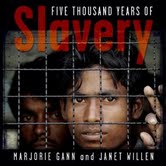 e Teacher Resources page on the Tundra Books website and at www.fivethousandyearsofslavery.com. Gann and Willen’s forthcoming book, also for young readers, is No Middle Way: Women Against Slavery (Tundra/Random House Canada, 2014). It tells the story of 14 women who fought against slavery.
The film 12 Years a Slave, which won the People’s Choice Award at the 2013 Toronto International Film Festival, has garnered rave reviews. I’d put off seeing it until last week, when I met Janet Willen, my co-author of Five Thousand Years of Slavery, in Maryland. We wanted to see 12 Years a Slave together because we tell its story in our book. It’s about Solomon Northup, a free Northern black kidnapped into slavery in Louisiana, where he languished for 12 long years until he was released in 1853. We were interested in how director Steve McQueen would adapt his story for film.
This he did brilliantly. The film is true to Northup’s memoir, and does a remarkable job conveying the brutality slaves were subjected to on a regular basis. What puzzles me, though, is the surprise of many viewers at the level of cruelty in the film. Why, I wondered, does slavery’s brutality surprise anyone? What did they learn about slavery in school? With African-American Studies firmly established as a legitimate discipline, with Black History Month mandated for every school in Ontario, are people still bamboozled by the Gone With the Wind version of the American South?
Students should leave school with a clear picture of what slavery was, and that picture is not pretty. More than that, they deserve a rounded picture of slavery, because slavery was not an exclusively American phenomenon. It existed in every culture and at every period of history, and it persists in many parts of the world to this day. The book I wrote in 2011 with Janet Willen paints that picture. Aimed at students age 10 and up, Five Thousand Years of Slavery devotes four of its twelve chapters to slavery in the Caribbean and the United States. The other eight chapters range the globe: the Ancient Near East, Greece and Rome, medieval Europe, the vast Islamic world, Africa before European contact and after the transatlantic slave trade ended. Readers learn what Buddha taught about slavery in India, how Chinese parents sold their daughters into bondage, and how pirates captured slaves in the Sulu and Celebes Seas in the nineteenth century. They learn that children are sold to work at carpet looms in Pakistan, and that Canada’s Craig Kielburger founded Free the Children to end the practice.
The rightness of slavery went unquestioned from the dawn of human history until the mid-eighteenth century, when a few brave Anglicans and Evangelicals in England began to question it. Five Thousand Years asks why this happened, and points to the two pillars of Western culture that nurtured the first human rights movement in history: the Judeo-Christian religious tradition and Enlightenment thought. Without minimizing for a minute the brutality of slavery in the Americas, it gives credit where credit is due.
Schools should teach real history, not cultural myths, and real history relies on primary sources. Five Thousand Years contains a lot of these:
• an Egyptian papyrus account of adopting a slave girl’s children
• an eyewitness report on the sacrifice of a Viking slave girl at her master’s funeral pyre
• a fourteenth-century Italian merchant’s order for a slave girl to clean and cook for him
• Frederick Douglass’s reminiscence of being taught to read by his owner’s wife
Teaching about slavery fits the Ontario curriculum. Slaves came to Canada with the Loyalists, and Upper Canada was the first jurisdiction in the British Empire to pass an antislavery law (introduced by Lieutenant Governor John Graves Simcoe in 1793). Canada took in slave runaways after the American Revolution and the War of 1812, and was the terminus of the Underground Railroad. Grade Fours study ancient societies, Grade Sixes learn about child labour and human rights, and Grades Seven and Eight discuss the Underground Railroad.
The film 12 Years a Slave is too graphic for elementary students to watch, but the story of slavery is embedded in human history and should be taught honestly. It is not a romantic story of Scarlet O’Hara and her loyal mammy. It is a story of human beings treating other human beings as property, and runs through all of history to the present day. We should teach it the way we should teach all of history – accurately.

Share this article