
 Subscribe to our Blog


Math Push-Ups
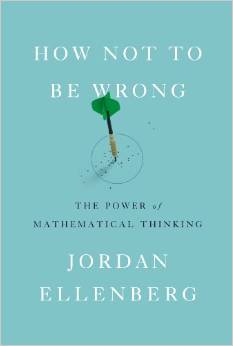 I have just started reading How Not To Be Wrong: The power of mathematical thinking by Jordan Ellenberg and I already like it a lot. Here's an excerpt from the introduction (pp. 2-3) where the author explains why students need to spend hours practising mundane and boring mathematical computations.
"Mathematics is not just a sequence of computations to be carried out by rote until your patience or stamina runs out - although it might seem that way from what you've been taught in courses called mathematics. These integrals are to mathematics as weight training and calisthenics are to soccer. If you want to play soccer - I mean, really play, at a competitive level - you've got to do a lot of boring, repetitive, apparently pointless drills. Do professional players ever use those drills? Well, you won't see anybody on the field curling a weight or zigzagging between traffic cones. But you do see players using the strength, speed, insight, and flexibility they built up by doing those drills, week after tedious week. Learning those drills is part of learning soccer.
"If you want to play soccer for a living, or even make the varsity team, you're going to be spending lots of boring weekends on the practice field. There's no other way. But now here's the good news. If the drills are too much for you to take, you can still play for fun, with friends. You can enjoy the thrill of making a slick pass between defenders or scoring from distance just as much as a pro athlete does. You'll be healthier and happier than you would be if you sat home watching the professionals on TV.
"Mathematics is pretty much the same. You may not be aiming for a mathematically oriented career. That's fine - most people aren't. But you can still do math. You probably already are doing math, even if you don't call it that. Math is woven into the way we reason. And math makes you better at things. knowing mathematics is like wearing a pair of X-ray specs that reveal hidden structures underneath the messy and chaotic surface of the world. Math is a science of not being wrong about things, its techniques and habits hammered out by centuries of hard work and argument. With the tools of mathematics in hand, you can understand the world in a deeper, sounder, and more meaningful way."
Share this article