Donate now

Privacy Policy

Protection of privacy is our first concern, and SQE does not sell or trade information provided by its subscribers or supporters. Your information is used to process donations and newsletter subscriptions, and to contact you about upcoming publications and events.

feed iconSubscribe to our Blog

Follow Us
Follow SQESocQualEd
on Twitter

Please note Downloads require you to have the Adobe Reader installed, you can get it here for free Adobe.com


Society for Quality Education

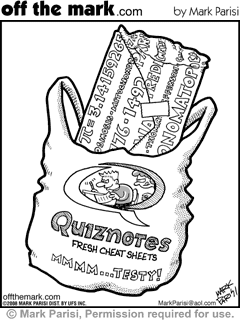
A Lesson on Cheating

A Lesson on Cheating
September 27, 2010 by .(JavaScript must be enabled to view this email address) at 09:08 AM

According to this Globe and Mail article, the EQAO plans to provide the province's educators with more explicit test-giving directions, in the hopes that it will make it more difficult for them to rationalize cheating. The article includes a poll about the value of standardized testing, with the results split more or less evenly, as well as 28 comments which are overwhelmingly critical of the cheating educators - as well as the lack of consequences for their dishonesty. 

A sidebar to the article, unfortunately not available on-line, reports on what happened to the cheating educators at one school. Two of them had retired by the time the investigation had concluded, and so nothing much happened to them. The other two had transferred to other schools in the meantime, and they were given short suspensions but are now back in the classroom. The sidebar doesn't say whether the suspensions were with pay or not.

Of course, there are cheaters in every profession and the number of confirmed cases (10) is actually surprisingly small in a province with about 5,000 publicly-funded schools. To me, the issue is not that there are cheaters - that is a given - but how their cheating is handled. The current policy of giving them a slap on the wrist sends a strong message to the students that cheating is okay. Is this what we intend?

Comments

“the EQAO plans to provide the province’s educators with more explicit test-giving directions”

great, more work for well-paid bureaucrats. Here’s a hint - use pictures for clarity.

re: consequences for cheaters - that’s what the outcome usually is when the investigation is “in house”. Perhaps the EQAO knew all along that the consequences were moot and that’s why they released this story in the first place?

Posted by Chuck on 09/27 at 10:47 AM

When my children were in school, I didn’t like most of the teachers’ attutides about their work; their refusal to respect authority; their sense of entitlement; etc.  They were not people whom I wanted setting an example for any children.  Now children are also learning that it’s OK to cheat, and their phones are welcome in classrooms!  Having such poor role models and very few rules is bad for our children, and society as a whole.  I am glad however to see though that some teachers are actually coming forward and disagreeing with the status quo.

Posted by Bev on 09/27 at 11:56 AM

Todays cellphone is also a calculator, a translation devise for ESL students, a dictionary, a calendar, a TDL, a planner, an atlas, a thesaurus, etc. It is in effect a small laptop. Keeping them out of class no longer makes sense.

Posted by Dean on 09/27 at 01:55 PM

Isn’t that wonderful!  Today’s cell phones are also very distracting.  Calculators shouldn’t even be allowed.

Posted by Bev on 09/27 at 02:03 PM

Cell phones although useful, not at all particular valuable doing school work in the classroom. Much quicker to look it up in the text book, or dictionary.Great for distraction, being bored, or cheating. As for translation, it all depends on the application, Some are good, some are so-so and others are just poor. Calculators are being relied on far too often, where children do not have a solid foundation in basic arithmetic facts. Their reliance on the calculators to do simple calculations, actually makes them less efficient and takes a longer time to complete one problem, compared to students who do have a solid foundation in basic arithmetic facts.

Posted by Nancy on 09/27 at 03:05 PM

Dean,

Believe what you will.  No one is here arguing against anything that will improve student performance.

Your assertion that cellphones have other uses is simplistic, reiterates failed policies, and ignores their detrimental effect.  For the past three decades, students have had enough technology thrown at them to choke an elephant - and their reading comprehension and numeracy are worse than ever.  Yet the ministry keeps telling us to use even more technology.  Geez, you would have thought that after a quarter of a century even the MOE would catch on.

I write all of this as a computer science/math teacher.  I have not seen technology improve any student’s comprehension in anything (except computer science).  The Ministry approves math textbooks that use computer programs to illustrate trigonometry.  I have watched students struggle for hours (yes, even with step by step written instructions) to get a right-angled triangle drawn on the computer, then try to get the program to calculate the TAN of 30 degrees.  They could have done it much quicker, and learned more if they had used a paper, pencil and ruler.

Posted by Wayne Scott Ng on 09/27 at 06:51 PM
Page 1 of 1 pages

Leave A Comment

Name:

Email (required but not displayed):

Emotions

Notify me of follow-up comments?

Submit the word you see below: