Donate now

Privacy Policy

Protection of privacy is our first concern, and SQE does not sell or trade information provided by its subscribers or supporters. Your information is used to process donations and newsletter subscriptions, and to contact you about upcoming publications and events.

feed iconRSS Feed

Follow Us
Follow SQESocQualEd
on Twitter

Please note Downloads require you to have the Adobe Reader installed, you can get it here for free Adobe.com


Society for Quality Education

Subscribe to our mailing list

A Delicious Idea

October 01, 2014 by .(JavaScript must be enabled to view this email address) at 10:41 AM

GUEST BLOG BY TOM BEREND, SQE DIRECTOR

Earlier this week, this blog highlighted the Fraser Institute report suggesting that Ontario could save $1.9 billion every year by adopting BC's partial-funding formula for private schools. $1.9 Billion is about 8% of $25 billion that Ontario currently spends on K-12 schools.That is a lot of money! But it leads to a delicious idea.

After years of zero raises, Ontario teachers are probably looking for at least 2+2+2+2 in their next contract. That's also a lot of money, especially when you consider that it leads to increased future costs in terms of pension liabilities, and it can't be funded by small-potato savings like chopping textbooks or deferring maintenance. And because it is a recurring expense, one-time wheezes like selling empty schools won't work. However, that amount is almost exactly what the Fraser Institute predicts we can save with a BC-style funding formula.

The government is demanding 'net zero' in order to meet their deficit target.  Maybe changing the funding formula is the 'net zero' that will make everyone happy. Of course it's not perfect, since the funding-formula savings would take a few years to develop and private schools can't absorb that many students right away. But salary increases also roll in over a few years.

The rate of student transfer to the private system will be slower than the teacher's attrition rate (retirement, etc), so shrinking the public system won't cost a single teacher's job. The teachers win, the parents win, the taxpayers win, the government wins and, most of all, the students win.

Share this article

Comments

So how is the term ‘net-zero’ defined the way that Tom has portrayed?  Net-zero seems to have several definitions. If I am a bit confuse, I am sure there is a few more that are as well.

The closest I came to is a 2012 article on ‘net-zero’ and BC unions. Net zero saved B.C. taxpayers $3 billion this year. That’s seven per cent of the entire budget.-
http://citycaucus.com/2012/05/bcs-unions-still-dont-understand-net-zero/

Tom, could you clear up the meaning of net-zero in Ontario’s context?

Posted by Nancy on 10/01 at 11:58 AM

Umm, no I can’t clarify it, ‘Net Zero’ is a deliberately vague term.  That’s probably a good thing, since a negotiation requires some flexibility.

Posted by Tom on 10/01 at 12:04 PM

The teachers would have a party if they got 0,0,4,4

or 1,1,3,3. In general the teachers don’t believe in cut. They believe in revenue enhancements. The best one come from growth. If not growth corporate taxes or green taxes.

Posted by Doug Little on 10/01 at 07:41 PM

Net zero to Kathleen Wynne means the teachers get a small raise but
the education budget does not increase.

Teachers will suggest:

Kill EQAO
Kill CoT
Cut ministry
Cut board admin

Similar.

I suggest return sick days
Enhance pensions

Very little cost BEFORE 2017. smile

Posted by Doug Little on 10/01 at 07:46 PM

On the Ontario Ministry of Finance website - “The government should provide a zero budget increase for wage costs; ministries and agencies will then have to drive out inefficiencies to absorb any wage increase. Bumping provisions unduly impede the move towards a progressive and efficient public service; these should be modified.”  http://www.fin.gov.on.ca/en/reformcommission/chapters/summary.html

Tom is right that the term is vague. However, I was correct earlier this morning but was afraid that I was wrong. Hence the question to Tom. The real term is called zero-based budgeting. In Wikipedia - http://en.wikipedia.org/wiki/Zero-based_budgeting
And here is the simple way of understanding - the household budget - http://lifehacker.com/the-power-of-a-zero-sum-budget-1443100021

The Ontario Finance link is of interest. Throughout the report, the words of zero-based budgeting is not written in black and white, but nevertheless it is zero-based budgeting being used to carve out a surplus. I see no evidence that the Ontario government is starting zero at the point of the funding formulas. Pity, because it is the funding formulas that will extract true savings and efficiencies.

Posted by Nancy on 10/01 at 09:05 PM

A zero-based budget is quite different from ‘net-zero’. 

A zero-based budget requires managers to justify every dollar of spending.  Instead if saying “Lets grow (or shrink) by some percentage, management starts with what they want to accomplish and then figures how much they need to spend. 

Net-zero means that any increase must be matched with a saving, balancing to zero.

Governments often wheeze by adjusting forecast spending to justify extra spending instead of adjusting previous spending, for example perhaps by predicting rising spending on Special Ed, trading that spending for salaries, and then calling it ‘net zero’ because budget balanced forecast.  Spending goes up, but most voters are fooled.

Yet after years of spending deficits, Ontario is facing credit rating cuts.  This is serious because Ontario is the largest non-sovereign borrower on the planet, a drop in our ratings will cost us hundred of millions in interest each year.

The government has promised to hold the line on spending, and counting on economic growth (plus inflation) to bring the deficit under control.  But that growth is not coming as quickly as hoped - the last provincial budget update reported tax receipts below expectations, and national GDP numbers are disappointing.  http://www.cbc.ca/news/business/canadian-gdp-unchanged-in-july-1.2782283

Maybe growth will kick in and save us.  The alternatives are to raise taxes, to grimly hold onto ‘net-zero’ (possibly for years), or to let the deficit continue to grow.  Probably a bit of all three. 

Posted by Tom on 10/01 at 09:53 PM

Yup, we Ontario are in trouble.
And as we age most of will put a higher priority on healthcare and elderly benefits election issues.

Teachers vote, parents have bought out with reduced cost daycare for children younger than six ... unfortunately the political reality is there is not a high proportion of voters who put the quality of education at the top of their electoral choices.

Perhaps cost savings is a better argument.
Although .. I dont’ think that private schools are a solution unless exit or entrance exams are also implemented.

The same thing will happen with private schools as what has happened with tutoring.
If it doesn’t matter very much how competent a student is, and it doesn’t, then the private schools will have no incentive to be significantly better on average.
There will be a few excellent private schools a few that would be lifesavers for disadvantaged kids but I don’t think the average will move significantly.

Posted by fromEurope on 10/01 at 10:35 PM

Private schools may not be the solution some parents think.

http://www.telegraph.co.uk/education/educationadvice/9805779/Why-pushy-parents-are-the-bane-of-private-schools.html

Posted by Doug Little on 10/01 at 10:59 PM

Private schools might not be ideal for every child, but parents have the right to decide what is best for their kid.  Except today parents need to sacrifice in order to exercise that right.

Public schools in Ontario are ‘free’ to parents, but they aren’t free to the taxpayer.  Private schools are a vibrant part of the education system in Ontario.  Private school parents pay taxes too, and it is unfair that we don’t fund those schools to the same extent that we fund public schools.

The Fraser Institute calculates that we could save $1.9 Billion per year if we partially funded private schools the way BC does. 

Private schools in BC that accept public funding also have to accept the regulations that go with it, and some choose not to.  By partially funding private schools in Ontario, we would bring them into the regulated education system.

That would give Ontario parents more choice AND save the taxpayer a bundle.  And sweetly, it would free up some funds to give public-school teachers a well-earned salary increase.

Posted by Tom on 10/02 at 07:19 AM

I agree with Europe, that private schools have no incentive to be significantly better than the average public school. A private school parent noted on the WISE Math website - “.... but at her $30,000.00 a year private school in Ontario, it is more important that they follow some convoluted strategies for doing those calculations for better “conceptual” understanding.”
http://wisemath.org/join/

The incentive to change the curriculum, pedagogy and education practices may not change at all if the Fraser report recommendations were made a reality. However, I agree with Tom that the Fraser plan would provide more choice and save the taxpayers a bundle. More importantly, it will empower parents to become more involved in their children’s education that will put pressure on both the private and public schools to change the pedagogy and education practices that hinders broad achievement and progress for individual students. Perhaps, it may also stop public school administrators from arresting parents who are advocating for their children. The latest being in NL -
http://www.vocm.com/newsarticle.asp?mn=2&id=49662

Posted by Nancy on 10/02 at 09:42 AM

Private Schools with public funding, are just Public Schools without Public controls, regulations, rules, etc. The only way they remain cheaper is by hiring non-union teachers, not paying for school boards, trustees or school councils and denying the teachers a pension.

Want cheaper schools - The solution is simple, disband the teachers union, nationalize their pension. and remove all “qualty” reviews by eliminating the overhead of trustees, etc. Then you have the equivalent cost structure.
Talk of “funding” Private Schools is just a PR friendly way of doing that. Be honest and up front.

Posted by Dale Jeffries on 10/02 at 11:53 AM

Are you joking? Are you living in Ontario .. what controls?

There are NO controls for
- the quality of teaching teaching or
- student achievement.

Posted by fromEurope on 10/03 at 12:54 PM

When my son was of elementary school age I have been looking at private elementary schools.

I think I’ve looked closely at about 10 private schools.
With two exceptions none of them has a clear curriculum.
While some - I think - have privately their own curriculum or better said the curriculum of their good teachers other than the two exceptions no school had the guts to say we are following Singapore Math, Open Court or that specific textbook. They all said: we are fully implementing the Ontario curriculum but our kids are usually 1-2 year ahead. What that means ... only God knows?
To me it was BS. So basically, there is no set curriculum, it only comes down to better teachers and likely more disciplined quiet classrooms.
It is next to impossible to understand what they teach and it seems to vary from teacher to teacher.

So, no, unless we have standards that are enforced I don’t think they’ll make a significant difference to the average.

As a private school how much you are going to enforce grading policy and homework policy may depend on whether or not you think you will have enough students enrolled next year.

Posted by fromEurope on 10/03 at 01:13 PM

To return to a question that Tom has asked a few post ago, how come so much tutoring has not increased the achievement level ..

First most of the tutoring in elementary grades simply fills in what students in other countries learn at school. Some parents preventively sent their kids to Kumon for 2-3 years others only after they realize that their ten year old has trouble with additions, subtractions and multiplication and go in a loop doing very strange counting without being quite sure whether they got the correct result or not.
Same thing with reading.

Secondly, once a kid can read well and do basic math well he is set for the rest of the elementary school. More tutoring will not result in marked difference at school since the standards are so loose.
By grade 5-6 most kids have figured out that the same things as last year will be repeated this year with little difference so if they do well already next year they’ll probably do well enough as well.

Add to the above that tutoring takes some of their free time away and kids once they do well enough start to protest vehemently against any more tutoring, saying that I already get A, what else do you want? None of my friend goes to tutoring any more. I’m not stupid!
So even if the parent pushes after a while the question is how much is a kid who is not into it going to gain from it and is it worth the discussions, the time and the money? After all the kid is doing well, even very well at school even if to the parent is obvious that his son has serious gaps.

So yeah, once tutoring has helped a kid know the basics, very few kids go beyond that because there’s no point.

Things starts shaking up a bit in grade 9, but by then it’s too late. The gaps are too big and the learning habits and expectations have been formed.
Excellence is beyond reach.
Even high school, .. the grades 9 and 10 curriculum is fairly easy. Only now, in grade 11 I see curriculum expectations requiring my son to work fairly hard, but by no means at his full capacity.

Posted by fromEurope on 10/03 at 07:21 PM

Europe

Who are all of these other countries who do better than us?

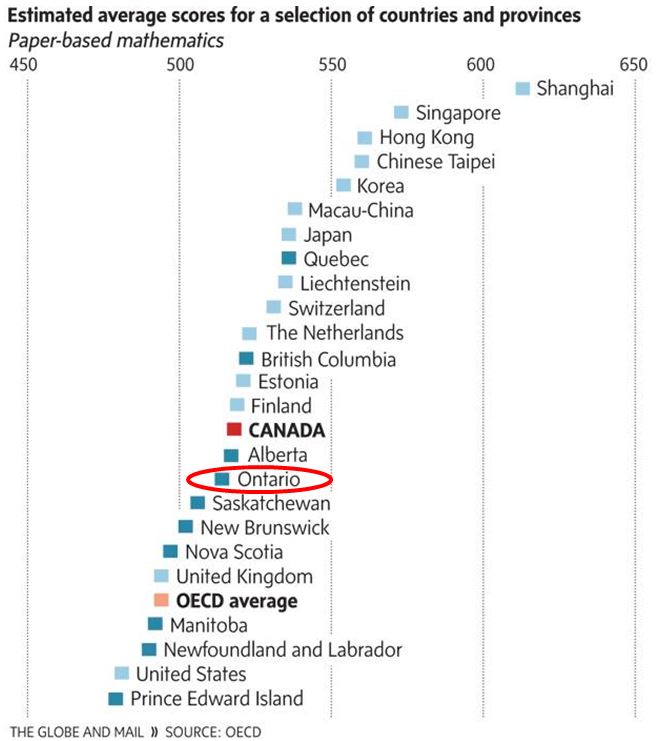
2012 PISA We ate # 4 Reading, #6 math #5 science

The COUNTRIES , that are usually ahead of us are Korea, Finland and Japan.

No serious person includes Hong Kong Shanghai or Macao and Singapore is very dubious. They are totally artificial city states or high ranking cities in a low ranking nation.

Do we want Finland’ no test, masters degree, 5% poverty, little homework policy?

How about we keep kids in school in hagwons until 10 PM like Korea?

I like Japan with longest teacher prep time in the world?

Not one of even these 3 graduates over 50% of its students from college or university like Canada does.

The case for Canada having a bad education system is risible.

Posted by Doug Little on 10/04 at 10:17 AM

Doug, PISA is a measure of minimum standards for competence in every day life not a measure of excellence.

>> Quote from PISA
PISA is unique because it develops tests which are not directly linked to the school curriculum. The tests are designed to assess to what extent students at the end of compulsory education, can apply their knowledge to real-life situations and be equipped for full participation in society.
<<

If you read the PISA samples you will realize that PISA math and reading are at a grade 6-7 level.
As such PISA levels 5 and 6 mean excellent competence in math for every day life.

PISA level 5 and 6 in math DOES NOT mean excellence at the grade 9 or 10 level canadian math curriculum let aside excellence at the grade 9 or 10 level advanced math curriculum from other countries.

So now .. based on PISA of our canadian kids
- Only 16.4 % have excellent math competence for every day living
- 13.8% have very poor math competence for every day living
- 69.8% will manage every day math, but not very well

So even though only 16.4% 15-year old canadians, who have passed grade 9 do very well on a grade 6-7 math test.

Really? How is that good news?
So even though only 16.4% grade 9 graduates do very well on a grade 6-7 math test 50% of them graduate university and college and we pretend that all college and university diplomas are meaningful.
Really?

Posted by fromEurope on 10/04 at 04:19 PM

Is the Canadian education becoming more equitable by dumbing down?

PISA 2012
Page 14 - the graph
Canada = Equity Improved, Performance Deteriorated

The good news is that neither changes are statistically significant. Based on the graph
- equity improved by only 1%
- performance deteriorated by only 1.5%

So, we’ll see… I would be curious to see this graph in the next PISA assessment.

Posted by fromEurope on 10/04 at 04:51 PM

From the available evidence, no western nation is better than Canada except perhaps Finland and 2 Asians nations MAY be better, Korea and Japan. There are 64 nations in OECD.

Posted by Doug Little on 10/04 at 05:34 PM

OECD understands there is only one way forward for most nations. The upper and middle classes have maxed out their education. Theh were the low hanging fruit. The only way to improve is to maximize the results of the lower classes. As such equity = excellence. No contradiction.

Posted by Doug Little on 10/04 at 11:56 PM

This goes with post above.

http://www.thelittleeducationreport.ca/

Posted by Doug Little on 10/05 at 12:04 AM

http://cheeseandcrackers.ca/pisa2012.JPG.

The claim about ‘nations’ is horse-pucky.  Canada doesn’t have a national education policy or even a minister of education.  Ontario is lagging behind the other big provinces and pulling the national average down.  And some of the cities that Doug disparages are bigger than Ontario.

Posted by Tom on 10/05 at 11:52 AM

The cities chosen by China - Shanghai Macao and Hong Kong were chosen because they are the best educated cities in China. China is not prepared to test the whole nation. If the Americans submitted only Massachusetts they would be in the top 3 kn the world.

Nobody takes scores from Chinese cities seriously and Singapore is dubious. Korea Japan - they are serious.

Posted by Doug Little on 10/05 at 12:23 PM

According to PISA only 16.4% of our kids have excellent competence in math for EVERY DAY LIVING.

In Ontario, how many kids, on average attend Kumon or get other tutoring in math basics? My guess is around 15-20%, some areas may be as high as 50%, others as low as 2%.

Perhaps a good question to ask for PISA or other studies is when does tutoring happen and what kind of tutoring is it.

Is it tutoring normal kid in the basics because they have not been taught in school?
Is it tutoring kids with read learning deficits in the basics because that’s the only way they can keep up the pace?
Or is it tutoring average or above average kids in middle school or high school for very good or excellent performance?

Extremely different things.
Asians seem to be tutoring for excellence.
In Ontario most of the tutoring seems to be the basics in elementary with some sparse remedial tutoring in high school.

Posted by fromEurope on 10/05 at 07:29 PM

Just wondering…......wouldn’t Charter Schools alleviate much of the problem and offset the financial burden incurred by the Ministry?

What I don’t understand to the opposition of their existence is this: if they fail to enroll set number of students (set by the Ministry) they will be forced to close.

If they do better than public schools with money following the kids, and decent salaries for teachers, and adhere to Ministry basics but surpass them, then perhaps they will up the ante and make the public schools improve, compete with private but not cost the parents, etc….......I’m sorry, but I don’t get why we can’t have Charter Schools across Canada, especially in Ontario. Alberta has done it, and they have overall improved in many facets.

Would it ruin life as we know it for everyone and dumb down future generations if we tried?

Posted by A Parent on 10/05 at 10:41 PM

A very large % of the tutoring is ESL to catch immigrant kids up and corporate Sylvan Oxford style tutoring that plays on parent anxiety.

Nothing wrong with that I guess. We live in a free enterprise system more or less so tutors need to make a living as well.

Posted by Doug Little on 10/06 at 01:06 AM

This Fraser Report comes with an assumption that the Catholic school system will agree / acquiesce to a demotion of their constitutional rights to full funding. In BC, the Catholic community had no funding status prior to the current equitable arrangement. For Ontario to move to the BC model, this would greatly upset the established Catholic system. I’s love to hear Catholic leaders and parents speak to this matter.

Posted by Julius de Jager on 10/06 at 07:58 AM

Doug, you suggest:

Kill EQAO
Kill CoT
Cut ministry
Cut board admin

You make me hold my head.  Be clear on ONE THING:

IF YOU SPEND MONEY OR TIME IN THE INTEREST OF ANY ENTERPRISE, YOU MUST, MUST, MUST TEST FOR RESULTS.

I can either stop there or write a book.  I’ll stop there.

Frank Gue Burlington.

Posted by Frank Gue, Burlington on 10/06 at 12:28 PM

Leave A Comment

Be polite and respectful. Stay on-topic. State your position clearly and write succinctly. Provide support for claims. Don't hog the microphone. Strong opinions are OK, but outrage is not. Don't post just to upset others.

Name:

Email (required but not displayed):

Emotions

Notify me of follow-up comments?

Submit the word you see below: